Dockworkers at more than 110 ports in 22 countries walked off the job on Friday, October 30, 2026, in a coordinated global strike against the use of commercial seaports to move weapons into war zones, an action organisers describe as historic in scale and one that they say could disrupt more than 40 percent of Mediterranean cargo and leave more than $2 billion worth of freight stranded for the day.
The International Day of Action of Dockworkers and Port Workers, held under the slogan “Dockworkers do not work for war,” brought together more than 25 trade unions across five continents. Stoppages ranged from full 24-hour strikes in France, Italy, India, Greece and Turkey to shorter stoppages of up to two hours in Morocco, Cyprus and other ports, according to organisers and news reports of the action.
The strike began on Friday morning local time across Europe and spread through the day as ports in Asia, Africa, the Americas and Australia joined. At Piraeus, Greece’s largest port, dockworkers staged a three-hour stoppage, while other Greek unions planned 24-hour action and ferry services connecting the Greek islands were interrupted. In Italy, the grassroots union Unione Sindacale di Base (USB) called a nationwide 24-hour general strike, with protests expected in more than 40 cities.
In France, the CGT Ports et Docks union predicted a sharp reduction in operations at Le Havre, Marseille-Fos, Rouen, Dunkirk and Calais. Major European shipping hubs on the strike list included Hamburg in Germany, Valencia and Algeciras in Spain, Le Havre in France, Piraeus in Greece and Genoa in Italy, along with Morocco’s Tangier Med port and India’s Nhava Sheva port. In India, organisers forecast that around a dozen ports could be affected, with the Water Transport Workers Federation of India declaring its support.
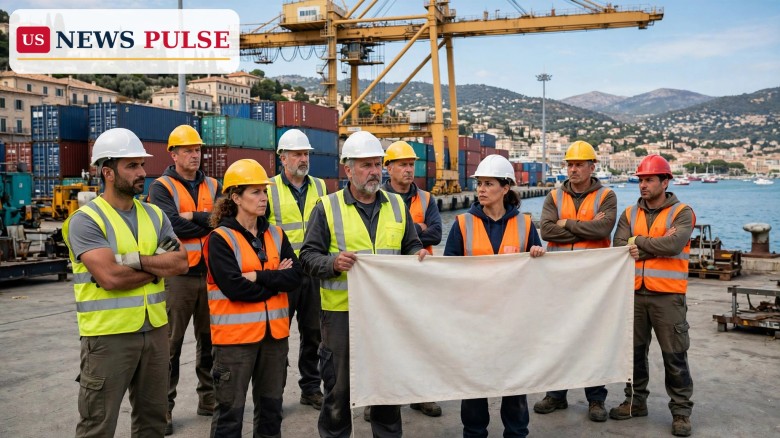
Photographs from Piraeus on Friday showed dockworkers unfurling a banner reading “Workers do not work for war” at the port. In Milan, demonstrators waved Palestinian flags and carried a banner reading “Embargo Zionism Now” during the general strike, according to Associated Press photographs published on the day.
The actual scale of participation and the extent of disruption remained unclear as the day unfolded, reports noted. Representatives of the port of Genoa forecast only limited disruption there, while Piraeus warned that ferry services could be interrupted. Shipping companies and port authorities in several countries had not, by Friday afternoon, published full assessments of delayed cargo.
The October 30 action grew out of meetings of Mediterranean dockworkers that began in early 2025. Five unions organising in 20 ports across five countries first came together to discuss how to act, in their words, against privatisation and against the war in Gaza. The network met in Athens, then in Genoa, and later in Istanbul, where unions from more than 35 ports published the Istanbul Declaration in May 2026 and declared October 30 as their day of action.
The movement has since widened well beyond the Mediterranean. Participating unions include Germany’s ver.di, Ireland’s largest union SIPTU, Denmark’s 3F and France’s CGT Ports et Docks. Dockworker unions in India, Sweden, Denmark, Australia, Brazil, Mexico, Uruguay and the west coast of the United States all pledged to take part, according to No Harbour for Genocide, a campaigning collective that researches weapon supply chains and supports the action.
“Every union will do what they choose, but be connected to the same principles and struggle,” Francesco Staccioli, the national secretary of transport and ports in Italy’s USB union, told Al Jazeera. “It’s bigger than we thought. This has spread all over the world.”
In their statement, the unions called for “recognition of an independent Palestinian state, recognised by the international community, within the 1967 borders and with East Jerusalem as its capital” and “an end to the US-Israeli wars of aggression in the Middle East and against Iran, and full solidarity with the peoples of Cuba, Venezuela and Sudan.” The unions’ main demand, as reported by Al Jazeera, is “an immediate end to the genocide of the Palestinian people and all imperialist wars” — language used by the organisers; Israel has rejected the genocide allegation in international proceedings, and the United States has likewise rejected it.
The strikers’ argument rests on a simple logistical claim: weapons cannot reach a battlefield without passing through ports, and the workers who load and unload them can therefore refuse. “Weapons need transport, infrastructure, and workers’ hands to reach their destination,” Markos Bekris, leader of Greece’s dockworkers’ union ENEDEP at the Port of Piraeus, told Al Jazeera. “That is where our power lies.”
No Harbour for Genocide said that between August 2025 and September 2026 it tracked 315 shipments of components for Elbit Systems, Israel’s largest arms manufacturer, moving through 56 commercial ports in 29 countries, and that all 56 of those ports were expected to be on strike on October 30. The group said Genoa, Livorno and Gioia Tauro in Italy, Marseille in France, Piraeus in Greece and Tangier in Morocco all have proven links to weapons shipments to Israel.
The campaign group also put numbers on the leverage: up to 95 percent of Israel’s imports and exports travel by sea, it said, and the participating Mediterranean ports handle 63 percent of all container activity in the sea — 74 percent between southern France and Piraeus. Worldwide, the ports taking part handle 13.5 percent of global shipping, the group said.
There is a long history behind Friday’s action. Dockworkers have refused war cargo before, from the Vietnam war era to the Iraq war, and in October 2024 Bekris and other workers blocked the loading of a container holding 21 tonnes of ammunition destined for Israel — a protest for which Bekris is now facing prosecution in Greece. “We carry forward the tradition of workers who refuse to load weapons against other people,” Bekris told Al Jazeera on the eve of the strike. “Our hands get covered in grease and sweat every day. We refuse to let them be stained with the blood of other people.”
Friday’s strike also lands in a wider moment of strain on global shipping. Oil prices surged past $117 a barrel on the same day amid attacks around the Strait of Hormuz, and the United States remains engaged in a months-long war with Iran that has already reshaped energy markets and driven American fuel prices sharply higher. The strikers explicitly linked their action to that war as well as to Gaza.
Mohammed al-Attar, a dockworker who left Gaza in 2015 and is now based in Hamburg, Germany, told Al Jazeera the workers “are the power.” “We can save thousands of lives if we stop working just for two days,” he said, while expressing disappointment at what he called the “incomprehensible silence” of his own union, ver.di, over Gaza.
“Refusing the war is giving humanity a chance to live better. This is what I’m really convinced about,” Staccioli said. Linda Maggiore, an Italian journalist and activist who has documented weapons shipments from Italy’s major ports to Israel, told Al Jazeera that blockades matter because “they make it clear that civil society does not wish to be complicit.” Maggiore also warned that a European regulation on military mobility, she said, is about to be approved and will make it even easier for arms to be transferred without scrutiny.
The Palestinian labour movement endorsed the strike and called on more unions to join, urging them to escalate boycott, divestment and sanctions pressure to end what it called state, corporate and institutional complicity in Israel’s occupation. The Global Sumud Flotilla, the pro-Palestinian campaign group that has repeatedly tried to break Israel’s blockade of Gaza to deliver humanitarian aid, also expressed support for the action.
Port operators and governments, for their part, have generally treated the stoppages as lawful industrial action where they were properly notified, while warning about knock-on delays. The port of Genoa’s forecast of limited disruption and Piraeus’s warning about ferries illustrate the uneven picture: a one-day strike bites hardest where a port is a transshipment hub, and less where cargo can wait a day or be rerouted.
A one-day strike, even one spanning 113 ports, does not by itself stop a war. Its significance lies elsewhere. First, it tests whether organised labour can act as a practical brake on arms logistics below the level of governments — a question that matters because, as analysts noted in coverage of the strike, international maritime law places few obligations on commercial port operators or shipping companies themselves, even where treaties require exporting governments to assess the risk that licensed weapons transfers will be used in violations of humanitarian law.
Second, the strike connects two conflicts — Gaza and the US-Iran war — into a single labour protest, and it does so four days before the US midterm elections on November 3, when voters will decide control of Congress against a backdrop of high fuel prices and war fatigue. The unions’ demand for an end to US-Israeli wars is a direct challenge to the foreign policy of the Trump administration, which has said the Iran war will be “wrapped up soon.”
Third, the numbers give the protest real economic weight. If more than $2 billion in cargo sat idle on Friday and 40 percent of Mediterranean cargo was disrupted, shippers, insurers and importers will have noticed — and a repeat action, or a longer one, would be far harder to absorb. The organisers’ message, repeated by al-Attar, is that two days of stopped work could save lives; the counter-argument from ports and governments is that civilian cargo, food and medicine move through the same terminals, and a general strike disrupts those too.
The immediate question is how much cargo was actually delayed and whether any shipments were turned back, as happened in Genoa in an earlier blockade when the Saudi vessel Bahri Yanbu, carrying weapons cargo, ultimately returned to its origin without unloading. Port-by-port tallies are expected over the weekend as operators clear backlogs.
The unions have not announced a second day of action, but the network behind October 30 has grown with each mobilisation — from five unions in 20 ports in early 2025 to more than 25 unions in 113 ports now — and organisers have signalled that further days of action are possible if their demands are ignored. Any escalation would be watched closely by shipping firms, which price war-risk and delay into freight rates that eventually reach consumers.
In the United States, attention will turn to whether west-coast dockworkers’ participation draws a response from port employers or federal authorities, and to how the protest plays in the final days before the midterms. For now, the strike stands as the largest coordinated dockworker protest against war shipments in years — and as a reminder that the global supply chain, for all its automation, still runs on workers’ hands.
How many ports joined the October 30 dockworkers strike? Organisers said more than 25 unions at 110 to 113 ports in 22 countries across five continents took part, with the count varying slightly between announcements as late additions were confirmed.
What did the strikers demand? An end to the use of civilian ports to move weapons into conflict zones, recognition of an independent Palestinian state within the 1967 borders with East Jerusalem as its capital, and an end to what they call US-Israeli wars in the Middle East and against Iran.
How much trade was disrupted? Organisers said the action could disrupt more than 40 percent of Mediterranean cargo and leave more than $2 billion worth of freight idle for the day, though the actual disruption varied by port and was still being assessed on Friday.
Did US ports take part? Dockworker unions on the west coast of the United States pledged to take part, according to No Harbour for Genocide, alongside unions in India, Sweden, Denmark, Australia, Brazil, Mexico and Uruguay.
Is this the first dockworkers strike against war shipments? No. Dockworkers have a long tradition of refusing war cargo, including during the Vietnam and Iraq wars, and the current network grew from Mediterranean meetings in early 2025 and the Istanbul Declaration of May 2026.
Related coverage on US News Pulse: Oil prices surge past $117 as Houthi attacks and Hormuz tanker blast stoke fears, Trump says Iran war will be wrapped up soon as mediators return to Tehran, and US oil profits hit $130 billion in Iran war as drivers pay $147 billion more.
Leave a Comment



 | Today's Date: