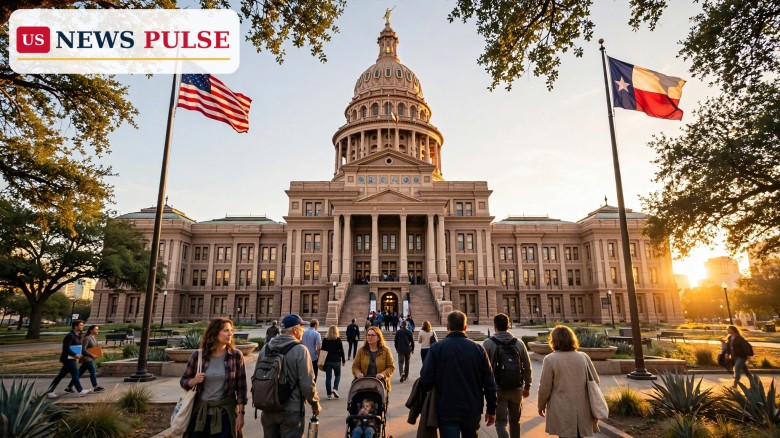
Senator Ted Cruz has delivered the bluntest warning of the Texas campaign so far: in a state Republicans have treated as safe ground for a generation, he says the party could lose everything. “Texas is excruciatingly close,” Cruz said on his podcast on 30 October 2026. “We could lose Texas, and by the way, not just the Senate race. We could lose every single statewide race in Texas.” The Ted Cruz Texas warning landed four days before the 3 November midterm elections, with early voting just closed and the final polls showing a Senate race, a governor’s race and a string of down-ballot contests all inside or near the margin of error.
The warning arrived in two forms on the same day. The Wall Street Journal reported that Cruz made the remarks on his podcast on Thursday, discussing strong Democratic turnout. Separately, FactPost posted a brief, 15-second voice clip of Cruz saying the same thing, without further context about where or when the full remarks were recorded. The Washington Current, which first highlighted the clip, quoted it in full: “By the way, Texas is excruciatingly close. Understand: We could lose Texas. Let me repeat that: We could lose Texas. And, by the way, not just the Senate race. We could lose every single statewide race in Texas. That’s how close these numbers are.”
The distinction matters. Cruz was not conceding defeat. He was making a turnout argument — the same argument he has made for weeks on Verdict, the podcast he co-hosts with Ben Ferguson. In an earlier episode he called the Senate race a dead heat, saying: “Texas is a tie right now. It is a dead heat. If you’re in Texas, come out and vote.” He added: “This is really a turnout election.” The new remarks extend that logic from one race to the whole statewide ticket: if Republican voters stay home on Tuesday, he argues, even offices Republicans have held for decades could fall.
The timing is no accident. Early voting in Texas ran from 19 October through 30 October, and the final weekend before Election Day is traditionally when campaigns make their closing turnout push. President Donald Trump, who had briefly cancelled weekend rallies in Kansas and Iowa before restoring them for Sunday, 1 November, is also scheduled to hold back-to-back rallies in those states, while his campaign runs nearly 20 tele-rallies in the final days. Cruz himself has been barnstorming the country in the closing stretch, with an episode of Verdict released on 30 October titled “Barnstorming the Country — the Most Consequential Midterms of our Lifetimes”.
Texas has not elected a Democrat to the United States Senate since Lloyd Bentsen in 1988, and no Democrat has won a statewide office in Texas since the 1990s. That history is precisely why Cruz’s language struck a nerve. Cruz, who has represented Texas in the Senate since 2013, knows how close Texas races can get: he defended his own seat against Democrat Beto O’Rourke in 2018 in an unusually tight contest, and beat challenger Colin Allred in 2024. In this cycle he is not on the ballot himself. The Senate seat at stake is the one long held by John Cornyn, whom Paxton defeated in the Republican primary. Paxton, backed by Trump, now faces Talarico, a Democratic state representative from Austin.
The polling picture explains the alarm. A Fox News poll conducted 15–19 October among 1,398 likely voters put Paxton and Talarico tied at 49% each, with a margin of error of 2.5 points. Emerson College had Talarico ahead 49% to 48%. A University of Houston Hobby School poll from 10–14 October, among 2,000 likely voters, had Talarico up 48% to 46%. A CNN/SSRS survey conducted 20–27 October found Talarico leading 49% to 43%, a six-point gap larger than that poll’s four-point margin of error, with 63% of likely Latino voters backing the Democrat. An ActiVote survey from 22–28 October put Talarico 4.2 points ahead, inside its 4.9-point average expected error. Prediction markets moved further still: Kalshi traders on 30 October gave Talarico a 70% chance of winning, a new high, with Paxton at 30%, his lowest probability since the market launched in December 2024.
The governor’s race is tighter than Republicans are used to as well. Abbott won re-election against O’Rourke by 11 points in 2022. The Texas Southern University poll released on 29 October, surveying 2,000 likely voters from 21–25 October with a margin of error of 2.19 points, put Abbott ahead of Hinojosa by just three points, 50% to 47%, with Abbott viewed favourably by 48% and unfavourably by 51%. A University of Texas/Texas Politics Project poll from late September to early October had Hinojosa ahead 49% to 48% among likely voters. A survey conducted for 254 Labs by YouGov Blue from 21–26 October found Hinojosa leading Abbott 49% to 46%, and Democrats ahead in the other statewide contests it polled — a reminder that poll sponsorship and likely-voter models can move the headline by several points, and that no single survey should be read as a result.
Down the ballot, the same pattern holds. A Texas Public Opinion Research poll from 15–18 October among 969 likely voters, with a 3.9-point margin of error, put Lieutenant Governor Dan Patrick ahead of Democrat Vikki Goodwin by 50% to 47%, and found every statewide race, from governor to railroad commissioner, within a few points. The 254 Labs survey put Goodwin ahead of Patrick 48% to 45%, Democrat Nathan Johnson ahead of Mayes Middleton 47% to 45% for attorney general, and Democrat Jon Rosenthal ahead of Bo French 47% to 43% for railroad commissioner. The two surveys disagree on who leads in several races. They agree on the essential point Cruz was making: none of these races is comfortable for the incumbent party.
Cruz’s warning is about coattails and turnout, not just one candidate. In Texas, voters who turn out for a Senate race also vote for governor, lieutenant governor, attorney general and railroad commissioner on the same ballot. If Democratic enthusiasm lifts turnout in the cities and suburbs while Republican turnout softens in rural counties, the effect ripples down the ticket. That is why Cruz framed the risk as statewide rather than personal to Paxton.
Early-voting data gives both parties something to point to — and a reason to worry. By 30 October, more than 6 million of Texas’s 18.8 million registered voters had cast an early ballot, roughly a third of the electorate before Election Day itself. Dallas County set a single-day early-voting record on day one, with more than 88,000 ballots cast. Harris County had passed 362,534 ballots as of 22 October, a record pace. Reporting from Texas noted a turnout gap that could matter most in the final stretch: about 21% of registered voters in rural counties had voted early, compared with 24% in the larger metro areas. Republicans traditionally count on rural turnout and Election Day votes to offset Democratic strength in cities and early voting; a soft rural number is exactly the kind of signal that would make a Republican senator warn that “every single statewide race” is at risk.
Rice University political scientist Mark Jones offered a caution that applies to every early-vote claim this week: “High turnout tells you people care. It doesn’t tell you who they’re voting for.” Early-vote totals measure who showed up, not who they picked, and party breakdowns published during early voting are statistical models built on past voting behaviour, not actual ballots. Cruz’s warning, read fairly, is not a claim that Democrats have already won. It is a claim that the margin for error has vanished.
The clip itself did most of the political work. FactPost’s post, amplified by commentators including Keith Edwards, was picked up in live midterm coverage within hours, with the headline version of Cruz’s line — “We could lose every single statewide race in Texas” — travelling further than any policy argument in the race. Democratic-aligned accounts treated it as a confession that Texas is genuinely in play. Republican-aligned responses, in the coverage reviewed, tended to read it as a mobilisation tactic: a senior Republican telling his own voters, in the starkest possible terms, that staying home has consequences.
Cruz has used stark worst-case framing before in this campaign. In an earlier Verdict episode he warned that Republicans could lose every close Senate race on the map and “wake up in January with 45 Republicans in the Senate”, a net loss of eight seats from the 53 Republicans currently hold. He framed that explicitly as a worst case, not a prediction, and used it to push conservatives to vote in the final two weeks. The Texas warning follows the same pattern, narrowed to his home state and sharpened by the calendar: with early voting over, only Election Day turnout remains to be moved.
The White House, for its part, signalled no retreat from the closing schedule. After cancelling the Kansas and Iowa rallies on 29 October, the administration reversed course the next day. A White House official said: “Rallies are BACK ON! President Trump loves his supporters, and in addition to nearly 20 tele-rallies, he will hold back-to-back rallies in Kansas and Iowa on Sunday.” Trump also held a rally in Daytona Beach, Florida, on 30 October. The restored schedule, like Cruz’s warning, is aimed at the same problem: turning a national polling deficit — Emerson College Polling’s final national survey put Trump’s approval at 37%, a new low for that pollster, with Democrats leading the generic ballot 52% to 42% — into actual votes in the states where Senate control will be decided.
If Cruz is right that Texas is “excruciatingly close”, the consequences extend far beyond one Senate seat. A Democratic win in Texas would be the party’s first Senate victory there since 1988 and would break a statewide losing streak stretching back to the 1990s. It would also change the national Senate maths: Republicans can afford to lose a net three seats and keep the chamber, but a Texas loss combined with competitive races in Iowa, Kansas, Alaska, Maine, Ohio and North Carolina — all states Cruz has named as close — could put the majority itself in play. Conversely, if Paxton and Abbott both win, even narrowly, Republicans will argue that the late alarm was a successful turnout device and that Texas remains, as ever, a red state that flirts with competitiveness without flipping.
There is a second, quieter significance. Cruz is one of the most prominent Republican voices in the country, and he chose to deliver this warning on his own podcast and, in the clipped version, in his own voice. That makes it harder for either party to dismiss. Democrats cannot claim it is a media invention; Republicans cannot claim their own senator was misquoted. The quote is short, it is his, and it will be replayed in Democratic advertising and Republican get-out-the-vote appeals alike in the final 72 hours.
Finally, the warning reframes what Election Day in Texas will measure. It will not only measure Paxton against Talarico, or Abbott against Hinojosa. It will measure whether the enthusiasm gap visible in early voting — record county totals, a third of the electorate voting before Election Day, and a national mood favouring Democrats by eight points on the generic ballot — survives contact with Election Day itself, when Republican voters have historically turned out in greater numbers. If rural turnout surges on Tuesday, Cruz’s warning will look like a well-timed scare. If it does not, his warning will look like prophecy.
Trump holds rallies in Kansas and Iowa on Sunday, 1 November, alongside nearly 20 tele-rallies for Republican candidates across the country. In Texas, both campaigns spend the weekend on get-out-the-vote operations, with no more early voting available — the next votes cast will be on Election Day itself, Tuesday, 3 November, when Texas polls open at 7 a.m. local time. Final polls will continue to arrive through the weekend, but after Tuesday morning the only numbers that matter will be the counted ballots. Results for the Senate race are expected on election night, though a very close margin could delay a call, and down-ballot statewide races may take longer to settle if the margins are as narrow as the late polls suggest.
For readers following the race, the key indicators on Tuesday night are not the statewide topline alone. Watch the margin in Harris, Dallas, Tarrant and Bexar counties against 2022 and 2024; watch rural county turnout against the early-vote pace; and watch whether voters who back Abbott also back Paxton, or whether ticket-splitting — visible in earlier polls, where some Abbott voters did not support Paxton — decides the Senate race separately from the governor’s race. Cruz’s warning will be judged against all three.
On his podcast on 30 October 2026, Cruz said: “Texas is excruciatingly close. Understand: We could lose Texas. Let me repeat that: We could lose Texas. And, by the way, not just the Senate race. We could lose every single statewide race in Texas. That’s how close these numbers are.” A 15-second clip of the remarks was posted on Friday by FactPost.
No. Cruz, who has represented Texas in the Senate since 2013, is not up for re-election this cycle. The Senate race is between Republican Ken Paxton and Democrat James Talarico for the seat long held by John Cornyn, whom Paxton beat in the Republican primary.
Very close by Texas standards. Late polls put the Senate race tied or within a few points — Fox News tied it 49–49 in mid-October, CNN/SSRS put Talarico ahead 49–43 in late October — while the governor’s race has Abbott ahead of Hinojosa by three points in the latest Texas Southern University poll, 50% to 47%, after Abbott won by 11 points in 2022.
Election Day is Tuesday, 3 November 2026. In-person early voting in Texas ran from 19 October through 30 October, with more than 6 million early ballots cast, about 32% of the state’s 18.8 million registered voters.
Polls show it is possible in the sense that several races are within the margin of error, and one Democratic-leaning survey found Democrats ahead across the ticket. It is not the consensus forecast: most late polls still show Abbott ahead for governor and several Republican incumbents ahead down-ballot, and prediction markets favour Talarico in the Senate race while the governor’s race remains closer to a toss-up. Tuesday’s turnout will decide it.
Related coverage: Trump approval hits new low at 37% in Emerson poll before midterms, Trump Kansas and Iowa rallies back on after cancellation before midterms, and Trump Texas rallies: Paxton, methane plan and a Talarico surge on Oct. 27.
Leave a Comment



 | Today's Date: