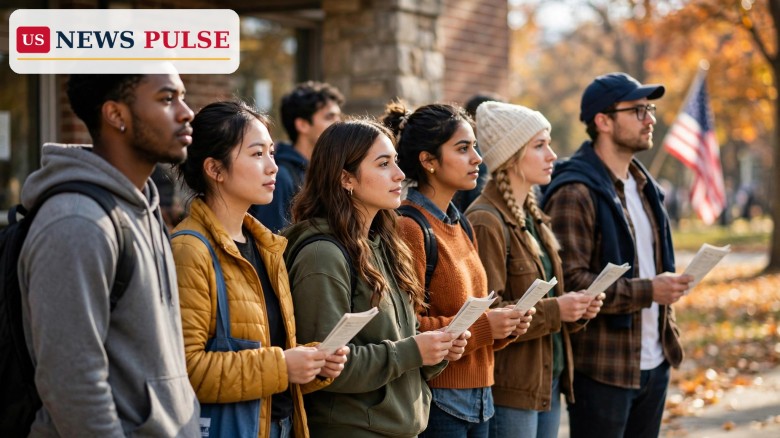
Three days before the November 3 midterm elections, the Harvard Youth Poll has delivered one of the starkest findings of the 2026 campaign: among young Americans who say they will definitely vote, Democrats lead Republicans by 37 points, 63% to 26%. The same survey warns that the advantage may not fully reach the ballot box, because only a third of all 18- to 29-year-olds say they are certain to vote at all. The Harvard Youth Poll, released on October 22 by Harvard Kennedy School's Institute of Politics, captures a generation moving away from President Donald Trump, worried about the cost of living, and far less sure than in past midterms that it will actually turn out.
The fall 2026 Harvard Youth Poll, the survey's 53rd edition, was conducted by Ipsos Public Affairs using the KnowledgePanel, with interviews in English and Spanish from September 30 to October 7, 2026. It covered 2,024 Americans aged 18 to 29, with a margin of error of 2.61 percentage points for the full sample and 4.30 points for the 749 respondents classified as likely voters. The findings were released on October 22, and they have gained fresh attention in the final days of the campaign as early voting surges and the parties make their closing arguments.
The headline number is the generic ballot for the US House of Representatives among young people who say they will definitely vote: 63% prefer the Democratic candidate, 26% prefer the Republican candidate, and 10% are undecided. Among all registered young voters, regardless of voting intention, Democrats lead 45% to 24%. The gap between those two figures is the story of this poll. The Democratic advantage grows sharply once the sample is narrowed to the people most likely to cast a ballot, because young Democrats are considerably more likely than young Republicans to say they will definitely vote.
That turnout gap is 16 points wide: 50% of young Democrats say they will definitely vote, against 34% of young Republicans. It is the widest partisan turnout gap in the last three midterm cycles. In the 2022 pre-election poll the difference was five points; in 2018 it was 11 points. The decline is driven mainly by young Republicans. Only 34% of them say they will definitely vote in 2026, down from 46% ahead of the 2022 midterms and 43% before the 2018 elections. Among young Democrats the figure is 50%, slightly below 51% in 2022 and 54% in 2018.
The gender breakdown tells a similar story. Among young men, 31% say they will definitely vote, down from 42% in the 2022 survey. Among young women the figure is 35%, compared with 37% four years earlier. Inside the Republican camp there is a further split: 50% of young Americans who identify with the MAGA movement say they will definitely vote, compared with just 29% of non-MAGA Republicans — but only 31% of young Republicans identify as part of the MAGA movement at all.
Young voters have long turned out at lower rates than older Americans, but the 2018 and 2022 midterms broke that pattern in part. In 2018, a record-high 36% of young people turned out to vote, compared with a typical 15% to 20% rate in prior midterms. Overall turnout among all eligible voters was between 52% and 54% in 2018 and 2022, so young voters still lagged behind — but the gap narrowed. The Harvard poll suggests that momentum may be stalling: the 33% who say they will definitely vote this year is below the 40% who said the same before both of the last two midterms. A September Marquette Law School poll pointed the same way, finding only 56% of young voters "absolutely certain" or "very likely" to vote, against 73% of the whole electorate.
The Harvard findings also sit alongside the broader national picture. The final Emerson College Polling national survey, released on October 30, put Democrats ahead 52% to 42% on the generic ballot among all likely voters, with President Trump's approval at 37%. The youth poll's 37-point Democratic lead among likely young voters is far larger than the national margin, which is exactly why both parties are watching the youth vote so closely.
Young men deserve special attention, because they were a group that helped power Trump's return to the White House in 2024. In this poll, 58% of young men prefer Democrats and 32% prefer Republicans. Among young women, 66% prefer Democrats to 21% choosing Republicans. The Democratic advantage showed up in nearly every subgroup. Young rural voters were the exception, with Democrats holding only a one-point preference lead, 43% to 42%.
The poll also found deep pessimism. Just 9% of young Americans said the nation is headed in the right direction, tying the poll's record low, and 69% said they feel more fearful than hopeful about America's future. Trust in the election itself is shaky: only 34% expressed a great deal or a fair amount of trust that the November elections will be conducted fairly and accurately, while 40% expressed little or no trust and 22% were unsure.
The 37-point lead is not a single number but the product of two forces pulling in the same direction: young voters prefer Democrats, and the young voters most likely to show up prefer Democrats by even more. Among likely voters, Democrats lead 63% to 26%. Among all registered young voters, the lead is 45% to 24% — still a 21-point advantage, but much smaller. The difference between those two margins is the turnout gap at work.
Then consider motivation. Among likely young voters, 63% said their congressional vote is in opposition to Trump and his policies, compared with only 14% who said their vote represents support for the president, while 17% said he was not much of a factor. Among young voters who prefer Democratic control of Congress, 51% said their preference was driven more by opposition to Republicans, while 49% said it was more about supporting Democrats. That split matters for what happens after November 3: an advantage built on opposition is not the same as loyalty.
The economic numbers explain much of the mood. Among likely young voters, 94% said the cost of living was important to their decision, and 70% called it extremely important. Government corruption was cited by 90%, with 61% calling it extremely important. Overall, 91% of young voters listed the cost of living as a motivator, 77% said they disapprove of Trump's handling of the economy, and almost half said their personal financial situation has worsened. Some 49% said it had worsened since the current administration took office, while only 11% said it had improved. Disapproval of Trump's economic handling reached 94% among young Democrats, 83% among independents and 48% among young Republicans.
The long-term outlook is bleaker still. Just 25% of young Americans expect to be better off financially than their parents at the same age, while 27% expect to be worse off and 25% expect about the same. For the first time in the poll's history, a larger share expected to be worse off than their parents than expected to do better. On the issues, registered young voters trusted Democrats more than Republicans on most topics tested, including healthcare costs, the cost of living, government corruption, immigration enforcement and free and fair elections. Yet dissatisfaction runs both ways: 66% disapproved of congressional Democrats' performance, while 74% disapproved of congressional Republicans.
John Della Volpe, director of polling at Harvard Kennedy School's Institute of Politics, summed up the poll's central message in its release: "Young voters are poised to deliver a sharp rebuke to President Trump, while the broader generation is sending a message to everyone in power." He added: "Just one in four young Americans expects to be better off financially than their parents — and with corruption near the top of their concerns, leaders will have to earn trust by making life more affordable and showing whose interests they serve."
Speaking on a press call on October 21, Della Volpe put the finding in broader terms: "Big-picture central finding is that young voters are poised to deliver a sharp rebuke to President Trump, while the broader generation is sending a message to those in power." He also addressed the economic pessimism directly: "We see for the first time a shift where we see more pessimism than optimism on that question," referring to whether young Americans expect to be better off than their parents. And he framed the challenge for both parties plainly: "The challenge I think for leaders is to make life more affordable and give young people concrete reasons to believe that participating in politics and in civic life can improve their futures."
The poll's other motivators underline why affordability dominates the youth conversation. Corruption in government was cited by 88% of young voters as a voting motivator, US involvement in wars by 83%, the cost of health care by 83% and freedom in elections by 82%. Artificial intelligence is also emerging as a worry: 64% viewed AI-driven job displacement as a serious threat to their long-term financial security. The survey also found cross-party support for some economic reforms: 63% support banning members of Congress and their spouses from trading stock, 57% support Medicare for All, and 54% want an annual wealth tax on households above $50 million.
The youth vote matters in 2026 not because young voters decide elections alone, but because the races that will decide control of Congress are close enough for any group's turnout to tip them. The national generic ballot lead for Democrats is around eight to ten points in recent polling, and the Senate map runs through states where the polling averages are within a few points. In that environment, a 37-point Democratic advantage among likely young voters is a real asset for Democrats — but only if those voters actually vote. The Harvard poll's warning is that the asset is smaller than it looks: the overall pool of certain young voters has shrunk from 40% to 33%, and the sharpest fall is among young Republicans.
There is also a longer-term signal. A generation in which only a quarter expect to do better than their parents, in which 69% feel more fearful than hopeful, and in which only a third trust the election to be fair, is a generation whose relationship with politics is fragile. Young Americans are not apathetic in the old sense — they name concrete issues, from the cost of living to corruption to AI and jobs — but many are unconvinced that voting changes their circumstances. For Republicans, the poll contains a double warning: the party has lost ground among young men who helped return Trump to office, and its own young supporters are the least certain to vote. For Democrats, the warning runs the other way: a lead built more on opposition to Trump than on enthusiasm for Democrats can fade quickly, and 66% disapproval of congressional Democrats among registered young voters shows the party has not yet earned those voters' trust.
Election Day is Tuesday, November 3, and early voting is already under way in much of the country, with a record number of early ballots reported cast. The final days will test whether the Harvard poll's turnout intentions hold, and the closing polls — including the final Emerson survey and the state polls in Texas, Kansas, Iowa, Michigan, Ohio and Alaska — will show whether the youth numbers are moving or stable.
After November 3, the real test of the Harvard poll will be the actual youth turnout figures, which will not be known until researchers and the Census Bureau publish post-election estimates. If young turnout holds near the 2018 and 2022 levels despite the weaker stated intentions, the Democratic advantage among likely young voters may prove decisive in close House and Senate races. If turnout falls back toward the typical 15% to 20% midterm range for young voters, the 37-point lead will matter far less than the headline suggests.
Related coverage on US News Pulse: Trump approval hits new low at 37% in Emerson poll before midterms, Ted Cruz warns Republicans could lose every statewide race in Texas, and X suspends 15 Russian disinformation accounts days before 2026 midterms.
It is a survey of Americans aged 18 to 29 conducted by Harvard Kennedy School's Institute of Politics. The fall 2026 edition, its 53rd, was conducted by Ipsos Public Affairs from September 30 to October 7, 2026, among 2,024 young Americans, and released on October 22.
Among young people who say they will definitely vote, Democrats lead Republicans 63% to 26% on the generic House ballot, a 37-point gap. Among all registered young voters the lead is 45% to 24%.
Only 33% of young Americans say they will definitely vote, down from 40% before both the 2018 and 2022 midterms. Half of young Democrats say they will definitely vote, compared with 34% of young Republicans.
The cost of living tops the list, cited as important by 94% of likely young voters, followed by government corruption at 90%. US involvement in wars, healthcare costs and freedom in elections were also major motivators.
No. It is a snapshot of views and stated voting intentions at the time of the survey, not a forecast. Stated intention is not turnout: some who say they will vote may stay home, and some who are uncertain may still cast a ballot.
Leave a Comment



 | Today's Date: