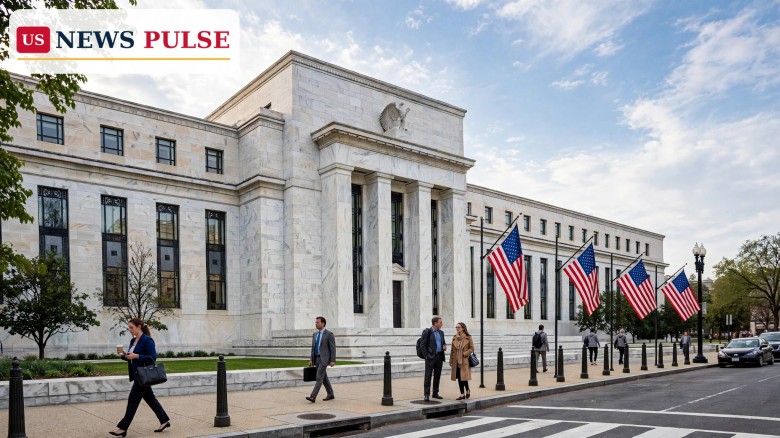
The Fed rate decision due on Wednesday, October 28, 2026, arrives with financial markets in a holding pattern and the US dollar sitting at its strongest level in two weeks. Traders are overwhelmingly betting that the Federal Open Market Committee will leave interest rates unchanged, but the real market-moving question is not today's decision itself — it is what the Fed signals about December.
Fed funds futures are pricing an implied 91% probability that the committee keeps its policy rate on hold, according to the CME Group's FedWatch tool. That near-certainty has left currency, bond and stock markets to trade on the wording of the statement and the chair's press conference rather than on the rate itself.
Early on Wednesday, the dollar held steady at a two-week high ahead of a string of central bank decisions around the world. The Federal Reserve's announcement is the centrepiece, but it is not the only one: the Reserve Bank of New Zealand is also due to decide policy, with economists widely expecting an interest rate hike, and the Reserve Bank of Australia will debate its own next move at a meeting next week.
Most of the dollar's major peers barely moved ahead of the Fed's decision. The euro traded flat at $1.1129 and the pound was also unchanged at $1.3307. Against the yen, the dollar oscillated between gains and losses before settling 0.1% firmer at 158.03 yen. The New Zealand dollar traded level at $0.5682 ahead of the Reserve Bank of New Zealand decision, while its Australian counterpart firmed 0.1% to $0.7031 ahead of September consumer price data.
In bond markets, the yield on the benchmark US 10-year Treasury bond was unchanged at 4.9967%. In cryptocurrencies, bitcoin was flat at $80,736.07, while ether nudged up 0.1% to $2,345.25 — a picture of markets waiting rather than betting.
The calm follows a strong session on Wall Street on Tuesday. The Dow Jones Industrial Average closed up 15.99 points, or 0.03%, at 52,377.57, the S&P 500 gained 45.83 points, or 0.60%, to 7,722.60, and the Nasdaq Composite jumped 308.43 points, or 1.18%, to 26,477.81. Falling oil prices supported sentiment a day ahead of the Fed decision, and semiconductor stocks showed notable strength, with AMD up 5.45% and Broadcom up 4.00%, while Nvidia rose 0.91%.
The Federal Reserve sets the federal funds rate — the overnight rate banks charge each other — and that single rate ripples through the entire US economy. It influences mortgage rates, car loans, credit card interest, business borrowing and the returns savers earn on deposits. When the Fed holds rates steady, it is effectively deciding that the current setting is restrictive enough to keep inflation in check without doing further damage to jobs and growth.
This week's decision comes at a complicated moment. The US economy is still digesting a long stretch of elevated interest rates, a government funding fight in Washington, and a technology investment boom that has powered stock markets to record levels. On Tuesday, the House Rules Committee advanced a Senate funding bill after a hearing lasting more than six hours, setting up a full House vote late on Wednesday — the same day as the Fed decision. Markets are therefore weighing monetary policy and fiscal politics at once.
The AI trade is another cross-current. After Anthropic's IPO filing the previous day, renewed momentum returned to artificial intelligence stocks on Tuesday. Argent Capital Management portfolio manager Jed Ellerbrook said the market goes through cyclical lulls where it worries about AI spending, and then technology stocks tend to lift it higher again. "The light switch had been off for the past two weeks, but the first two days of this week look like it has been switched back on," he said.
Meanwhile, the dollar's rise to 102.40 on the dollar index — its highest since October 14 — reflects a market that sees US rates staying higher for longer than rates elsewhere, or at least not falling as fast. A stronger dollar makes imports cheaper for Americans but makes US exports more expensive abroad, and it tends to tighten financial conditions around the world because so much global trade and debt is priced in dollars.
The statement itself will be parsed word by word. Traders will look for any change in the committee's description of inflation, employment and the balance of risks. A statement that leans hawkish — emphasising inflation risks — would reinforce the case for holding rates through December. A softer tone, acknowledging cooling price pressures or a weakening labour market, would keep a December cut alive in market pricing.
Chris Weston, head of research at Pepperstone Group in Melbourne, summed up the stakes bluntly: "The Fed doesn't need to hike today to move markets. It simply needs to change the perceived probability of hiking in December." In other words, a single sentence can do the work of a rate move.
The press conference matters just as much. The Fed chair's answers on how the committee is weighing incoming data, on whether members are more worried about inflation or jobs, and on what would change their minds will set the tone for trading into the end of the year. With the next meeting in December, today's guidance effectively frames the market's year-end playbook.
Market reaction ahead of the decision has been notably restrained. Currencies barely moved, bond yields were flat, and bitcoin held steady — all signs of a market that has already priced in a hold and is waiting for the signal that comes with it.
Ketter Group managing partner Matthew Ketter said IPOs by AI companies such as Anthropic are drawing additional attention to the semiconductor sector, adding that there is also "a signal that they may be able to scale back future spending in this area somewhat" and that "to me, that reads as a sign that this trade may have gotten a bit ahead of itself." That caution sits alongside the broader rally: chip stocks led Tuesday's gains, but analysts are openly debating whether the AI trade has run too far, too fast.
Ellerbrook said he still has a strong conviction that companies with data centres will continue to grow despite recent concerns about AI spending, adding that "the potential for cracks in the foundation depends on how volatile capital markets are." That volatility could well arrive on Wednesday afternoon if the Fed's message surprises.
Abroad, the contrast is sharp. Australia's inflation data showed prices rising 1.3% in the third quarter, after 0.6% in the previous quarter, with the trimmed mean measure of core inflation at 1%, matching market estimates and keeping the annualised rate at an above-target 3.6%. Reserve Bank of Australia Governor Michele Bullock told lawmakers on Wednesday that the bank will debate whether four interest rate hikes this year will prove sufficient to return inflation to target at a policy meeting next week. New Zealand, meanwhile, is widely expected to hike. The US, by standing still, would be the outlier among major central banks this week — and that divergence is part of why the dollar is firm.
For ordinary Americans, the Fed's decision shapes the cost of borrowing and the return on saving. Mortgage rates track the 10-year Treasury yield, which stood at 4.9967% ahead of the decision; credit card and auto loan rates follow the Fed's benchmark more closely. A hold means no immediate relief for borrowers, but also no new squeeze. A hawkish signal pointing toward a December hike would push borrowing costs higher and could cool the housing market further. A dovish signal would do the opposite, easing financial conditions into the holiday season.
For investors, the stakes are higher still. Stocks are trading near record levels — the S&P 500 closed Tuesday at 7,722.60 — and much of that valuation rests on the assumption that rates will eventually come down rather than go up. If the Fed closes the door on easing, or even hints at tightening, equity markets could reprice quickly. If it keeps December open, the rally has room to run.
For the rest of the world, a strong dollar at 102.40 is a double-edged sword. It eases imported inflation for the US but raises the cost of dollar-denominated debt for emerging economies and squeezes exporters competing with American firms. Central banks from Wellington to Sydney are calibrating their own decisions against what Washington does — which is why this week's global policy round is being watched as a single, connected story.
The Fed will announce its decision on Wednesday afternoon US time, followed by the chair's press conference. Markets will react within minutes to the statement, and the full interpretation will unfold over the following hours as analysts digest the wording and the press conference answers.
After that, attention turns to the data: the next inflation and jobs reports will determine whether the December meeting becomes a live decision or a formality. The Reserve Bank of New Zealand's decision and Australia's policy debate next week will add to the global picture, as will the outcome of the House funding vote on Wednesday.
If the Fed holds and signals patience, expect the dollar to consolidate near its two-week high and stocks to hold their gains. If it surprises with a hawkish tilt, expect the dollar to extend its rally, bond yields to rise and equities to give back some of Tuesday's advance. Either way, Wednesday's announcement sets the market's direction into the final weeks of 2026.
Traders broadly expect no change in policy. Fed funds futures price an implied 91% probability that the Federal Open Market Committee keeps its policy interest rate on hold, according to the CME Group's FedWatch tool.
The dollar index rose 0.3% on Tuesday to 102.40, its highest since October 14, as traders positioned for a Fed hold while other central banks, such as New Zealand's, are expected to hike — a divergence that supports the greenback.
The signal about December. As Pepperstone's Chris Weston put it, the Fed does not need to hike today to move markets — it simply needs to change the perceived probability of a December move.
Mortgage rates track the 10-year Treasury yield, which was unchanged at 4.9967% ahead of the decision, while credit card and auto loan rates follow the Fed's benchmark more closely. A hold means borrowing costs stay roughly where they are for now.
The next scheduled Federal Open Market Committee meeting is in December 2026, which is why today's guidance is being read as a preview of the year-end decision.
Read more on US News Pulse: Wall Street Rally: Nasdaq Jumps 1.18% as Chip Stocks Lift Markets Ahead of Fed, House Shutdown Vote Nears as Rules Panel Clears Funding Bill for Wednesday, and Canada Tariffs Revised: Plywood and Packaging Off the 50% List From Oct 30.
Sources: Reuters, CME Group FedWatch, Newspim, USA TODAY, Pepperstone Group, Argent Capital Management, Ketter Group, Reserve Bank of Australia, October 27–28, 2026.
Leave a Comment



 | Today's Date: