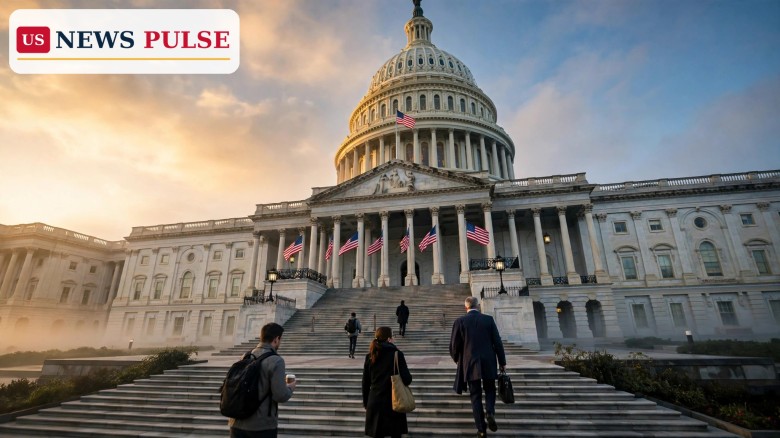
The House Rules Committee shutdown bill took its biggest step yet toward becoming law, as the panel voted 8-4 early Wednesday morning to advance the Senate-passed funding measure that would end the longest government shutdown in American history. The party-line vote sends the bill to the full House, where lawmakers are expected to take it up on Wednesday, with a final vote possible by Wednesday evening.
The vote came after a marathon hearing that lasted more than six hours, beginning on Tuesday evening and running past 1 a.m. on Wednesday. All Republicans on the committee supported the measure, and all Democrats opposed it, a split that captured the bitter politics of a 42-day shutdown that has furloughed federal workers, disrupted flights and left millions of Americans who rely on food assistance in limbo.
If the House passes the bill as expected, it would go to President Donald Trump, who has signalled his support for the deal. The president told reporters on Monday that the country would be opening up very quickly, and people familiar with Republican leaders' conversations told Fox News Digital they believe the bill will pass with nearly all Republicans on board.
The Rules Committee is the gatekeeper of the House floor: no major bill reaches a final vote without a rule setting the terms of debate, and the rule itself must win a majority. That made Tuesday night's session the first real test of whether the Senate's compromise could survive the House, and it passed that test, 8-4.
The hearing opened on Tuesday evening and stretched past midnight, with members clashing repeatedly across the aisle. Democrats accused Republicans of robbing Americans of their health care and of taking a vacation for weeks while remaining in their districts during the shutdown. That charge drew a sharp response from the panel's chairwoman, Representative Virginia Foxx of North Carolina.
"I am sick and tired of hearing you all say we had an eight-week vacation," Foxx said at one point. "I worked every day. I don't know about you. I don't want to hear another soul say that."
Democrats tried repeatedly to force votes on amendments, including measures dealing with the enhanced Affordable Care Act subsidies from the COVID-19 era that are set to expire at the end of this year. Every one of those amendments failed. In a notable surprise appearance, Jeffries himself testified in favour of his own amendment to extend those subsidies for another three years, but Republicans rejected it.
The panel's vote sends the rule to the full House, which must adopt it before debating the funding bill itself. House lawmakers are returning to Washington on Wednesday for the first time since mid-September, when the lower chamber last sat in session, and a late-afternoon vote is planned.
The shutdown began 42 days ago and is now the longest in United States history by roughly a week, surpassing the 35-day shutdown of 2018-2019. Federal workers have gone without pay, air traffic controllers and Transportation Security Administration officers have worked without pay while many took second jobs, and staffing shortages have fuelled flight delays that threatened to overshadow the Thanksgiving holiday travel period.
The Senate broke weeks of gridlock on Monday night, passing the funding legislation 60-40, with eight Democrats joining Republicans to reopen the government. The compromise, negotiated by Democratic centrists in the upper chamber, would fund military construction, veterans' affairs, the Department of Agriculture and the legislative branch through September 30, and the rest of the government through January 30.
The package also reverses the Trump administration's firings of federal workers since the shutdown began, protects federal workers against further layoffs through January, and guarantees they are paid once the shutdown ends. Funding for the Agriculture Department means people who rely on key food assistance programmes will see those benefits funded without threat of interruption through the rest of the budget year.
What the bill does not do is extend the Affordable Care Act subsidies, the central Democratic demand in the shutdown fight. Republicans promised only a vote by mid-December on extending the health-care tax credits, with no guarantee of success. Experts have warned that without an extension, the cost of health insurance premium plans will rise sharply, and Democrats have argued that millions of Americans face a health-care shock during open enrolment.
The Supreme Court has also weighed in on one corner of the crisis, extending a block on full Supplemental Nutrition Assistance Program payments through Thursday, as reported in our earlier coverage of the shutdown deal heading to a House vote. The court's order, with Justice Ketanji Brown Jackson dissenting, kept the food-assistance fight alive even as Congress moved toward reopening the government.
The fiercest argument of the night was not about health care or food assistance, but about a provision added by the Senate that would allow senators to sue the federal government for up to $500,000 if their data was sought or obtained as part of an investigation into President Trump without them being notified.
The provision, formally titled "Requiring Senate Notification for Senate Data," is retroactive to 2022. It would allow senators whose phone records were seized as part of former special counsel Jack Smith's Arctic Frost investigation into efforts to overturn the 2020 election to seek statutory damages. At least eight senators could be eligible, and critics described it as a multimillion-dollar payout tucked into a must-pass bill.
"This is a multimillion-dollar slush fund tucked into the bill," Representative Joe Neguse of Colorado said during the hearing. Representative Jamie Raskin of Maryland called the provision one of the most blatantly corrupt measures he had ever seen and questioned whether it could be constitutional.
What made the fight unusual was that the loudest objections came from both parties. Representatives Chip Roy of Texas and Austin Scott of Georgia were among the Republicans who opposed the provision, even as they voted to advance the bill.
"I think there's gonna be a lot of people, if they look and understand this, are gonna see it as self-serving, self-dealing kind of stuff. And I don't think that's right," Roy said. He added that he was trying to figure out what could be done to force the Senate's hand to repeal the provision and fix it without amending the bill in the House.
House Appropriations Committee Chairman Tom Cole of Oklahoma, who helped craft part of the funding deal, told Fox News Digital he had feared the provision could derail the final vote. "It had been added in the Senate without our knowledge," Cole said. "It was a real trust factor. I mean, all of a sudden, this pops up in the bill, and we're confronted with either: leave this in here, or we pull it out, we have to go to conference, and the government doesn't get reopened."
That dilemma explains why the provision survived: striking it in the House would have sent the bill back to the Senate, delaying the reopening of the government further. Republicans on the Rules Committee voted down an amendment from Representative Teresa Leger Fernández of New Mexico to strip the provision, and Speaker Mike Johnson has promised a standalone vote to repeal it as early as next week, a promise that satisfied few of its critics.
Representative Greg Steube of Florida voiced that frustration publicly, writing that a standalone repeal would do nothing to change the fact that certain senators would still be paid. "The Senate will never take up your 'standalone' bill," Steube wrote to the speaker. "This is precisely why you shouldn't let the Senate jam the House."
Republican leaders struck an optimistic note after the committee vote, with people close to their conversations telling Fox News Digital they expect the bill to pass with nearly all Republicans on board. Nearly all House Democrats are opposed to the funding measure, but even without much Democratic support, the bill is expected to pass on Wednesday.
When asked whether he supported the Senate deal, President Trump told reporters at the Oval Office on Monday that it depends on what deal was being discussed. "But if it's the deal I heard about, I would say so," Trump continued. "I think based on everything I'm hearing they haven't changed anything, and we have support from enough Democrats, and we're going to be opening up our country."
Democrats, meanwhile, framed the vote as a missed chance. Jeffries' appearance in support of his three-year subsidy extension underscored how central the health-care fight remains to his party, even as the shutdown deal moves forward without it. Democratic leaders have also warned that the mid-December vote on subsidies offers no guarantee, and that premium increases will hit households during open enrolment regardless of the funding deal.
Johnson has said he was very angry about the $500,000 provision, telling reporters it was dropped in at the last minute without his knowledge and that he did not appreciate it, nor did most House members. His promise of a separate repeal vote is meant to defuse that anger, but as Steube's criticism shows, many House members doubt the Senate will ever act on it.
The Rules Committee vote matters because it removes the last procedural obstacle before the House can act. In a chamber where the Republican majority is razor-thin, a failed rule vote can kill a bill outright, and party-line rule votes are typically tests of the majority's control of the floor. Clearing the panel 8-4, with every Republican in favour, signals that the leadership believes it has the votes for final passage.
It also matters because of what it reveals about the deal itself. The bill reopening the government carries provisions that neither chamber fully likes: Democrats are swallowing a deal without the health-care subsidies they fought 42 days for, and House Republicans are swallowing a Senate provision they call self-dealing. That mutual dissatisfaction is often the signature of a compromise that can actually pass, but it also stores up trouble for the next funding fight in January.
For the millions of Americans caught in the shutdown, the practical stakes are immediate. Federal workers would receive back pay, food assistance would be funded through the budget year, and airports would begin returning to normal staffing. For the political system, the stakes run to the November 3 midterm elections, just days away, where voters will judge both parties on how the longest shutdown in history was allowed to happen and how it ended.
The episode also fits a wider pattern of election-eve brinkmanship covered in our reporting on the president's warnings about the midterms, with the shutdown's end arriving in the final week of campaigning.
The House is expected to hold a procedural rule vote on Wednesday, and if that passes, lawmakers will debate the legislation itself before a final vote on Wednesday evening. If the bill passes, it goes to President Trump for his signature, and the government would begin reopening, with agencies working through back pay and the restoration of services.
Two follow-up fights are already scheduled. Johnson has promised a standalone vote as early as next week on repealing the $500,000 Senate provision, though Senate Majority Leader John Thune has resisted calls to take up such a repeal. And Republicans have promised a vote by mid-December on extending the Affordable Care Act subsidies, a vote Democrats say they will use to force every member on the record on health-care costs.
The funding itself only runs through January 30 for most of the government, meaning Congress will face another deadline within months. If the health-care and spending fights are not resolved by then, the country could be back in the same position, with another shutdown threat hanging over the start of 2027.
The committee voted 8-4 to advance a rule governing debate on the Senate-passed funding bill. The rule must be adopted by the full House before the bill itself can receive a final vote.
House lawmakers are expected to hold a procedural rule vote and then a final vote on Wednesday evening, after returning to Washington for the first time since mid-September.
It is a Senate-added provision, retroactive to 2022, that would let senators sue the federal government for up to $500,000 if their phone records were obtained in an investigation into President Trump without notification, as happened in the Arctic Frost probe.
No. The bill does not extend the enhanced subsidies, which expire at the end of the year. Republicans promised only a vote by mid-December on an extension, with no guarantee it will pass.
The compromise funds military construction, veterans' affairs, agriculture and the legislative branch through September 30, and the rest of the government through January 30, setting up another funding deadline early next year.
Leave a Comment



 | Today's Date: