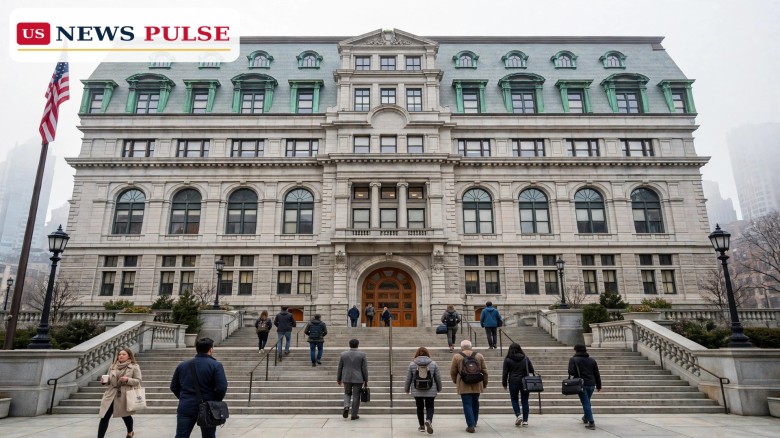
A federal judge in Boston on Tuesday temporarily blocked the Trump administration's new refugee rule, which would have cut the time for refugees to respond to a notice stripping them of legal status from 30 days to just 10 days. The pause runs through November 6 while the wider legal fight continues.
The case matters because of what is at stake in those 10 days. A refugee who misses the deadline risks losing a status granted after a long vetting process, with no administrative appeal available under the regulation, and then facing removal proceedings.
Judge Kobick's order puts the USCIS rule on hold through November 6. According to Reuters, which first reported the ruling, the judge said the rule should be paused to preserve the status quo until the case could be heard by a colleague, so the government cannot enforce the 10-day deadline while the challenge moves forward.
The timing is tight. The rule had already been in force for almost two weeks, having taken effect immediately when it was published on October 14, so some refugees may already have received termination notices under the shorter clock before the judge intervened.
The ruling arrived on the same day the Supreme Court sided with the Trump administration in a separate immigration dispute over deportation procedures, a reminder of how much of the administration's immigration programme is being tested in the courts at the same time.
To understand the ruling, it helps to understand the process it interrupts. Under the regulation at issue, 8 CFR 207.9, USCIS can terminate a person's refugee status on a single ground: that the person was not in fact a refugee, as defined by section 101(a)(42) of the Immigration and Nationality Act, at the time of admission. The same rule applies to a spouse or child whose status derives from the principal refugee.
Before any termination, USCIS must send a written Notice of Intent to Terminate. The person named then has a set period to present written or oral evidence, or request an interview, showing why their status should not be terminated. Until October 14, that period was 30 days; the interim final rule published that day cut it to 10 days from service, leaving the legal standard unchanged.
DHS says the shorter period lets the government act faster when later reviews uncover identity, eligibility, fraud, national security or public safety concerns. The rule rests on executive orders 14161 and 14163 and on Operation PARRIS, which subjects refugee cases to renewed checks and reinterviews and has already produced termination notices.
Two features of the process make the deadline especially consequential. First, the regulation provides no administrative appeal from a USCIS decision to terminate refugee status. Second, once status is terminated, USCIS processes the person under the removal procedures in sections 235, 240 and 241 of the Immigration and Nationality Act. The response to the notice is, for many people, the main opportunity to defend a status they may have held for years.
Historically, termination of refugee status has been described by refugee advocates as exceedingly rare. The October 14 rule was published as an interim final rule, effective immediately, with public comments open until November 13, 2026. On the same day, USCIS also finalised a separate rule ending automatic extensions of employment authorisation documents for certain categories, including refugees and asylees.
The Boston ruling does not decide whether the 10-day rule is lawful. Temporary orders hold things steady while a court examines the arguments, and Judge Kobick framed hers in exactly those terms.
That distinction matters for both sides. For refugees and their lawyers, the order buys time only until November 6, unless a court extends it or grants a longer preliminary injunction. For the administration, it is a setback, not a final defeat: the government can argue at the next hearing that the rule is lawful, and appeal if it loses again.
The choice of Boston as the venue is also notable. The Massachusetts federal court has become a frequent battleground for challenges to federal immigration policy.
Erez Reuveni of Democracy Forward, a lawyer for the plaintiffs, welcomed the order, saying it "provides meaningful protection for people who were already facing termination notices" — the plaintiffs' central argument, since notices were already going out while the rule was in force.
The Department of Homeland Security, which oversees USCIS, did not respond to Reuters' request for comment. The administration's justification, set out when the rule was published, is that a shorter deadline lets the government act faster when re-checks raise identity, eligibility, fraud, national security or public safety concerns.
What neither side disputes is the scale of the population involved. DHS itself estimated that as many as 186,000 refugees could be affected by the new rule.
Ten days is a very short time to respond to a government notice that can end a person's legal status. A refugee who receives such a notice may need to find a lawyer, often a legal-aid lawyer with a long waiting list, obtain documents that may be in another country or in another language, and prepare evidence about events from years ago, at the time of their original admission. The shorter the window, the more likely it is that a meritorious response simply cannot be assembled in time.
The absence of an administrative appeal raises the stakes further. Here, the regulation says there is no such appeal, which means an adverse termination decision pushes a person directly toward removal proceedings, where other forms of relief may be available but are harder to obtain.
The ruling also matters beyond this one rule: the lawsuit challenges the broader review plan too, and the outcome will signal how much deference courts give the executive when it re-examines admissions made years earlier.
The immediate date to watch is November 6, when Judge Kobick's order expires unless extended or replaced by a longer injunction. A hearing before another judge will test whether the plaintiffs can show enough likelihood of success, and enough risk of irreparable harm, to keep the rule on hold longer.
Separately, the public comment period on the interim final rule runs until November 13, 2026, and comments by that date will form part of the administrative record.
Refugees who have received a termination notice should not assume the ruling ends their case. The order pauses the rule, not individual notices, so anyone affected should seek legal advice promptly and keep copies of every notice and receipt.
Related coverage on US News Pulse includes the Supreme Court's October 27 decision backing the administration in a deportation-procedure dispute, at Supreme Court Backs Trump in Deportation Case as Immigration Judges Lose Pause Power, and the administration's suspension of visa-free travel for Chinese nationals to the Northern Mariana Islands, at China Visa-Free Travel Suspended for Northern Mariana Islands Over Security Fears.
Judge Julia Kobick temporarily blocked the USCIS rule through November 6, preserving the status quo until the case can be heard further. She did not rule finally on whether the 10-day rule is lawful.
No. The order is temporary. Unless it is extended or replaced by a longer injunction, the 10-day rule could return after November 6, depending on what the court decides at the next stage.
Refugees whose status USCIS proposes to terminate on the ground that they were not refugees at admission. DHS estimated as many as 186,000 could be affected, including spouses and children with derivative status.
It is a written USCIS notice stating the agency intends to terminate a person's refugee status, giving them a chance to present evidence or request an interview. It is not itself a final termination.
The regulation provides no administrative appeal, and USCIS then processes the person under the removal procedures in sections 235, 240 and 241 of the Immigration and Nationality Act, where they may seek other relief if they qualify.
Leave a Comment



 | Today's Date: