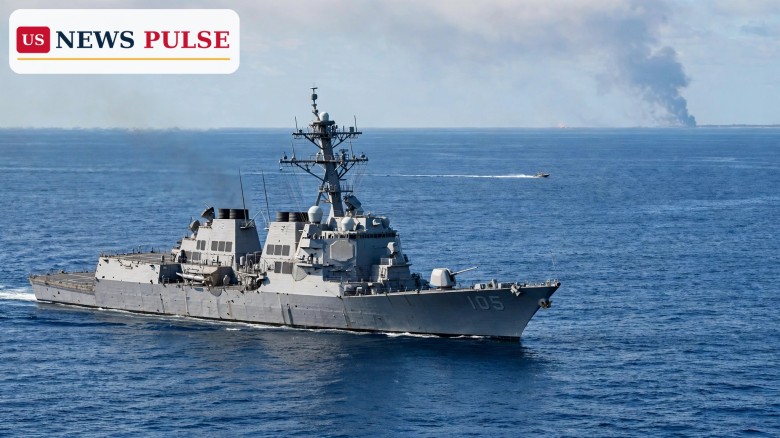
Five people were killed on Tuesday, October 27, 2026, when the United States military struck an alleged drug-trafficking boat in the eastern Pacific Ocean, US Southern Command (SOUTHCOM) announced — the latest lethal blow in a campaign that has now claimed at least 243 lives, according to independent trackers, and one that continues to draw accusations that Washington is carrying out extrajudicial killings at sea.
The strike, carried out by Joint Task Force Western Hemisphere under SOUTHCOM's direction, targeted what the military described as a "go-fast" vessel travelling along established narco-trafficking routes. SOUTHCOM said intelligence had confirmed the boat's active involvement in drug trafficking, but — as in previous strikes — it released no evidence, no details of the vessel's origin or destination, and no information about any narcotics supposedly on board.
"On October 27, under the direction of SOUTHCOM, Joint Task Force Western Hemisphere executed a lethal, kinetic strike on a go-fast vessel operating along established narco-trafficking routes in the Eastern Pacific," SOUTHCOM said in a post on social media. "Confirmed intelligence revealed the vessel's active involvement in narco-trafficking. The operation killed five narco-terrorists."
The post included a video clip of a stationary vessel being engulfed in an explosion, according to AFP's account of the announcement. SOUTHCOM has often accompanied its strike announcements with such videos, which purport to show the targeted boats being destroyed. No further detail was given about where exactly in the eastern Pacific the strike took place, what kind of weapon was used, or whether any wreckage or cargo was recovered afterwards.
The strike was the sixth lethal boat strike in the past four months, according to Adam Isacson, an analyst at the Washington Office on Latin America (WOLA) who has tracked the campaign. The most recent previous strike reported in the tracker killed four people in the Caribbean. Tuesday's operation, by contrast, took place in the eastern Pacific — the other main theatre of the campaign, where fast boats running north from South America's Pacific coast have long been a focus of US counter-narcotics operations.
Relatives of some of those killed in earlier strikes have said their loved ones were fishermen or workers who had nothing to do with the drug trade, and the government has rarely shared details that would allow its claims about individual vessels to be checked. That pattern — a short announcement, a video, and little else — has held again with this strike.
The United States began targeting alleged narcotics-smuggling boats in early September 2025, and President Donald Trump has argued that Washington is effectively at war with drug cartels operating out of Latin America. The administration has designated numerous criminal groups in Latin America as foreign terrorist organisations, a designation it uses to frame the boat strikes as counter-terrorism operations rather than law-enforcement actions.
Before Tuesday's strike, WOLA's tracker counted at least 238 people killed in 68 reported strikes in the Caribbean Sea and the eastern Pacific since the campaign began. Adding Tuesday's five dead brings that reported total to 243. AFP, which keeps its own tally, put the pre-strike figure at at least 235 — a difference that reflects how hard it is to verify a campaign conducted almost entirely through brief military announcements, with no independent observers present and no official casualty list published.
The campaign has also become a domestic political flashpoint. It is running alongside a much larger US military build-up around Latin America, including the deployment of warships and aircraft that the administration has linked both to counter-narcotics operations and to pressure on Venezuela. Critics in Congress and among rights groups have demanded the legal justification for strikes against boats that are not engaged in combat and are far from US shores, and have questioned whether the terrorist designations can lawfully stretch to cover suspected smugglers.
The timing matters too. Tuesday's strike came exactly one week before the November 3 midterm elections, in a campaign season in which the administration has repeatedly presented its hard line on drugs, borders and crime as a central achievement. It came on the same day the president campaigned in Texas, telling supporters there that the country was profiting from its confrontation with Iran — a reminder of how foreign military action and domestic politics have become intertwined in the final days before voters go to the polls.
What SOUTHCOM did say is contained in two sentences: the strike happened on October 27, it was a lethal kinetic strike on a go-fast vessel on established narco-trafficking routes in the eastern Pacific, intelligence confirmed the vessel's active involvement in narco-trafficking, and five people described as narco-terrorists were killed.
What it did not say is everything else. There was no statement of the vessel's flag, its point of departure, its intended destination, the nationality of those on board, or the quantity or type of any suspected narcotics. There was no claim that the vessel had threatened US forces or refused an order to stop, and no account of any attempt to intercept or board it before lethal force was used. News reports of the strike noted precisely that gap: the statement, they said, "did not provide further details about the vessel's origin, its intended destination or the quantity of suspected narcotics involved."
That gap is not new. Across the campaign, the administration has not provided definitive evidence that the vessels it has been striking are involved in drug trafficking. The absence of such evidence is central to the legal criticism: without proof that the people on board were combatants in an armed conflict or posed an imminent threat, critics argue, killing them is not warfare but unlawful killing.
The sharpest reaction to Tuesday's strike came from WOLA's Adam Isacson, who tracks the campaign strike by strike. "This is the 6th lethal boat strike in the past 4 months," he wrote in a social media post responding to SOUTHCOM's announcement. "The pace is slower than before, but the administration and its commanders persist in grinding out illegal killings every few weeks, with no discernible impact on the drug trade. A bleak pre-midterms message."
Legal experts have made the broader argument repeatedly since the campaign began: drug trafficking is a criminal activity, not an act of war, and military strikes are not a lawful response to it. The Trump administration rejects that framing, pointing to its terrorist designations of Latin American criminal groups and to the president's claim that the United States is effectively at war with the cartels. Rights groups counter that a designation does not turn suspected smugglers into lawful military targets, and that the strikes appear to target civilians who do not pose an immediate threat to the United States.
Families of some of those killed in earlier strikes have demanded accountability, including the families of Trinidadian men killed in a previous strike, who have publicly pressed for answers about their relatives' deaths. Those demands have so far produced no public accounting of individual cases, and no independent investigation has been announced into any single strike.
Within the United States, the campaign has drawn scrutiny from lawmakers of both parties, though it has not produced legislation to stop it. Supporters of the strikes argue that cartels flood American streets with drugs that kill tens of thousands of people a year, and that interdiction at sea has failed to stem the flow. Opponents reply that killing the crews of small boats does nothing to dismantle the organisations behind the trade — and that it puts American forces on legally perilous ground.
Tuesday's strike matters for three reasons. First, it extends a campaign that has already killed more than 240 people without a single public legal justification being tested in court or a single case file being opened to scrutiny. Each new strike adds to a death toll that exists only in the counts kept by journalists and researchers, because the government publishes no running total of its own.
Second, it tests the boundary of presidential war powers. If a president can order lethal strikes on suspected criminals far from any battlefield, on the basis of intelligence that is never disclosed, that precedent will outlast this administration and this campaign. Future presidents of either party could invoke it for other targets, in other seas, against other groups labelled terrorists.
Third, it lands in a region where US credibility is already under strain. Latin American governments have watched the strikes with a mixture of alarm and anger, and the families of the dead — some of whom insist their relatives were fishermen — have become a human face for a policy debated in Washington in abstract terms. Every strike that kills people later shown to have no connection to drugs would deepen that damage.
Further strikes are likely if the pattern of recent months holds: SOUTHCOM announces them in short social media posts, usually within a day of the operation, and the toll kept by trackers ticks upward. Whether any strike is ever subjected to independent review remains an open question, as does whether Congress will use its oversight powers to demand the intelligence and legal memos behind the campaign.
Attention will also turn to the midterm elections on November 3. The administration has made its confrontation with cartels and its military operations in the region part of its closing argument to voters; opponents have made the legality of the strikes part of theirs. The result may determine whether the campaign continues, expands, or faces a new round of congressional restraint.
For now, the facts of Tuesday's strike are limited to what SOUTHCOM chose to release: five people dead, one boat destroyed, in the eastern Pacific, on October 27, 2026. Everything else — who they were, what they were carrying, and whether they had to die — remains unanswered.
How many people were killed in the October 27 strike? SOUTHCOM said five people were killed. It described them as "narco-terrorists" but gave no names, ages or nationalities.
Where did the strike happen? In the eastern Pacific Ocean, along what SOUTHCOM called established narco-trafficking routes. The exact location was not disclosed.
How many people have been killed in the whole boat-strike campaign? WOLA's tracker counted at least 238 killed in 68 strikes before Tuesday, making 243 including this strike. AFP's tally put the pre-strike figure at 235, which would make 240. No official government total has been published.
Why do critics call the strikes extrajudicial killings? Because, they argue, drug trafficking is a crime, not an act of war, and the people on the boats are not lawful military targets. Killing them without an imminent threat, arrest or trial, they say, is unlawful killing rather than warfare.
Has the US provided evidence that the boats were carrying drugs? The administration has said intelligence confirmed the vessels' involvement in trafficking, but it has not publicly provided definitive evidence for individual strikes, including Tuesday's.
Related coverage: US-Iran strike plans: forces ready within 96 hours of Trump order, reports say; Alaska Senate lawsuit: DOJ wants certification blocked if Sullivan loses; Trump and Rubio visit Venezuelan oil tanker in Port Arthur, Texas today.
Leave a Comment



 | Today's Date: