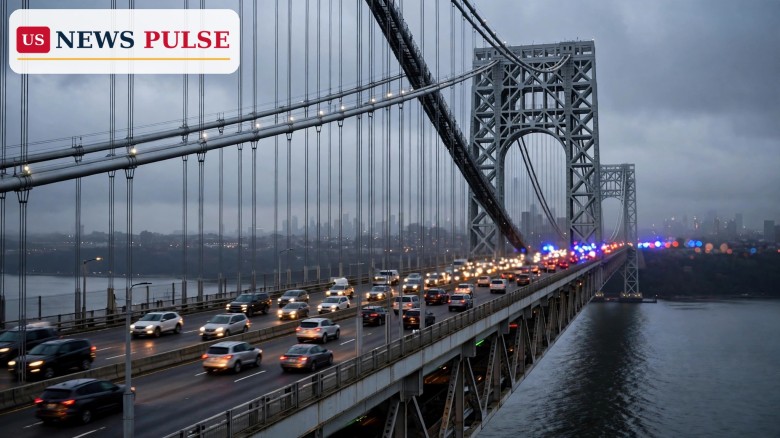
A retired New York Police Department detective accused of gunning down a Con Edison worker during a road-rage confrontation on the George Washington Bridge has been indicted on second-degree murder, a week after the fatal shooting shocked commuters in New York and New Jersey. Victor Romero, 62, was indicted on Tuesday, October 27, 2026, over the death of Koran Irvine, 46, whose family and co-workers had spent days demanding that prosecutors pursue the most serious charge available.
The George Washington Bridge murder indictment marks a sharp turn in a case that began as a near-collision on one of America's busiest crossings and ended, prosecutors say, with a single gunshot fired from one moving car into another. It also answers, for now, the central complaint of Irvine's supporters: that a former police officer was being treated more leniently than an ordinary defendant would be.
On the evening of October 20, 2026, Koran Irvine was driving home to Valley Cottage, in Rockland County, after work. Victor Romero was heading to Haverstraw. Their cars nearly collided on the approach to the George Washington Bridge, the suspension bridge that carries Interstate 95 across the Hudson River between Manhattan and Fort Lee, New Jersey.
According to court documents and prosecutors, Romero, driving a Range Rover owned by the investment firm where he worked in security, then began aggressively tailgating Irvine's Volkswagen Golf. On the bridge itself, prosecutors say, Romero pulled up alongside the smaller car and fired a single shot into its window before speeding away and exiting onto the Palisades Interstate Parkway.
Irvine, known to colleagues as Flaco, was struck by a bullet in the right shoulder. His car coasted across traffic and came to rest against the centre median. He was pronounced dead a short time later at Englewood Hospital in New Jersey. Prosecutors have said surveillance video shows Romero driving closely behind Irvine before pulling alongside and firing through the rear passenger-side window, striking him in the right back shoulder.
Romero surrendered the day after the shooting and handed over a gun he told investigators he always carried. He was arrested on a murder charge on Wednesday, October 21, but when he appeared in court the following day, prosecutors filed only a first-degree manslaughter charge, accusing him of causing Irvine's death while trying to seriously injure him. That decision, and the setting of $1 million bail, enraged Irvine's family and co-workers, who argued that Romero was being protected because he was a former police officer.
On Tuesday morning, October 27, Romero made a brief court appearance, jeered outside court by Irvine's Con Edison colleagues, with his lawyers telling the judge he would not testify before the grand jury. Later that day, the Manhattan District Attorney's Office announced that the grand jury had returned a true bill on second-degree murder. A spokesman said the presentation to the grand jury followed an extensive ongoing investigation since the criminal court arraignment the previous Thursday.
The George Washington Bridge is one of the most heavily used crossings in the United States, carrying more than 100 million vehicles a year between New York City and New Jersey. A shooting on its span, in moving traffic, at evening rush hour, is extraordinarily rare, and the case has drawn intense attention precisely because it unfolded in a place where drivers expect congestion, not gunfire.
Road rage is a growing concern for American law enforcement. Studies of aggressive driving have repeatedly found that tailgating, lane disputes and perceived slights can escalate in seconds, particularly when a firearm is within reach. Prosecutors in this case have described Irvine's killing as particularly senseless, a phrase that captures both the trivial trigger, a near-miss on a bridge approach, and the irreversible outcome for a man driving home from work.
Romero retired from the NYPD more than 20 years ago, according to reports of the case, and later worked in private security. That history became a focal point of the public dispute over charging. Irvine's family and supporters argued that the initial manslaughter charge, and his release on bail, showed a double standard. Prosecutors, for their part, said the grand jury presentation followed continued investigation, not public pressure, and the upgraded charge now reflects the evidence as they see it.
The case also sits within a wider New York debate about bail, police accountability and public trust. When a defendant is a former officer, every charging decision is scrutinised for favouritism, and every delay is read as protection. The murder indictment does not settle that debate, but it removes the most visible grievance: that the case was proceeding on a lesser charge than the facts warranted.
Second-degree murder in New York covers a killing committed with intent to cause death, without the aggravating circumstances that would make it first-degree murder. The charge against Romero accuses him of intending to cause Irvine's death when he fired into the Volkswagen. That is the crucial legal distinction from first-degree manslaughter, which covers causing death while intending to cause serious physical injury, but not death itself.
The distinction matters enormously at sentencing. A conviction for second-degree murder carries 15 to 25 years to life in prison. First-degree manslaughter carries five to 25 years. In practical terms, the murder charge means Romero, if convicted, would face a longer minimum period before any possibility of parole, and would be eligible for a life sentence.
An indictment is not a conviction. It means a grand jury found enough evidence to proceed to trial on the charge. Romero is presumed innocent unless proven guilty, and his lawyers have so far declined to comment after the indictment. At his Tuesday appearance, they told the judge he would not testify before the grand jury, a common defence choice that avoids locking a defendant into testimony before trial.
The next procedural step is arraignment on the indictment, scheduled for November 23 in Manhattan Supreme Court, Part 72. At that hearing, Romero will formally enter a plea to the murder charge, and the court will address bail. Irvine's family attorney has already said the family will push for his bail to be revoked, arguing that a man now facing a murder indictment should not remain free while awaiting trial.
Keith White, the attorney for the Irvine family, said on October 27 that the family was happy that the appropriate charge had now been brought, and that they are expecting and pushing for Romero's bail to be revoked. The statement captured the family's mood after a week in which they felt they had to campaign publicly for a murder charge.
At a Rally for Justice in Foley Square on Tuesday afternoon, organised by the Utility Workers Union of America Local 1 and 2, hundreds of Irvine's Con Edison co-workers chanted, "Jail, not bail for Victor Romero." Family members attended, including Irvine's wife, Patricia, and his younger sister, Zeria. Another chant, "Where's the video!", referred to the many cameras on the roadways leading to the bridge and on the span itself, and to demands that all available footage be preserved and disclosed.
"I am pissed off," Zeria Irvine said at the rally. "Because I want to know who does this guy think he is?" Her anger reflected a family's grief compounded by suspicion: that the system moved slowly, and softened its approach, because the accused once wore a badge.
Gale Forde, Irvine's aunt, spoke of a man devoted to his family. "He loved his children and the children loved his father," she said. "He loved his wife and his wife loved him." Con Edison has described Irvine as a dedicated mechanic who had recently marked 20 years with the company.
There were also calls at the rally to fire New York City Police Commissioner Jessica Tisch, questioning why Romero was out on bail and why the charge had at one point been lowered to manslaughter. Romero's lawyers declined to comment after the court appearance and could not immediately be reached following the indictment announcement. The Manhattan District Attorney's Office has said only that the grand jury presentation followed an extensive ongoing investigation.
This case matters for three reasons. First, it is a test of whether the criminal justice system treats former officers the same as everyone else. The initial downgrade from murder to manslaughter, followed by a grand jury upgrade back to murder, will be cited by both sides: by critics as proof that public pressure was needed, and by prosecutors as proof that the process, given time, reached the right charge.
Second, it is a reminder of how quickly road rage can turn lethal in a country where many drivers carry firearms. A near-collision that ended with no damage and no injury became, within minutes, a homicide investigation spanning two states. The bridge itself, a shared, high-speed, high-stress environment, leaves no room for error and no easy escape once a confrontation begins.
Third, it matters to the people who knew Koran Irvine. For his wife, his two children, his sister and his co-workers, the indictment is not an abstraction. It is the difference between a case that felt minimised and a case that now, in their view, matches the gravity of losing a husband, father and colleague on his way home from work.
Romero is scheduled to be arraigned on the murder indictment on November 23, 2026, in Manhattan Supreme Court. The court will then set a schedule for pre-trial motions, discovery and, potentially, trial. Bail will be a live issue: prosecutors may seek to have it revoked or increased, and the defence may argue that Romero, who surrendered voluntarily and has complied with bail conditions, should remain free.
Investigators are also expected to continue assembling the evidence that will be tested at trial, including surveillance video from the bridge and its approaches, forensic evidence from both vehicles, and any communications or witness accounts from the evening of October 20. The question at trial will not only be what happened on the bridge, which prosecutors say is captured on video, but what Romero intended when he fired.
For Irvine's family, the next milestone is not a court date but a longer wait for a trial that may be months away. Their public campaign, from the Foley Square rally to calls for bail revocation, suggests they intend to keep attending hearings and keeping the case in public view until a verdict is reached.
Who is Victor Romero? Victor Romero, 62, of Haverstraw, New York, is a retired NYPD detective who later worked in private security. He is accused of shooting Koran Irvine on the George Washington Bridge on October 20, 2026.
Who was Koran Irvine? Koran Irvine, 46, was a Con Edison mechanic of 20 years, a married father of two, known to colleagues as Flaco. He was driving home to Valley Cottage when he was shot.
What is the difference between murder and manslaughter in this case? Second-degree murder accuses Romero of intending to cause Irvine's death and carries 15 to 25 years to life. First-degree manslaughter, the earlier charge, accused him of causing death while intending serious injury, and carries five to 25 years.
Is Romero in custody? Romero posted $1 million bail on October 23 and was free at the time of the indictment. His family attorney says Irvine's family will push for bail to be revoked at the November 23 arraignment.
When is the next court date? Romero is due to be arraigned on the murder indictment on November 23, 2026, in Manhattan Supreme Court.
Related coverage on US News Pulse: Alexander brothers sentenced to 30 years each in sex trafficking case, Ted Bundy Utah cold case closed after 52 years, and Samuel Sey ICE arrest in Ohio.
Leave a Comment



 | Today's Date: