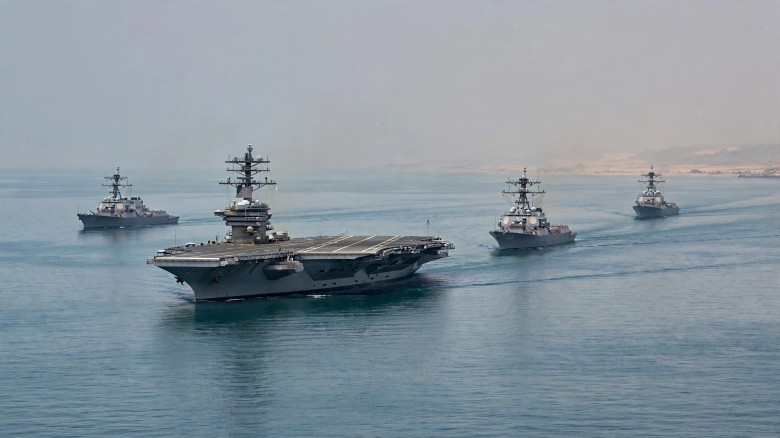
US forces deployed across the Middle East are prepared to launch major military operations against Iran within 96 hours of receiving an order from President Donald Trump, according to two US officials cited by CNN on 26 October 2026. The reported readiness puts a rapid, large-scale strike option on the president's desk just one week before America's midterm elections on 3 November, even as officials stress that no final decision has been made.
The potential campaign would go far beyond the limited, periodic strikes the United States has carried out since Trump halted full combat operations earlier this year, targeting Iranian military sites, nuclear facilities and energy infrastructure.
CNN reported on Sunday 26 October that sufficient American forces are already in position in the region to carry out the potential attacks, and that commanders in US Central Command (CENTCOM) and the Pentagon have been building a wide-ranging target list. One official summed up the scale bluntly: "It will be a big effort."
The same reporting says current and former officials familiar with internal planning discussions increasingly see the question as when, not if, Trump will issue a go-order. Some believe it could come at any point before the end of the year, though most expect the period after the midterm elections to be the likeliest window. Officials also caution that Trump has, in the past, appeared to lean toward a course of action only to pull back at the last moment.
The Pentagon, in a statement to CNN, neither confirmed nor denied the specifics. "The Department is a planning organization, and its job is to develop and execute military options ordered by the President," a senior Pentagon official said. CENTCOM did not immediately comment further.
The current standoff is the latest chapter in a confrontation that has simmered all year. After earlier rounds of fighting, Trump halted full combat operations, but limited American strikes continued against targets described as easy to rebuild — radar stations, missile launchers and similar assets. Military planners have a shorthand for that approach: "mowing the lawn."
Admiral Brad Cooper, the CENTCOM commander, visited the strait on Sunday, flying over the waterway by helicopter and meeting service members who have been clearing it of Iranian mines. The US military is maintaining a blockade on Iranian ports while assisting shipping through the strait, through which a large share of the world's seaborne oil passes.
"We continue to stand shoulder to shoulder with our Gulf partners and the shipping industry," Cooper said in a news release. "This visit underscores our strong commitment to continued freedom of navigation through the Strait of Hormuz." Despite more tankers transiting the strait, oil prices remain elevated, partly on fears of Iranian attacks.
The distinction between the old pattern and the new plan matters. "Mowing the lawn" strikes were designed to keep Iranian capabilities trimmed without triggering a wider war. The reported new target list — military sites, nuclear facilities and crucial energy infrastructure — is designed to do lasting damage, and it carries a much higher risk of a regional spiral.
That risk is spelled out in recent US intelligence assessments. According to two sources familiar with those assessments, Iran and the Houthi rebels in Yemen are taking the possibility of renewed attacks very seriously. If Washington and Jerusalem launch new operations, Tehran and the Houthis would likely retaliate immediately, targeting American personnel and facilities around the region — and potentially beyond.
An unclassified memo dated 23 October from the Director of National Intelligence to Secretary of State Marco Rubio, previously reported by CNN, says US intelligence has found that "Iran has substantially increased efforts to target US personnel" and that plotting efforts "have reached advanced stages in both the Middle East and certain other countries." US officials believe Iran and the Houthis are unlikely to launch pre-emptive attacks at this point, but would not hesitate to respond if Iran is targeted first.
Israel's role in the story is contested. According to CNN's sources, Prime Minister Benjamin Netanyahu has been pushing for new attacks on Iran and lobbying Washington to join them, while US officials — including Trump — told Israel to hold off until the two countries could launch joint operations. "Netanyahu really wanted and tried to convince Trump for a joint attack in Iran before the elections, and Trump did not give a green light," an Israeli security source told CNN. The prime minister's office dismissed that account as "fake news."
One reason Trump declined, the Israeli source said, was a warning from Israel Defence Forces chief of staff Eyal Zamir to US General Dan Caine, chairman of the Joint Chiefs of Staff, that an attack could postpone Israel's own elections. Defence Minister Israel Katz called reports of a rift "completely baseless and false" and insisted Israel had no plans to strike Iran before the election.
Netanyahu himself struck a harder public line this week, telling an IDF graduation ceremony that his directive to the military, the Mossad and other security branches is to topple the regime in Iran.
For now, all sources agree on one point: Israel appears to have delayed its plans in the immediate term but is building up for potential joint operations with the United States, likely after the American midterms. "The plans are ready, waiting for Trump's approval, could be after the midterms," one source told CNN.
A major US-Iran campaign would be the most consequential American military decision of the year. The Strait of Hormuz carries a significant share of global oil shipments, so any closure or sustained disruption would push energy prices higher and feed inflation in the United States just as voters head to the polls. It would also force a debate in Washington about war powers, costs and endgames.
The timing is equally sensitive. Launching a major operation days before or after the midterms would fuse foreign policy with domestic politics in a way few recent elections have seen. For the administration, a successful campaign could be presented as decisive leadership; a messy one, with American casualties or retaliatory attacks on US bases and embassies, could dominate the political conversation for months.
Three dates frame the near future. The first is Tuesday 3 November, when Americans and Israelis both vote — after which joint operations are most likely. The second is the end of the year, by which officials believe Trump could issue an order. The third is the coming days, when more US embassies in the region are expected to announce drawdowns.
Diplomacy has not been declared dead, but no breakthrough is publicly in view. Any sign of movement will be watched closely in capitals from Riyadh to Jerusalem to Tehran.
Not yet. US forces are prepared to launch major operations within 96 hours of an order from President Trump, but he has not made a final decision, and any order is seen as most likely after the 3 November midterm elections.
Earlier strikes largely hit radars, missile launchers and other assets Iran could quickly rebuild — an approach planners call "mowing the lawn." The reported new plan would target military sites, nuclear facilities and energy infrastructure.
Israel has been preparing for possible strikes and lobbying the US to join a joint operation, according to CNN's sources, but Washington asked it to hold off. Israel's prime minister's office denied reports that Netanyahu sought a pre-election attack.
US intelligence assessments say Iran and the Houthis would likely retaliate immediately against American personnel and facilities in the region if Iran is attacked, though they are not expected to strike pre-emptively.
The strait is a chokepoint for global oil shipments. The US is maintaining a blockade on Iranian ports and assisting shipping through it, and any disruption there would push oil prices higher.
Related coverage on US News Pulse: Epstein Files: Democrats Demand Special Counsel to Probe Trump Ties, G20 Atlanta Meeting: Rubio Hosts Foreign Ministers, and US-China Trade Deal Framework Agreed Ahead of Trump-Xi Meeting.
Leave a Comment



 | Today's Date: