Brazil election 2026 ended in a historic comeback on Sunday, October 25, as President Luiz Inacio Lula da Silva won a fourth term, defeating right-wing Senator Flavio Bolsonaro in a runoff that split the country almost evenly and carried implications far beyond Brazil's borders. With nearly all ballots counted, Lula took 51.8 percent of valid votes to Bolsonaro's 48.2 percent, a margin of more than four million votes, according to Brazil's Superior Electoral Court.
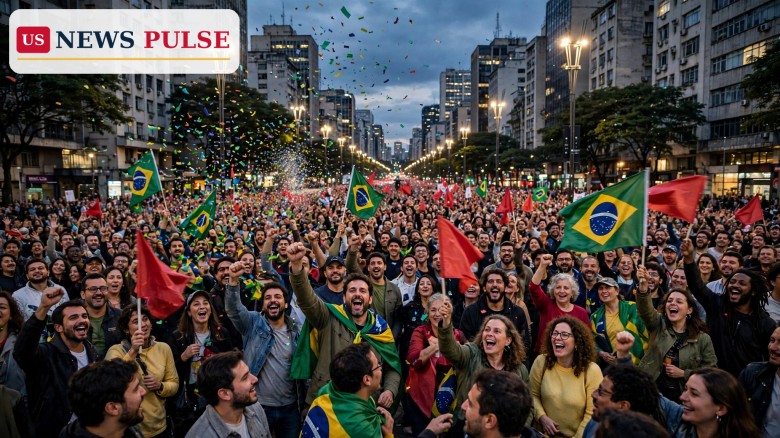
The result was called shortly after 9 p.m. Brasilia time, when the court declared Lula the winner with more than 80 percent of ballots counted. It was a remarkable reversal: Lula had trailed Bolsonaro in the first round on October 4, taking 45 percent to the senator's 47 percent, and no candidate in modern Brazilian history had ever lost a first round and then won the runoff. By Sunday night, crowds in Sao Paulo's Avenida Paulista were waving Brazilian flags and red Workers' Party flags under fireworks and confetti, celebrating a victory Lula himself described as a miracle.
Polls closed across Brazil on Sunday after a tense and chaotic voting day. Reports of suspended public transport in some areas, heavy rain in southern states considered Bolsonaro strongholds, and long queues prompted both campaigns to petition the Supreme Federal Court for more time. Justice Cristiano Zanin ordered polling stations to stay open two hours longer than planned, until 7 p.m. Brasilia time, and the electoral court called the race for Lula shortly afterwards.
More than 64 million ballots were cast for the incumbent, and more than 59 million for Bolsonaro, with the final gap exceeding four million votes. Lula, coughing and hoarse, took to a flag-draped podium in Sao Paulo shortly after the result was announced. "God watches over me!" he told the euphoric crowd, according to Le Monde. "Everything that has happened to me in life has been a miracle." He also thanked voters who had cast their ballots "to secure democracy in the country," and promised to govern for all Brazilians.
"Once we win the election, we no longer have opponents. I have to govern for 215 million people," Lula said in his victory speech. "I didn't choose Congress. The people did. And that is the Congress with which I will vote, work and get things done." Workers' Party president Edinho Silva called the result "a historic turning point for democracy" as supporters chanted "Lula, Lula!" in Sao Paulo and Rio de Janeiro.
Lula's comeback was built in three weeks of intense campaigning between the rounds. Geography tells much of the story. In Minas Gerais, the state with Brazil's second-largest electorate, he went from losing by nearly 590,000 votes in the first round to winning by about 99,000, a swing of roughly 690,000 votes in the margin. Minas Gerais has backed the winner of every direct presidential election since 1989, and it did so again.
Although Bolsonaro retained his lead in the states of Sao Paulo and Rio de Janeiro, Lula won both capitals, Brazil's two largest cities, and reversed the first-round result in the city of Rio. He also swept all nine northeastern states, his traditional stronghold, and benefited from higher turnout: abstention fell from 21.08 percent in the first round to approximately 19.2 percent in the runoff, bringing nearly three million more Brazilians to the polls.
The battle was also fought on voters' phones. After finishing second in the first round, Lula stepped up digital mobilisation to turn supporters who already preferred him into actual voters, rather than merely persuading the undecided. He paired that push with concrete, last-minute measures aimed at household budgets: a constitutional amendment passed this month that shortened the Brazilian workweek, proposals to renegotiate consumer debt, and a move to end online betting, whose expansion has contributed to household indebtedness. In September he banned online gambling and sports betting apps to address the same problem.
On security, Lula backed lowering the age of criminal responsibility for particularly serious offences, a traditional right-wing position intended to answer growing demands for a tougher approach to crime. Nearly half of Brazilians said the economy had worsened in the past year, according to a Quaest poll published in September 2026, and cost-of-living issues became the campaign's central battleground.
Lula's personal history made the comeback even more striking. A former metalworker who entered politics in the 1980s during the twilight of Brazil's military dictatorship, he has run for president seven times. He won two consecutive terms from 2002 through 2010, then a third term in 2022 in what was then the tightest race in modern Brazilian history, defeating Jair Bolsonaro, Flavio's father. Jair Bolsonaro has since been sentenced to 27 years in prison for his role in plotting a coup following that loss.
Bolsonaro's first reaction was defiance. "It is impossible to recognize the election results given the circumstances in which these events unfolded," he said in a short speech, accusing the Supreme Court of having "changed the rules of the game mid-game" and vowing to seek an annulment. He argued that some polling stations had not been able to reopen in time after the extension, harming votes he might have earned.
The argument faced an awkward complication: Bolsonaro's own campaign had also requested an extension in some areas, citing difficulties voters faced reaching polling stations because of heavy rain. On Monday, Bolsonaro said in a video posted on Instagram that police had asked for his passport and told him he was barred from leaving the country after he visited his father, who is under house arrest. He denied that he intended to leave Brazil, and CNN reported that it had contacted the Brazilian Federal Police for comment.
By Monday, the political ground had shifted. Bolsonaro's Liberal Party announced that it acknowledged the results, indicating that a formal appeal to the electoral tribunal would not be filed. "We recognize the presidential election results," party head Valdemar Costa Neto said, according to CNN Brasil. "But we believe the issues raised need to be properly clarified." As his father did four years ago, Flavio Bolsonaro had refused to recognise the result at first; unlike then, his party moved quickly to accept the outcome.
Abroad, reactions split along familiar lines. Mexican President Claudia Sheinbaum wrote: "Long live democracy, the people of Brazil have won. Congratulations, President Lula!" United States Senator Bernie Sanders called the re-election "extraordinary" and said Lula "has stood up for Brazilian workers and democracy, and will continue to do so in the next four years." Donald Trump Jr. suggested there had been judicial malpractice in the voting extension, while US Representative Ro Khanna wrote that "Trump must respect the results and not undermine Brazil's elections."
President Donald Trump was a major supporter of the Bolsonaro family, and his administration's backing became a central issue in the campaign. Trump had asserted without evidence that Lula's victory was "rigged," yet he also added that he likes Lula personally. "I like Lula. I get along with him very well," Trump said on Monday. "I just think it had a very bad look. The election, the way it was tabulated."
The Trump White House had openly supported the Bolsonaro family, issuing 50-percent tariffs last year on certain Brazilian products in a push to end the prosecution of Jair Bolsonaro, and US sanctions were imposed on judges involved in that case, most notably Supreme Court Justice Alexandre de Moraes. Lula has framed such moves as an attack on the sovereignty of Brazil's judicial system. At the United Nations in September, he declared: "Brazil does not belong in anyone's backyard," in a message directed at Washington.
Yet Lula has also shown caution in dealing with Washington. When the United States imposed a new round of tariffs on Brazilian goods in the middle of the year, he left open the possibility of retaliatory measures without rushing into a trade war. "Lula has shown an ability to adapt to Trump. He has balanced occasional harsh criticism with conciliatory gestures," said Michael Paarlberg, an associate professor of political science at Virginia Commonwealth University. "Lula is not ideologically anti-American, nor does he have difficulty working with right-wing governments."
Paarlberg added that Lula would closely follow the US midterm elections on November 3, especially if Republicans lose control of one or both chambers of Congress, potentially bringing greater scrutiny of Trump's agenda. A Bolsonaro victory, by contrast, would have marked a major win for Washington's efforts to secure its dominance in the hemisphere and curb Beijing's reach, with China as Brazil's top trading partner.
Lula's win interrupts two powerful trends at once. In recent years, right-wing leaders have swept presidential races across Latin America, including in Peru, Colombia, Argentina, Bolivia and Ecuador, many riding anti-incumbent energy and enjoying Trump's support. Lula's victory ends an 18-month losing streak for the Latin American left and raises a broader question: whether the rightward shift is a lasting wave or part of a political pendulum.
"Lula's victory shows that the far right, particularly Bolsonaro's movement, has a ceiling of support, because many voters consider it too radical," Paarlberg said. He added that the result also suggests that backing from the White House and its battery of economic measures "are not decisive factors" in an election. For the United States, the outcome preserves a Brazilian government willing to push back against Washington's trade and political demands, a degree of autonomy few of its neighbours can attempt.
For Brazil itself, the paradox of the next term is already clear: a historic electoral triumph paired with limited room to govern. Right-wing parties will hold 303 of the 513 seats in the Chamber of Deputies, compared with 124 for the left and 86 for the centre, and the right will control nearly two-thirds of Senate seats. Lula's own family politics add another layer: Flavio Bolsonaro's brother Eduardo is currently in exile in the United States and risks arrest if he returns to Brazil due to a conviction in absentia for coercion, while other Bolsonaro relatives secured seats as MPs or senators earlier in October.
The immediate calendar is dominated by transition and governing arithmetic. Lula will be sworn in on January 5, 2027, beating his own record as the oldest Brazilian president to take the oath since the return to democracy. Before then, he must build alliances beyond his own base to advance proposals and defend his government's priorities, negotiating with a conservative Congress and with state governors whose cooperation he needs to implement policy.
The most immediate challenge will be turning economic gains into relief Brazilians can feel daily. Debt, the deficit and high interest rates limit the government's ability to increase spending, and decisions about who pays and where cuts fall will test Lula's negotiating skill. Security will be another source of pressure, as will the question of succession: the left's ability to win presidential elections remains closely tied to Lula's own political stature, and he is barred by electoral law from seeking three consecutive terms.
Internationally, Lula must decide how to approach relations with the United States while protecting Brazil's autonomy, managing the tariff dispute, and positioning Brazil between Washington and Beijing. He also faces a changed regional landscape, without left-wing allies such as Alberto Fernandez in Argentina, Gabriel Boric in Chile and Gustavo Petro in Colombia in power. "Lula faces a very different political environment from the one that existed when he first took office, during the Pink Tide," Paarlberg said. "Back then, he had several regional allies and could play both sides to Brazil's advantage."
Related coverage on US News Pulse includes the Israel election 2026, where voters also went to the polls on October 27, the near-final US-India trade deal and its tariff stakes, and the ceasefire bringing hope to Oleshky in Ukraine.
Luiz Inacio Lula da Silva won the runoff on October 25, 2026, with 51.8 percent of valid votes, defeating Senator Flavio Bolsonaro, who took 48.2 percent, to secure a fourth non-consecutive term as president.
It is the first time since Brazil returned to direct elections in 1989 that a candidate who lost the first round went on to win the runoff, and it makes Lula the first Brazilian president to win a fourth term. He added more than 10 million votes between rounds.
Bolsonaro initially refused to concede and said he would seek annulment over a two-hour voting extension ordered by the Supreme Court. By Monday, his Liberal Party said it recognised the results, indicating no formal appeal to the electoral tribunal would be filed.
Lula will be sworn in on January 5, 2027. He turns 81 on October 27, 2026, and will be the oldest Brazilian president to take the oath since the country's return to democracy.
Lula has pushed back against US tariffs and political pressure while keeping room for negotiation with Washington. His win denies the Trump-backed right a major victory in Latin America, but he must still manage tariffs, trade with China, and a conservative Congress at home.
Leave a Comment



 | Today's Date: