Celestica delivered one of the strongest earnings reports of the season on Monday, with third-quarter revenue jumping 83% to $5.83 billion as demand for artificial intelligence data-centre hardware accelerated, and the Toronto-based electronics manufacturer then stunned investors by forecasting $40 billion in revenue for 2027, nearly double what it expects this year. The Celestica Q3 earnings beat sent the company's shares soaring about 17% in premarket trading on Tuesday, October 27, 2026, after a bruising session in which the stock had fallen 5% to near its 52-week low.
The report landed at a moment of acute anxiety about the AI trade. Shares of data-centre builders such as CoreWeave, Nebius and IREN have fallen more than 35% so far in October as investors question whether the vast sums being poured into AI infrastructure will ever earn their keep. Celestica's answer, delivered after the closing bell on Monday, was emphatic: not only did it beat its own guidance and Wall Street's forecasts, it raised its 2026 outlook and pointed to demand forecasts for 2028 that have also increased.
Celestica released its third-quarter results after the market closed on Monday, October 26, and the numbers beat on almost every line. Revenue of $5.83 billion came in above the top of the company's own guidance range of $5.25 billion to $5.55 billion, and above the $5.47 billion expected by analysts. Adjusted earnings of $3.30 per share beat the consensus by roughly 9% to 12%, depending on the data provider, and marked the company's eighth consecutive quarter of beating profit expectations.
On a standard accounting basis, Celestica earned $397.2 million, or $3.26 per share, up from $2.31 a year earlier. Its GAAP operating margin fell to 7.9% from 10.2%, but its adjusted operating margin rose to 8.5% from 7.6%, a level chair and chief executive Rob Mionis called a new high for the company. The company also completed a previously announced public offering that raised $3.45 billion in gross proceeds during the quarter.
The market's reaction was swift. Celestica shares, which had dropped 5% in regular trading on Monday to $246.65, just above the 52-week low of $244.51 and roughly half the 52-week high of $474.03 set on June 2, jumped nearly 17% after hours to about $288, and held most of that gain in premarket trading on Tuesday. The stock had been on track for its worst month in more than six years before the report, and it remains down about 12% since the start of the year, against an 11.4% gain for the S&P 500.
Management discussed the results with investors on a conference call at 8:00 a.m. Eastern Time on Tuesday, the same morning that the Federal Reserve began its two-day policy meeting and a day before Alphabet and Microsoft report their own quarterly results.
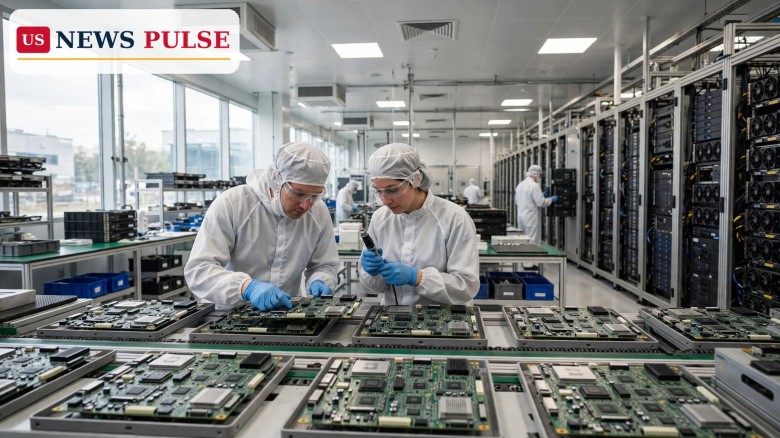
Celestica, headquartered in Toronto and listed in New York and Toronto, is one of the world's largest electronics manufacturing services companies. It builds networking equipment, servers, storage systems and other hardware for customers that include the hyperscale cloud operators and AI infrastructure companies now racing to build data centres. That position has turned it into an unusually direct proxy for the AI buildout: when cloud giants spend, Celestica's factories feel it first.
The acceleration in its growth has been remarkable. Year-on-year revenue growth has quickened for seven consecutive quarters, from 19.9% to 20.9%, 27.6%, 43.3%, 52.8% and 62.6%, before reaching 82.8% in the third quarter of 2026. The engine is the Connectivity & Cloud Solutions segment, which covers networking equipment, servers and storage. Its revenue rose 102% in the quarter to $4.87 billion, including a 70% jump in the Hardware Platform Solutions business to about $2.3 billion. The smaller Advanced Technology Solutions segment, which serves aerospace and defence, industrial, health technology and capital equipment customers, grew 23% to $960 million.
The report also arrived on a day when the AI trade showed signs of life. Technology shares rallied on Monday after Anthropic, the AI company behind the Claude models, filed its paperwork for a public listing, disclosing $16.29 billion of revenue for the six months to June. That filing lifted chip and infrastructure names across the market and set the stage for Celestica's own rebound, even as sceptics continued to warn that AI valuations have run ahead of profits.
The most market-moving part of the release was not the quarter itself but the outlook. For the fourth quarter, Celestica guided revenue of up to $6.675 billion, above the roughly $6.4 billion consensus, implying about $6.42 billion at the midpoint and roughly 76% year-on-year growth. For the full year 2026, it raised its revenue forecast to $21 billion from $20.5 billion and lifted its adjusted earnings forecast to $11.55 per share from $11.30.
For 2027, the company forecast revenue of $40 billion, against Wall Street's $35.71 billion estimate, with adjusted earnings of $21.50 per share and an adjusted operating margin of 9%. Capital spending is expected to reach $1.5 billion to $2 billion in 2027 as the company expands capacity. Mionis said customer demand forecasts for 2028 had also increased, signalling that the company expects the investment wave to continue beyond next year.
There was one notable downgrade inside the release. Celestica cut its non-GAAP free-cash-flow forecast for 2026 to $460 million from $600 million, citing targeted working-capital investments for anticipated growth. Inventories have more than doubled since the end of 2025, a reminder that building hardware at this pace consumes cash before customers pay. Management stressed that the spending is deliberate, tied to program ramps and orders already in hand, but investors will watch inventory and cash conversion closely in the coming quarters.
Mionis framed the quarter as evidence that the AI infrastructure cycle is strengthening rather than cooling. He described the adjusted operating margin of 8.5% as a new high for the company and pointed to rising customer demand forecasts for 2028 as a sign that the buildout has further to run. The company's own description of the demand environment, echoed by retail traders on Tuesday, was of an AI infrastructure "supercycle" driven by stronger customer demand.
Retail investors were quick to celebrate. On trading forums, Celestica was described as "very inexpensive" for a company growing this fast, with some noting that the GAAP earnings of $3.26 per share, annualised against Monday's closing price of $246.65, implied a price-to-earnings multiple below 19, cheap beside other AI infrastructure names. The rally, they argued, was a reminder that the market had been pricing Celestica for a slowdown that has not arrived.
Caution remains, however. The same reports that carried the earnings also noted the risks the company itself flags: customer demand, program ramps, supply availability and trade-policy changes could all knock the 2027 forecast off course. And the broader debate has not gone away. With CoreWeave, Nebius and IREN each down more than 35% in October, and with hyperscalers due to report their own capital spending plans this week, Celestica's outlook will be tested against what Alphabet, Microsoft and Amazon actually say they plan to spend.
Celestica matters because it sits at the physical end of the AI boom. The models and chatbots dominate headlines, but they run on servers, switches and storage built by companies like Celestica, and its order book is one of the earliest real-world readings of whether the data-centre spending spree is accelerating or stalling. A quarter in which its cloud hardware revenue doubles, and a forecast in which next year's revenue nearly doubles again, is hard to square with the argument that the AI buildout has already peaked.
It also matters for the bubble debate that has gripped markets all autumn. If the companies building AI infrastructure can convert orders into revenue and margin at this pace, the spending looks more like an industrial expansion than a speculative mania. If inventories pile up and cash flow disappoints, the opposite case gains force. Celestica's report gave both sides something to work with: spectacular growth on the one hand, a free-cash-flow cut and a doubled inventory pile on the other.
For investors watching the week ahead, the timing is ideal. The Federal Reserve announces its rate decision on Wednesday, Alphabet and Microsoft report the same day, and Amazon follows on Thursday. Celestica's numbers raise the bar for all of them: if the hardware builders are seeing this kind of demand, the hyperscalers' capital spending plans will be read even more closely for signs of follow-through.
The immediate test is the fourth quarter. Celestica's guidance implies revenue of about $6.42 billion at the midpoint, and a beat of the kind it delivered in the third quarter would put the company on course for an even stronger finish to the year. Investors will also watch whether the stock can hold its post-earnings gains after a month in which it fell to near its 52-week low.
Beyond that, attention turns to execution on the 2027 plan. Delivering $40 billion in revenue means almost doubling the business again, expanding factories, managing a doubled inventory base and converting orders into cash. The $1.5 billion to $2 billion of planned capital spending will show whether the company can add capacity fast enough without sacrificing the margin gains it has just reported.
The hyperscaler earnings this week will provide the first external check. If Alphabet, Microsoft and Amazon reaffirm or raise their data-centre spending plans, Celestica's supercycle thesis gains support. If they sound a note of caution, the stock's sharp rebound could quickly be re-examined.
Revenue rose 83% year on year to $5.83 billion, from $3.19 billion in the third quarter of 2025, beating analyst expectations of about $5.47 billion and the company's own guidance of $5.25 billion to $5.55 billion.
Adjusted earnings per share more than doubled to $3.30, from $1.58 a year earlier, beating the consensus estimate of about $2.96 to $3.02. GAAP earnings were $3.26 per share, up from $2.31.
Celestica forecast 2027 revenue of $40 billion, above Wall Street's $35.71 billion estimate, with adjusted earnings of $21.50 per share and an adjusted operating margin of 9%.
The shares had fallen 5% on Monday to $246.65, near their 52-week low, before the results. The revenue and earnings beats, the raised 2026 outlook and the $40 billion 2027 forecast drove a jump of about 17% in after-hours and premarket trading on Tuesday.
Yes. It cut its 2026 non-GAAP free-cash-flow outlook to $460 million from $600 million, citing working-capital investments to support growth, and said inventories have more than doubled since the end of 2025.
Related coverage on US News Pulse: Nvidia's $3 billion Meta investment deepens the Muse AI partnership, UPS's Q3 earnings beat and raised outlook, and the Big Tech earnings test facing Alphabet, Amazon and Apple.
Leave a Comment



 | Today's Date: