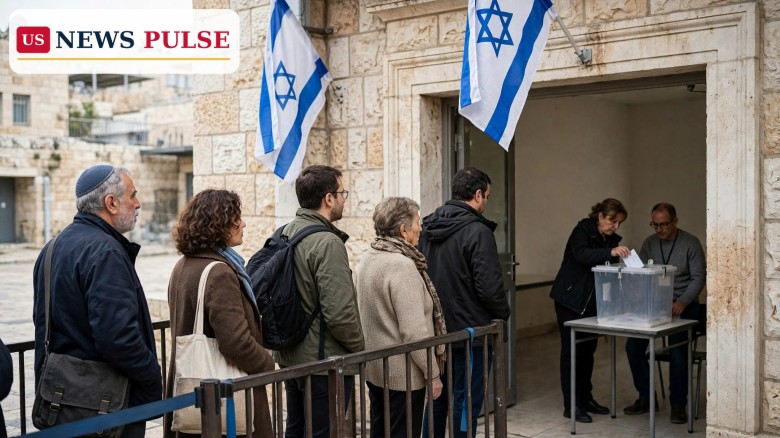
Israelis voted on Tuesday, October 27, 2026, in the country's first national election since the October 7, 2023 attacks, and voters turned out in numbers not seen for decades. By 2 p.m. local time, turnout had reached 44.9 percent, the highest figure at that hour since hourly turnout records began in 1973, according to live election coverage. As the count climbed, Prime Minister Benjamin Netanyahu issued an extraordinary appeal to his own supporters, warning that rivals were trying to steal the election from him.
The Israel Election 2026 is widely seen as a referendum on Netanyahu's leadership after three years of war. Final polls published before voting began left both blocs short of the 61 seats needed in the 120-seat Knesset, setting up weeks of coalition bargaining no matter who finishes first.
Voting began in the early hours of Tuesday, with most polling stations opening at 7 a.m. local time and due to close at 10 p.m. Netanyahu cast his ballot in Jerusalem alongside his wife Sara. By mid-morning, turnout was already running ahead of recent elections, and by early afternoon it had reached a level unmatched in more than half a century of hourly records.
As the afternoon wore on, Netanyahu released a video message aimed directly at Likud voters. He claimed that Arab voters in the southern region were racing to the polls and warned that his opponents were trying to steal the election. He referred to allegations that three people had been arrested carrying money-filled envelopes on suspicion of bribing voters, telling supporters: "It's serious. It's criminal. They will reach every single person. You have been warned."
Earlier in the day, Netanyahu had already warned right-wing voters of an "emergency" and urged Likud supporters to turn out, pointing to strong participation among left-wing voters.
The election is the first since the Hamas-led attacks of October 7, 2023, and the war in Gaza that followed. About half a million people are voting for the first time, and the campaign has been fought against the backdrop of that war, a ground invasion of Lebanon, strikes on Syria, and two rounds of open conflict with Iran.
Netanyahu, 77, has spent 19 years as prime minister in total since he was first chosen in 1996. Israel has no term limits for the office, so he can keep serving four-year terms for as long as a Knesset majority backs him. The stakes for him are personal as well as political: he faces corruption charges in three cases, and he is also the subject of an International Criminal Court arrest warrant.
Since the last election in 2022, Netanyahu has led Israel through the war in Gaza and the hostage crisis, a ground invasion of Lebanon, strikes on Syria, and the current conflict with Tehran alongside the United States.
His main challenger is Gadi Eisenkot, the former military chief who leads the Yashar party. Eisenkot quit Netanyahu's war cabinet in June 2024, saying politics had infiltrated its decisions, and he has campaigned on a state inquiry into the October 7 failures and on drafting ultra-Orthodox men into military service. A poll of 4,000 voters this month gave Likud only 19 seats, down from 32 now, while Yashar could win the most seats with 20.
Israel's proportional system makes outright victory almost impossible: no single party has ever won a majority on its own, and governments are always coalitions. Parties must clear a 3.25 percent threshold to enter the Knesset, and roughly a dozen are considered capable of doing so.
The final polls published in the 72 hours before the vote converged on the same picture. A Haaretz average of Channels 11, 12 and 13 put Netanyahu's coalition at 50 seats and Eisenkot's opposition bloc at 54. Channel 12 gave the opposition bloc 56 seats to Netanyahu's 50, with Yashar on 23 and Likud on 21, while Channel 13 and Kan 11 put the blocs at 54-50 and 52-50. A separate Madad poll projected Arab-led parties at about 15 seats, a bloc both main camps have historically struggled to bring into government.
That arithmetic is why Tuesday's turnout matters so much. With neither bloc near 61, the parties hovering near the threshold, the first-time voters, and the 1.2 million Palestinian citizens of Israel could all tip the balance between a narrow Netanyahu survival, an Eisenkot-led alternative, or prolonged deadlock.
Netanyahu's election-day message was the day's sharpest intervention. "They are trying to steal the election from us," he told Likud voters, adding of the alleged envelope arrests: "It's serious. It's criminal. They will reach every single person. You have been warned."
On the campaign trail, Netanyahu tied his political survival directly to Iran. He suggested that United States President Donald Trump was ready to finally remove the Iranian threat, but only if Netanyahu stays in power, and he campaigned on "absolute victory" over Hamas, with rebuilding in Gaza only after Hamas fully disarms. He has also made opposition to a Palestinian state a first principle of any government he forms.
Eisenkot offers a different route to similar ends. He backs a United States-backed "kill zone" around Iran's uranium programme and more covert operations rather than a deal that only delays the threat, and he would accept the Palestinian Authority in Gaza if Hamas is kept out. He opposes a Palestinian state during a first term, and he has promised a state inquiry into October 7, saying Netanyahu was warned and did not act.
The American dimension runs through the whole contest. Trump has publicly backed Netanyahu and, according to live coverage, has written to President Isaac Herzog seeking a pardon for the prime minister. The White House, however, has said the United States will not attack Iran before the midterm elections in November.
For the United States, the result will shape the most consequential foreign-policy relationship in the Middle East at a delicate moment. Washington is managing a Gaza ceasefire agreed in October 2025, a confrontation with Iran that has already produced two rounds of direct conflict, and a midterm election of its own on November 3.
For Israelis, the vote is about accountability as much as direction. The October 7 attacks, the war that followed, the hostage crisis, and the corruption trial have all fused into a single question: whether the country's longest-serving prime minister should lead its next chapter. The record turnout suggests voters understand that weight, even if the polls suggest they have not yet agreed on the answer.
And for the region, deadlock is itself an outcome. If neither bloc reaches 61, weeks of coalition talks follow, during which Netanyahu's cabinet would remain in caretaker office, unable to make hard decisions on Gaza's future, on Iran, or on the ultra-Orthodox draft dispute that helped bring down previous coalitions.
Polls close at 10 p.m. local time, and broadcasters are expected to publish exit-poll estimates within hours. The Central Elections Committee will then publish live results as counting proceeds, with a final tally expected by Friday, October 30, and formal results scheduled for November 4.
After the results, President Isaac Herzog will consult party leaders and ask the Knesset member he considers most likely to succeed to try to form a government, with as many as 42 days to assemble a coalition. If that fails, the current cabinet stays on as caretaker and Israel heads toward another election.
Watch three things after the polls close. First, the exit polls: whether Yashar really finishes as the largest party, and whether Likud's collapse to around 19 seats is confirmed. Second, the threshold casualties: which small parties survive, since every seat they lose is redistributed to the larger blocs. Third, the Arab-led parties' total, because a combined figure near 15 seats would make them impossible to ignore even for leaders who have ruled out formal partnerships with them.
Most polling stations close at 10 p.m. local time on Tuesday, October 27, 2026. Broadcasters are expected to release exit polls within hours of the close.
The opposition bloc led by Gadi Eisenkot leads narrowly, at roughly 52 to 56 seats against about 50 for Benjamin Netanyahu's coalition. Neither reaches the 61-seat majority.
President Isaac Herzog tasks the candidate most likely to succeed with forming a government, with up to 42 days to build a coalition. If that fails, the current cabinet stays on as caretaker and Israel heads toward another election.
Turnout hit 44.9% by 2 p.m. local time, the highest at that hour since hourly records began in 1973. The vote is the first since the October 7, 2023 attacks, about half a million people are voting for the first time, and both camps spent election day urging supporters to turn out.
Netanyahu has tied his re-election to a decisive move against Iran with American backing, while the White House says the US will not attack Iran before the November midterms. The winner will shape Gaza's future, the Iran confrontation, and Washington's closest Middle East partnership.
Related coverage on US News Pulse: our pre-vote guide to the Israel election, the treason-probe demand against Netanyahu, and the reported United States strike plans for Iran.
Leave a Comment



 | Today's Date: