Arizona Governor Katie Hobbs has declined to declare a state emergency for Heber-Overgaard, the Navajo County mountain community struck by the Heber-Overgaard tornado on Wednesday, October 21, 2026. The decision, confirmed on Monday, October 26, closes — for now — the most direct route to state disaster money for a town still clearing snapped pines, torn roofs and downed power lines, even as state emergency staff remain on the ground and the county says it will not appeal and does not plan to seek a federal declaration.
The Heber-Overgaard tornado was rated EF1 by the National Weather Service in Flagstaff, with peak winds of 110 miles per hour, a path 9.26 miles long and up to 350 yards wide. It touched down south of the community at 6:59 p.m. local time, crossed Highway 260 through town and lifted near Highway 277 eleven minutes later. One person was injured, none were killed, and the heaviest damage fell on the southern side of Highway 260 and in central Overgaard. For many residents, however, the argument is not about the rating. It is about who pays for repairs to homes that, in the words of the area's state representative, many owners cannot afford to fix alone.
The tornado developed south of Heber-Overgaard on the evening of Wednesday, October 21, during severe storms that swept northern Arizona. The National Weather Service's damage survey, issued on Saturday, October 24, places the touchdown five miles south-southwest of Heber-Overgaard at 6:59 p.m. Mountain Standard Time and the end point four miles northeast of the community at 7:10 p.m. The storm travelled north across Highway 260 — the main road through town — before dissipating near Highway 277.
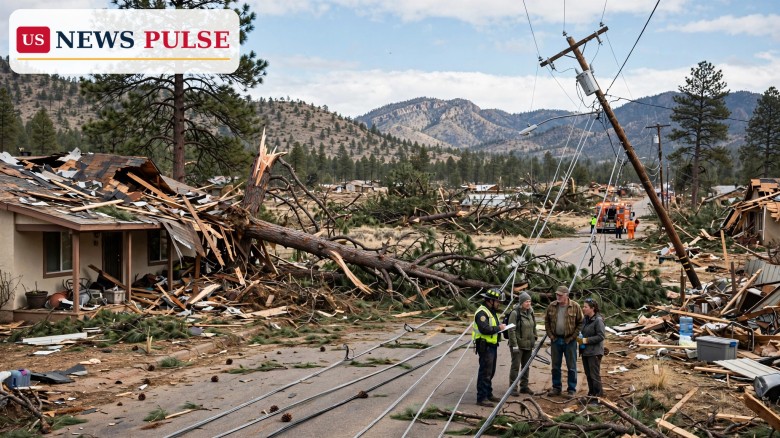
Surveyors found the most significant damage on the southern side of Highway 260 and in central Overgaard, where tree and roof damage was more extensive. Multiple homes and other structures were damaged, trees were snapped and uprooted, power lines came down and a trailer was flipped, according to local reporting of the survey. State Representative Walt Blackman, a Republican who represents the area in District 7, described a scene in which trees fell on buildings and trampolines ended up miles away from the yards they came from.
The human cost, mercifully, was limited. One person suffered a non-life-threatening injury — a man riding a bicycle who was caught in the storm and taken to hospital. Fire officials received more than a dozen 911 calls in the first half-hour, reporting downed power lines, damaged propane tanks and possible people trapped. Heber-Overgaard Fire District Chief Jason Payne said fallen trees struck propane tanks and crews had to make those hazards safe, while most power in Overgaard was knocked out. Navajo County Sheriff David Clouse said residents near the storm's path took shelter in closets and bathrooms as the tornado passed.
It was not the only tornado in Arizona that day. Hours earlier, at 7:32 a.m., a second EF1 tornado touched down near Spruce Mountain south of Prescott in Yavapai County, with peak winds of 105 mph, a path of 8.02 miles and a width of up to 300 yards. It uprooted and snapped ponderosa pines across the Bradshaw Mountains and caused no injuries. Together, the two storms made October 21 one of the more active tornado days in recent Arizona memory, in a state where tornadoes are far less common than in the Plains.
The Enhanced Fujita Scale rates tornadoes by the damage they cause, not by direct wind measurements, which are rarely available. An EF1 rating covers estimated winds of 86 to 110 mph — strong enough to peel roofs, push over mobile homes, snap trees and turn loose objects into projectiles, but below the 111 to 135 mph range of an EF2. The Heber-Overgaard storm, at exactly 110 mph, sits at the very top of the EF1 band. Radar on the night had shown rotation consistent with EF2 strength, but the ground survey — the number that counts — came in just under that threshold.
The survey process itself took three days. National Weather Service teams walked the path with local and state emergency officials and residents, matching broken trees, lifted roofing and shifted structures to wind-speed estimates. The final statement thanked residents of the Heber-Overgaard community for the information they provided, a reminder that in a small, spread-out mountain town, the damage record depends heavily on the people who lived through it.
Heber-Overgaard sits in the White Mountains of Navajo County, a community of scattered homes among ponderosa pine forest, roughly midway between Show Low and Payson along Highway 260. Its remoteness shapes the recovery: contractors are few, distances are long and, as local reporting has noted, the town's small size means damage that looks modest in statewide dollar terms can still overwhelm individual households. That gap — between a $20,000 county-wide estimate and a single family's uninsured roof — is at the heart of the dispute over the governor's decision.
Blackman formally requested a state emergency declaration on Wednesday, October 21, as the damage was still being counted. The Navajo County Board of Supervisors also declared a local emergency, a step intended to help the county qualify for any state funds that might become available. On Monday, October 26, the governor's office declined the request.
The state's reasoning rests on two pillars. First, the scale of public damage: county chairman Daryl Seymour put the county's damage estimate at about $20,000 so far and said roads and public infrastructure remained intact. Second, the law: as the governor's office explained, disaster relief assistance provided through a state emergency declaration supports recovery through ongoing response efforts and the repair of public infrastructure — not direct payments to homeowners for private property. "Our roads are fine. Our infrastructure is fine. Our schools are fine. Our public buildings are fine," Seymour said.
That legal distinction matters, and it is widely misunderstood. A state declaration would not, by itself, write cheques to homeowners. Roni Fraser, an Arizona State University assistant professor of emergency management, explained that such a declaration would create an opportunity for public assistance, such as support for roads. Individual assistance for residents would require a separate federal disaster declaration through the Federal Emergency Management Agency — a step the county says it does not plan to take, precisely because its public facilities are intact.
The denial, the governor's office stressed, does not mean state agencies have stopped responding. The Department of Emergency and Military Affairs activated the State Emergency Operations Center at Level 1 and embedded staff directly with emergency managers in Navajo and Greenlee counties. State agencies have also coordinated with the Department of Public Safety and the Department of Forestry and Fire Management on resident wellness checks and damage assessment surveys in the affected communities.
Blackman has not hidden his frustration. He argued the declaration should have happened within the first day after the storm, and said he expects more from the governor's office than has been delivered so far. "This isn't just a 'I need a state of emergency,' this is a real live issue and I expect the governor's office to do more than what was done," he said. "We're Arizonans too. I expect leadership to step up at that level just like I exhibited leadership at my level." He said he will request an in-person meeting with Hobbs, and the governor's office says it is working closely with Navajo County leaders.
For its part, the governor's office struck a grateful, operational tone. "Governor Hobbs is deeply grateful to the first responders who deployed swiftly to support the Heber-Overgaard community," it said. "At the Governor's direction, state agencies are on the ground and working directly with local officials to keep residents safe and support a rapid recovery." The statement pointed to the Level 1 operations centre, the embedded emergency managers and the continuing wellness checks and damage surveys as evidence that help has not stopped.
The dispute has also played out on social media, where a widely shared post claimed the governor had cut the community off and that the area would receive no more assistance. Local fact-checking found the core claim — that no state declaration had been issued — to be true, but the suggestion that assistance had ended to be false: state crews and assessments were continuing, and the post's own account of state help on the ground was accurate. In a small town where rumour travels fast, that distinction has mattered to residents trying to work out what help, if any, is still coming.
The Heber-Overgaard case is a test of what disaster declarations are actually for — and of who falls through the gaps when they are not issued. When public infrastructure survives but private homes do not, the standard disaster playbook offers little: state money follows roads and public buildings, federal individual assistance requires a federal declaration that the county itself does not want to seek, and uninsured or underinsured homeowners are left to charities, volunteers and their own savings. For a remote community with few contractors and a thin local tax base, that gap can last long after the debris is cleared.
It also matters politically. With the 2026 midterm elections just a week away, every decision by a governor in a closely watched state is read through a partisan lens — even a technical one about damage thresholds. Blackman, a Republican, is publicly pressing a Democratic governor; Hobbs's office is publicly defending a response it says is already under way. The facts of the damage do not change with the politics, but the argument over them will shape how the next Arizona community hit by a storm judges whether the state will be there.
Finally, the case is a reminder that Arizona's tornado risk, while lower than the Plains, is real. Two EF1 tornadoes in one day, a third rare tornado days later in Santa Fe, New Mexico, and a week of severe weather across the Southwest have kept forecasters and emergency managers busy. Communities that rarely plan for tornadoes are discovering, storm by storm, what their plans are missing.
Blackman will seek an in-person meeting with Hobbs to press the case again, though the county has said it will not appeal the formal decision. State emergency managers will continue damage assessments with Navajo County officials, and those assessments could still change the picture if further damage is documented. In the meantime, cleanup continues in Heber-Overgaard, volunteers and local crews are clearing trees and making homes safe, and residents are being urged to report damage through the county so the official record reflects the full cost. If the county's damage total rises materially, or if a new storm strikes, the declaration question could return — but for now, the answer from Phoenix is no.
No. Governor Katie Hobbs declined the request on Monday, October 26, 2026. Navajo County had declared a local emergency, but the state declined to follow with a state declaration.
It was rated EF1, with peak winds of 110 mph, a path 9.26 miles long and up to 350 yards wide. It was on the ground for 11 minutes, from 6:59 p.m. to 7:10 p.m. on October 21, 2026.
One person was injured — a man riding a bicycle who was caught in the storm. His injuries were described as non-life-threatening, and no deaths were reported.
No. Under Arizona law, state emergency declaration assistance supports response efforts and the repair of public infrastructure, not direct payments for private property. Individual assistance for residents would require a federal disaster declaration through FEMA.
Yes, according to the governor's office. The State Emergency Operations Center is activated at Level 1, state staff are embedded with county emergency managers, and agencies are conducting wellness checks and damage assessments with local officials.
Related coverage on US News Pulse: the rare EF1 tornado that hit Santa Fe, New Mexico, for the first time in more than 50 years, and the Queen Creek water-bill shock as Arizona's era of cheap water ends. For the latest on Arizona weather and recovery efforts, follow our weather coverage.
Leave a Comment



 | Today's Date: