A rare Santa Fe tornado tore through neighbourhoods in New Mexico's capital city on Saturday evening, October 24, 2026, damaging at least 10 homes, snapping power poles and uprooting trees in the first tornado recorded in the city in more than 50 years. The National Weather Service rated the storm a high-end EF-1, with peak winds of 110 miles per hour, just one mile per hour below the threshold for an EF-2. Remarkably, given the damage along its path, officials reported no injuries.
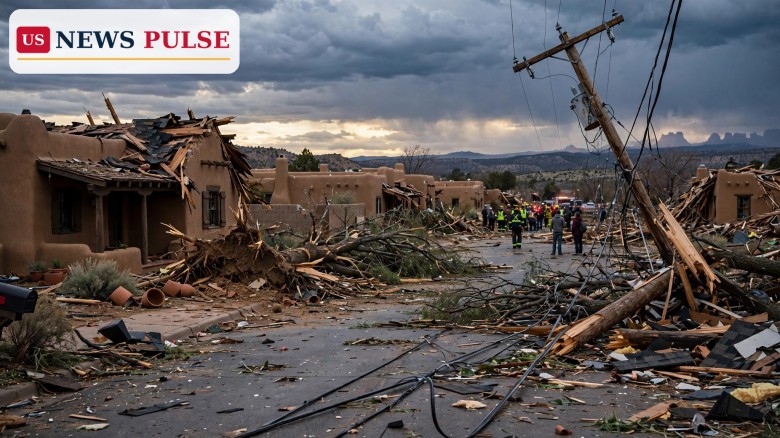
The tornado touched down at about 7 p.m. in the Via Caballero neighbourhood, just north of Interstate 25 on the south side of Santa Fe, and travelled north for about 1.4 miles before lifting near the former College of Santa Fe at about 7:08 p.m. It was on the ground for roughly eight minutes and reached a maximum width of about 100 yards. Drone video shared by the Santa Fe Police Department showed roofs torn from houses, broken utility poles and debris scattered across residential streets, a scene few residents of the high-desert city ever expected to see.
Santa Fe sits at about 7,000 feet above sea level in the foothills of the Sangre de Cristo Mountains, a setting where tornadoes are exceptionally rare. The city's spokesman told the Albuquerque Journal that nobody can recall ever having a tornado in Santa Fe itself, and county records cited in local reporting show 27 tornadoes in Santa Fe County since 1950, almost all of them weak EF-0 storms in open country, with nothing stronger than an F1 before Saturday. That history is what makes this storm, modest by the standards of Tornado Alley, a genuinely historic weather event for New Mexico's capital.
The tornado formed on Saturday evening as severe storms moved across New Mexico, bringing damaging winds, large hail and isolated thunderstorms to parts of the state. Forecasters had placed the region under a Level 1 out of 5 severe storm threat, the lowest tier on the Storm Prediction Center's scale, and the afternoon forecast had placed the greater tornado risk in the south and south-east of the state rather than in the capital. The storm that hit Santa Fe developed quickly, in the dark, in a city where residents had no living memory of a tornado to measure it against.
According to the National Weather Service damage survey, the tornado's path began in the Via Caballero neighbourhood, south of central Santa Fe and just north of Interstate 25. It moved north, and the worst damage was concentrated along Rancho Siringo Road and Camino Chueco, where broken power poles, fallen trees and damaged houses marked the track. One home lost most of its roof and suffered a collapsed wall, and two roofs were reported collapsed in the neighbourhood. Fox Weather, citing the survey, put the path at about 1.5 miles, while the National Weather Service's own track measured about 1.4 miles; the difference reflects the preliminary nature of the survey, which can be refined as more damage points are mapped.
Elsewhere in the city, severe thunderstorms caused damage beyond the tornado's narrow track. In the Los Cedros and Camino Carlos Rey neighbourhoods, large trees fell onto homes and power lines, and police officers visited affected households on Saturday night as strong winds and heavy rain left debris across properties. The distinction matters for residents sorting out insurance claims: some damage came from the tornado itself, and some from the straight-line winds and storms around it.
The timing added to the danger. Reports on the storm note that the tornado warning went out at 7:01 p.m., about a minute after the tornado was already on the ground, and after dark, when tornadoes are difficult to see. The warning's own final line read, in effect: tornadoes are difficult to observe at night, take cover now. For residents in the path, there was little time between the alert and the impact, and the fact that nobody was hurt owes much to people getting into interior rooms and bathrooms, the safest places in a home without a basement or storm shelter.
To understand why a relatively weak tornado made headlines, it helps to know how tornadoes are rated and where they usually happen. The Enhanced Fujita scale rates tornadoes by the damage they cause, which is used to estimate wind speed. An EF-0 covers winds of 65 to 85 mph, an EF-1 covers 86 to 110 mph, and an EF-2 begins at 111 mph. Saturday's Santa Fe tornado, at 110 mph, sits at the very top of the EF-1 range. It was strong enough to tear roofs from houses and snap power poles, but it was not in the league of the EF-3, EF-4 and EF-5 monsters that level whole neighbourhoods in the central United States.
Geography also explains the surprise. Tornadoes need warm, moist air near the ground, cold air above, and wind shear, a change in wind speed or direction with height that lets a rotating column form. Those ingredients come together most often in the Great Plains, in Tornado Alley, where Gulf of Mexico moisture meets dry air from the Rockies and cold air from Canada. Santa Fe, high, dry and ringed by mountains, rarely assembles all three at once, and the mountains tend to disrupt the low-level rotation tornadoes need. When tornadoes do occur in New Mexico, they are usually landspouts or weak tornadoes in the open plains of the eastern part of the state, far from the capital.
The same weekend storm system caused far worse damage elsewhere in New Mexico, which puts the Santa Fe tornado in a wider context. A second tornado struck Alto, in Lincoln County, about two hours earlier on Saturday. In the north-west of the state, the San Juan River rose above a record set in 1909 at Farmington, flooding parts of San Juan County, forcing evacuations and leaving an evacuation centre at McGee Park open for displaced residents. Governor Michelle Lujan Grisham visited San Juan County on Monday to assess the flood damage and had requested a federal emergency declaration worth at least 13.8 million dollars in relief funding. The weekend, in other words, was a statewide severe weather event, and Santa Fe's tornado was its most unexpected chapter.
The Santa Fe tornado was unusual in three ways at once: where it happened, when it happened, and how strong it was for that place. A tornado in a city that had not recorded one in more than half a century is, by definition, a once-in-a-generation event for its residents. A tornado after dark, when it cannot be seen coming, is more dangerous than the same storm in daylight, because people rely entirely on warnings and on the sound of the wind. And a high-end EF-1, one mile per hour short of EF-2, is about as strong as a Santa Fe County tornado has ever been, on the available record.
There is also a seasonal twist. Late October is not peak tornado season in the United States, which runs roughly from March to June, but autumn tornadoes are a recognised second season, especially when strong cold fronts sweep across the country and clash with lingering warm air. The weekend system did exactly that, and it arrived with a broader pattern of severe weather across the Southwest, including flooding in the Four Corners region that had already put rivers and desert washes under strain. Readers following the region's weather can find our earlier coverage of the Hawaii flood watch and the record coastal flooding elsewhere in the country in our weather section, including Hawaii flood watch: Olana remnants bring 5-8 inches of rain to islands and King tides flood US coasts with record high tides in Florida and California.
Forecasters also note that a single tornado in an unusual place does not, on its own, prove a trend. Tornado records depend on who was there to see and report them, and older records in mountainous, sparsely populated areas are patchy. What can be said with confidence is that Saturday's storm was verified by a formal National Weather Service damage survey, with a measured track, a measured width and a rating based on observed damage, not on a single eyewitness account. That survey is what turns a scary Saturday night into a confirmed, historic event in the official record.
Santa Fe Mayor Michael Garcia described a city shaken by the scale of the damage. In a press release quoted by Fox Weather, he said: "Saturday night and Sunday morning, parts of our city looked like a disaster zone. The tornado that moved through our community left a path of destruction." He added: "We know that some families have significant damage to their homes, and our work is not finished. We will continue to support those affected and address the remaining cleanup and recovery needs." The mayor was also reported to have been out in the streets hauling branches himself as the cleanup began.
Residents described the storm in vivid, personal terms. Phil Lucero showed local television station KOAT a tree that had fallen onto his home, damaging its heating and cooling equipment and possibly its solar panels. He said: "Our AC unit and our heat combo unit was knocked off the house. Our solar panels are potentially crushed, but I can't tell. And, we lost our tree. That's always a bummer." His 13-year-old son Xavi was home alone when the tornado arrived and sheltered in a bathroom with the family dog, because it had few windows. Xavi said: "The winds were really strong and my wall just started shaking. Then eventually, it just went silent." He added: "I was really, really scared."
Another resident, surveying a neighbour's roof in their front yard, summed up the wind's force in a single line quoted in local reports: "That house, that's their roof that's in our front yard." The Santa Fe Police Department's drone video, shared on social media, showed the same picture from above: roofs peeled back, trees flattened and streets littered with debris, with emergency workers moving between damaged homes checking for injuries.
The City of Santa Fe moved quickly to organise help. Officials encouraged residents affected by the tornado to contact the city's Constituent Services Team for assistance with debris removal and other storm-related needs, and said residents needing help with transportation, power outages, gas outages or other community services could call 211. The city also sought volunteers to assist with recovery efforts. A shelter opened after the storm closed within a day, as most residents found somewhere else to stay, but the debris cleanup and the repair work will take far longer.
The Santa Fe tornado matters first because of what it did to the people in its path. Ten homes damaged, families displaced, roofs and power lines destroyed: for those households, this was not a curiosity but a serious blow, coming as the heating season begins in the high desert, where cold nights make a damaged roof or a knocked-out heating unit an urgent problem rather than an inconvenience. The city's offer of debris help and the 211 line exist precisely for that reason.
It matters second because it is a warning about complacency in places that consider themselves safe from a particular disaster. Santa Fe residents had no reason, from their own experience, to expect a tornado, and the warning arrived a minute after touchdown. The lesson, which emergency managers repeat after every unusual event, is that warnings and a safe room matter everywhere, not only in the places where tornadoes are common. A bathroom with no windows, an interior closet, or a hallway away from exterior walls can be the difference between a frightening story and a tragedy, as Xavi Lucero's experience showed.
It matters third because it tests how a city recovers from a rare event. Santa Fe's emergency services, insurers and building inspectors do not handle tornado damage every year, and the survey, the debris removal and the repair permits will all move at the pace of a city learning on the job. How quickly power is restored, how fairly insurance claims are handled, and how many of the 10 damaged homes are repaired before winter will be the real measure of the recovery, long after the drone video stops circulating.
Cleanup operations are already under way, and officials have asked residents to avoid the affected neighbourhoods while debris is being removed, so that crews and heavy equipment can work safely. Homeowners are documenting damage for insurance claims, and the city is coordinating debris removal and volunteer help through its Constituent Services Team. The National Weather Service survey remains preliminary, meaning the track, width and rating could be adjusted slightly as surveyors complete their mapping.
The weather, meanwhile, is not standing still. Forecast reports cited in coverage of the storm said rain and high-terrain snow were back in the forecast for the Santa Fe area by Thursday, which will complicate outdoor cleanup and make damaged, tarped roofs more vulnerable. Residents with roof damage have been urged to get temporary coverings in place before the next round of wet weather, and to watch for further weather statements from the National Weather Service office in Albuquerque.
Further ahead, the storm will enter the official record as Santa Fe's first tornado in more than 50 years, a benchmark against which future storms in the city will be measured. Researchers studying tornadoes in mountainous terrain will have a rare, well-documented case to examine, including how the tornado formed so close to the mountains and why it reached high-end EF-1 strength. For the rest of New Mexico, the weekend's floods and second tornado will keep the focus on recovery in San Juan County and Lincoln County, where the damage was wider even if it was less surprising.
The tornado touched down at about 7 p.m. on Saturday, October 24, 2026, in the Via Caballero neighbourhood of Santa Fe, New Mexico, and lifted near the former College of Santa Fe at about 7:08 p.m.
The National Weather Service rated it a high-end EF-1, with peak winds of 110 mph. On the Enhanced Fujita scale, EF-1 covers 86 to 110 mph, so it was one mph below the EF-2 threshold of 111 mph.
At least 10 homes were damaged, one losing most of its roof and suffering a collapsed wall. Power poles were snapped, trees were uprooted and fences were torn down. No injuries were reported.
It was the first tornado recorded in the city of Santa Fe in more than 50 years. Santa Fe's high elevation and mountain setting make tornadoes exceptionally uncommon, and county records since 1950 show mostly weak EF-0 storms in open country.
Residents affected by the tornado can contact the city's Constituent Services Team for debris removal help, and call 211 for help with transportation, power or gas outages. Avoid the damaged neighbourhoods while cleanup crews work, document damage for insurance, and keep an eye on National Weather Service forecasts, with rain and high-terrain snow expected later in the week.
Leave a Comment



 | Today's Date: