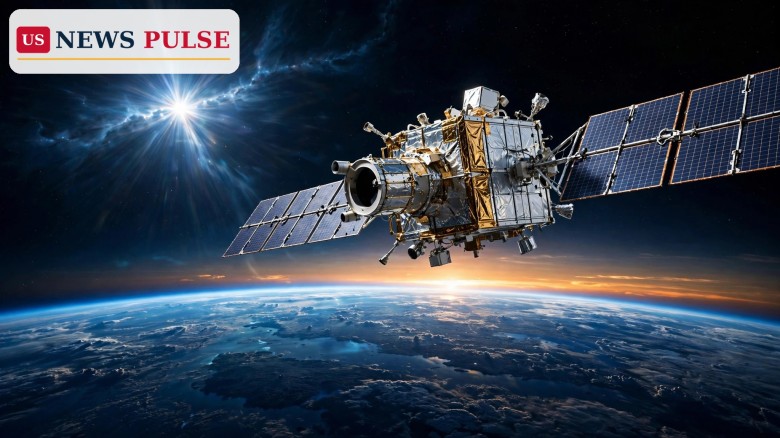
NASA has switched off one of the most productive telescopes it ever launched, closing the book on the NASA Swift Observatory after nearly 22 years of chasing the most violent explosions in the universe. The spacecraft made its final observation on 20 October 2026, and ground controllers have now sent the command that effectively ended Swift operations, leaving the ageing observatory to fall back towards Earth in the coming weeks.
Swift was built for a two-year mission. It lasted more than ten times as long, recorded more than 2,000 gamma-ray bursts, watched over 1,400 supernovae explode, and fed roughly 7,000 scientific papers. Its end was not a failure of its instruments, which were still working, but a simple matter of physics: its orbit had decayed so far that the thin upper atmosphere would no longer let it hold steady on a target.
On 20 October 2026, Swift sank to about 171 miles (275 kilometres) above Earth, so low that the drag of the upper atmosphere overwhelmed its ability to point its telescopes. The spacecraft slipped into safe mode, and the operations team at Pennsylvania State University in University Park sent a command that, in NASA's words, effectively ended Swift operations to prepare it for re-entry.
NASA confirmed the shutdown in an operations update published on 23 October 2026. The agency said the spacecraft's descent had accelerated in recent years, partly because increased solar activity puffed up the upper atmosphere and increased drag. Swift has no propulsion system of its own, so once it could no longer compensate for that drag, there was nothing left to save it with.
The observatory is now expected to re-enter Earth's atmosphere in the coming weeks, most likely just short of its 22nd launch anniversary on 20 November.
Swift launched from Cape Canaveral in Florida on 20 November 2004 aboard a Delta II rocket, and entered service on 1 February 2005. Its formal name at launch was the Swift Gamma Ray Burst Explorer, and it was the third Medium Explorer mission in NASA's Explorer programme. Its job was to solve a mystery that had stood for more than three decades: what causes gamma-ray bursts, the brief flashes of high-energy radiation that rank among the most powerful explosions known in the universe.
The answer turned out to be more varied than anyone expected. In May 2005, Swift recorded the afterglow of GRB 050509B, a burst that lasted just 0.03 seconds. The finding was compatible with the merger of two neutron stars, the ultra-dense remnants of dead stars, and it helped confirm that short gamma-ray bursts can be born in such collisions. That discovery reshaped the field.
In 2018, NASA renamed the observatory after Neil Gehrels, its first principal investigator, who had died the previous year. By then Swift had already grown far beyond its original brief. It mapped the whole sky in X-rays, watched stars being shredded by the tidal forces of black holes, monitored active galaxies, and studied asteroids and comets.
Swift's genius was speed. It carried three instruments working together: the Burst Alert Telescope, which scanned a wide patch of sky for gamma-ray bursts; the X-ray Telescope, which zoomed in on the burst's fading afterglow; and the Ultraviolet/Optical Telescope, which captured the event in visible and ultraviolet light.
As mission principal investigator S. Bradley Cenko, based at NASA's Goddard Space Flight Center in Greenbelt, Maryland, explained, Swift was designed around bursts that came and went too quickly for large telescopes to target on their own. Swift needed to detect and locate a burst, tell other observatories where to look, and then swing its own telescopes around to image the location before the afterglow faded. That whole sequence typically took about a minute.
That minute changed astronomy. Before Swift, most gamma-ray bursts were gone before anyone knew exactly where they had happened. After Swift, observatories around the world could follow up within minutes, turning a flash in the dark into a measured, located, understood event. The rapid-response model Swift pioneered is now standard practice across time-domain astronomy.
Shawn Domagal-Goldman, director of the Astrophysics Division at NASA Headquarters in Washington, paid tribute to the mission's extraordinary return on a modest investment. He said Swift delivered an incredible, lasting return on investment for the nation, designed for a two-year primary mission but productive for more than ten times as long.
He added that Swift played a major role in advancing understanding of the changing universe and was part of a revolution in astrophysics that showed how critical rapid-response observations are to the entire community. Looking ahead, he said NASA is exploring its ability to use and augment its fleet of existing space telescopes, from fast-to-orbit commercial capabilities to efficient, innovative new missions, to support rapid response in a post-Swift world.
Cenko summed up the design philosophy in similar terms, noting that Swift was built as a satellite dedicated to studying bursts that vanished so quickly that no one could target them with large telescopes to learn more. That single design choice — speed over size — is why a small observatory outlived its planned life by two decades.
Swift matters for three reasons. First, it answered a fundamental question: it showed that the universe's brightest flashes come from collapsing massive stars and colliding neutron stars, two of the most extreme processes in nature. Second, it proved that a modest, fast, well-aimed mission can outperform far larger instruments when timing is everything. Third, it leaves behind an archive that will keep producing science long after the spacecraft itself has burned up.
The archive is vast: about 12 terabytes of data, more than 1.5 million images from its ultraviolet and optical telescope, and nearly 22 years of brightness records across multiple wavelengths. Astronomers routinely mine old Swift data for new discoveries, from previously missed bursts to the long-term behaviour of variable stars and galaxies. That work does not stop because the satellite has.
Swift's end also shows how solar activity, on a roughly 11-year cycle, can quietly decide a satellite's fate.
Engineers will now track Swift's decaying orbit until re-entry, expected in the coming weeks.
Longer term, NASA says it is exploring how to preserve Swift's rapid-response capability using its existing fleet and new commercial options. No single successor has been named, but the agency has made clear that it does not intend to leave the sky unwatched. Future gamma-ray burst hunters will build directly on Swift's playbook: detect fast, locate precisely, and alert everyone at once.
For the public, the most visible legacy is the image library itself — more than a million pictures of a changing, flashing, violent universe, freely available for anyone to explore. Swift may be falling, but what it saw is not going anywhere.
What was the Swift Observatory? The Neil Gehrels Swift Observatory was a NASA space telescope launched in 2004 to study gamma-ray bursts, the most powerful explosions in the universe, along with supernovae, black holes and other fast-changing cosmic events.
Why did the mission end now? Its orbit decayed to below 171 miles (275 kilometres), where atmospheric drag stopped it holding its telescopes steady. It slipped into safe mode on 20 October 2026, and controllers sent the final shutdown command.
Could Swift have been saved? NASA tried. It awarded Katalyst Space Technologies a contract, reported at $30 million, to boost Swift to a higher orbit, but the company's LINK spacecraft could not capture or boost it because of an attitude-control issue, and the attempt was abandoned in August 2026.
Will Swift hit Earth? It is expected to burn up during atmospheric re-entry in the coming weeks. NASA expects a safe re-entry, with the spacecraft breaking apart high above the ground.
What happens to Swift's data? The full archive — about 12 terabytes and more than 1.5 million images — stays publicly available and will support new research for decades, just as it already contributed to about 7,000 scientific papers.
Related coverage on US News Pulse: Anthropic's IPO filing and the $2 trillion test for AI, Meta's $95 billion AI raise, and the Big Tech earnings test facing Alphabet, Amazon and Apple.
Leave a Comment



 | Today's Date: