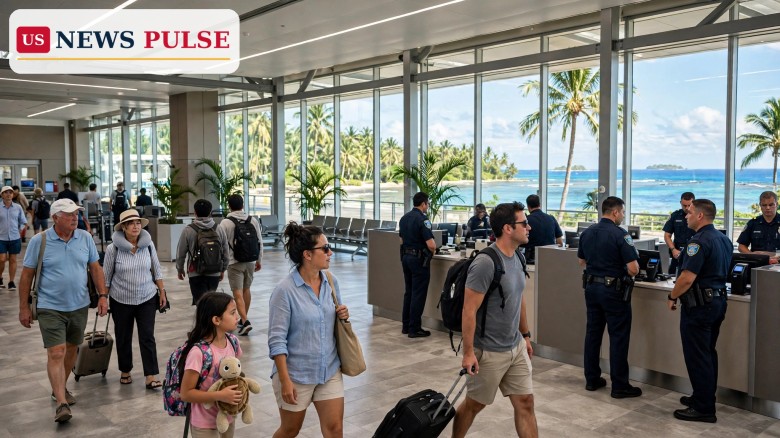
The Trump administration will suspend visa-free entry for Chinese nationals to the Commonwealth of the Northern Mariana Islands (CNMI) from 2 p.m. EDT on Friday, October 30, 2026, the Department of Homeland Security (DHS) has announced, closing a Biden-era travel programme it says presents "unacceptable security and law enforcement risks". The move ends, for now, a system that let pre-screened Chinese visitors travel to the US Pacific territory without first obtaining a visa from an American consulate.
The suspension was set out in a DHS notice in the Federal Register signed by Homeland Security Secretary Markwayne Mullin. It states that the department "judges that PRC nationals are almost certainly exploiting EVS-TAP" — PRC being the People's Republic of China — and that the volume of visa-exempt entries "presents unacceptable security and law enforcement risks".
The suspension applies to "previously approved travelers with an existing EVS-TAP travel authorization" as well as to new applicants. Chinese nationals already in the CNMI under the programme may complete their authorised stay, but, the notice states, they "will need to obtain a visa for any future travel". The suspension will remain in place while DHS evaluates the programme together with the secretaries of state and the interior. No end date has been given.
The notice also makes clear that the suspension does not restore an earlier parole policy for Chinese visitors to the islands. In practical terms, from Friday afternoon Eastern time, a Chinese national who wants to visit the CNMI for business or tourism will need to go through the standard visa process at a US consulate instead of obtaining an electronic travel authorisation in advance.
China has been excluded from the wider Guam-CNMI visa waiver programme since 2009 on what DHS has described as "political and security concerns". EVS-TAP was created as a narrower, separate channel: a 2024 rule, which took effect on February 20, 2025, allowed Chinese visitors to stay in the CNMI for up to 14 days, with travel authorisations valid for one year.
One distinction matters to the current argument. Under EVS-TAP, travellers were vetted by US Customs and Border Protection (CBP) rather than by a State Department consular officer — the officer who would normally interview a visa applicant at an embassy or consulate. DHS now treats that difference as a critical gap, arguing that reduced vetting lowers the barriers to abuse.
The geography matters too. The CNMI sits in the western Pacific, close to Guam, which hosts several US military installations that DHS describes as "critical to homeland defense". The Department of War is restoring Tinian Air Base in the CNMI itself. DHS argues the programme "may be exploited to facilitate PRC espionage and intelligence collection directed against sensitive U.S. defense infrastructure in the region".
The notice points to two federal sentencings — in March 2024 and February 2025 — of Chinese nationals who smuggled nine and seven other Chinese nationals respectively from the CNMI to Guam. Most of those smuggled people, the notice says, "were later encountered in or near sensitive military installations". Although EVS-TAP barred Chinese visitors from travelling beyond the CNMI, DHS says they "have the ability to illegally travel from the CNMI to Guam aboard smuggling vessels".
DHS also pointed to the CNMI's history of "PRC-linked criminal activity", including money laundering and labour abuses tied to a Chinese-run casino operation in Saipan, the territory's largest island and commercial centre.
For travellers, the change is straightforward but significant. Until now, a Chinese national could obtain an EVS-TAP authorisation electronically, travel to the CNMI, and stay for up to two weeks without holding a US visa. From 2 p.m. EDT on October 30, that route is closed — including for people whose authorisations were approved before the announcement.
What does not change is the underlying right to apply to visit. DHS says genuine visitors can still apply for a regular US visa, which involves consular vetting. What the suspension removes is the shortcut: visa-exempt entry on the basis of an electronic authorisation alone.
The action targets Chinese nationals under EVS-TAP. It does not, on its own, alter the visa arrangements for other nationalities travelling to the CNMI, and the notice does not extend the suspension to Hong Kong, even though some of the senators who campaigned against the programme had also sought Hong Kong's removal from waiver arrangements.
For the CNMI, the practical question is volume. More than 3,000 Chinese nationals entered under EVS-TAP in fiscal year 2025. That is a small number beside total US visitor flows, but a meaningful one for a small island economy where tourism is a leading industry and where Chinese visitors were once a major market before the pandemic and the long-running restrictions on direct flights.
Republican Senator Mike Lee of Utah welcomed the move within hours of the announcement. "I'm very pleased to report that @SecMullinDHS at @DHSgov just CLOSED Joe Biden's loophole for Chinese birth tourism for which we sounded the alarm earlier this year," he wrote on X. "America is not a nursery for the CCP to steal citizenship. Thank you, President Trump!"
Lee was one of four Republican senators — with Rick Scott of Florida, John Cornyn of Texas and Bill Cassidy of Louisiana — who wrote to Mullin in April urging him to end the programme. In March, 34 House members had made a similar appeal, according to reports of the campaign. Lee had also pressed the issue earlier in the year, when he was still a senator before Mullin's move to DHS, alongside Scott and Jim Banks of Indiana.
The reaction from the islands themselves was markedly different. Delegate Kimberlyn King-Hinds, the CNMI's non-voting representative in Congress, stressed that the programme is "suspended, not terminated". She said she had spoken with the White House and with Secretary Mullin, who promised to work with local officials on a path forward.
King-Hinds and other island leaders dispute the factual basis for the suspension. Her office has said data do not support claims that the visa arrangements pose a national security threat or are overwhelming local health services. "The Commonwealth Health Center is not overwhelmed by foreign births," her office said, noting that tourist births have declined and are now far outnumbered by resident births.
Local figures complicate the birth-tourism argument. According to figures cited by the CNMI's hospital system, births to Chinese tourists peaked at 574 in 2018 and fell to 55 in 2024. King-Hinds has said that decline followed reforms during President Trump's first term, and that tourist births fell further between 2024 and 2025 after EVS-TAP began. DHS, notably, did not publish any number of births linked to EVS-TAP travellers, and no public evidence of espionage carried out under the programme has been presented so far.
Business groups in the CNMI have warned of economic harm. The Hotel Association of the Northern Mariana Islands has called the visa programme "a critical economic tool essential to the Commonwealth's stability". The Marianas Visitors Authority said the programme operates under federal oversight and has worked closely with US agencies to strengthen screening, disputing data cited by the programme's critics as outdated. Saipan Chamber of Commerce president Joe Guerrero said: "We have an obligation as a community to correct misinformation and stand by the facts."
Not every island voice opposes tighter controls. Independent candidate for US delegate Galvin Sablan Deleon Guerrero has said: "While we should welcome tourists, we should not make ourselves vulnerable to bad actors or weaken national security."
DHS itself acknowledged that CNMI businesses dependent on Chinese tourism and prospective travellers may face losses, but said the "acute risks" outweighed them.
The suspension lands at the intersection of three larger stories: US-China strategic competition in the Pacific, the Trump administration's wider push to tighten visa vetting, and the politics of immigration one week before the November 3 midterm elections.
Strategically, the CNMI and Guam sit on the front line of American military posture in the western Pacific. Decisions about who can enter the CNMI without a consular interview are therefore treated in Washington as security decisions, not merely tourism policy. The restoration of Tinian Air Base — a Second World War-era field being brought back into use — only raises the stakes in that argument.
Politically, the move fits a broader administration campaign against birth tourism. A State Department task force launched on August 12 had revoked more than 750 visas tied to suspected birth tourism by late August, according to Fox News reporting cited in coverage of the suspension. Birth tourism — travelling to the United States to give birth so the child acquires US citizenship — has long been a target of immigration hawks, and the CNMI, as US soil in the Pacific, has been one of its focal points.
Legally, the suspension rests on the homeland security secretary's authority to suspend visa-free admission to Guam and the CNMI for a country's nationals on a finding of good cause or security risk. Because that judgment is left largely to the secretary, and because travellers abroad have little ability to challenge admission rules in court, the real contest over EVS-TAP is likely to be political: between a security-first case in Washington and an economy-first case in Saipan.
For the CNMI, the stakes are existential in a quieter way. The territory's economy is still in recovery, and its leaders argue that a programme designed with advance electronic authorisation, watchlist checks and a tightly controlled 14-day window can be refined in cooperation with federal agencies rather than scrapped outright. Whether Washington agrees will shape the islands' tourism prospects for years.
The immediate date is Friday, October 30, at 2 p.m. EDT, when the suspension takes effect. Travellers with existing EVS-TAP authorisations will find them unusable from that moment, and anyone already in the CNMI under the programme will need a visa for any return visit.
Next comes the review. DHS says it will evaluate the programme with the secretaries of state and the interior, and King-Hinds says Mullin has promised to work with local officials. Island leaders will press for that review to be quick, and for any replacement system to preserve a lawful route for genuine Chinese tourists.
Watch also for the wider ripple. The suspension is part of a pattern of tightened vetting that has already touched other visa categories, and it arrives as the administration weighs further immigration measures. Any response from Beijing, and any move by Congress to legislate on the Guam-CNMI waiver framework, would be the next signals of whether this suspension hardens into a permanent closure.
For now, the message from Washington is unambiguous: the shortcut is closed, the visa queue is the only route, and the security argument has won — at least for the moment — over the tourism one.
EVS-TAP is the CNMI Economic Vitality and Security Travel Authorization Program. Created by a 2024 rule that took effect on February 20, 2025, it let pre-screened Chinese nationals visit the Northern Mariana Islands for up to 14 days without a US visa, with authorisations valid for one year.
Chinese nationals travelling to the CNMI. It applies to new applicants and to people who already hold an approved EVS-TAP authorisation. Chinese nationals already in the CNMI under the programme may finish their authorised stay.
At 2 p.m. EDT on Friday, October 30, 2026, according to the DHS notice in the Federal Register.
Yes, but only with a regular US visa obtained through the standard consular process. Visa-free entry under EVS-TAP is suspended until further notice.
DHS cites possible espionage and intelligence gathering near US defence sites on Tinian and Guam, illegal boat travel from the CNMI to Guam — pointing to smuggling sentencings in 2024 and 2025 — and birth tourism, which it says visa-exempt travel may make easier.
Related coverage on US News Pulse: US-Iran strike plans: forces ready within 96 hours of Trump order, reports say; US-India trade deal nears finish as White House calls talks productive; Trump $1 million voter fraud reward: tips must lead to arrest and conviction.
Leave a Comment



 | Today's Date: