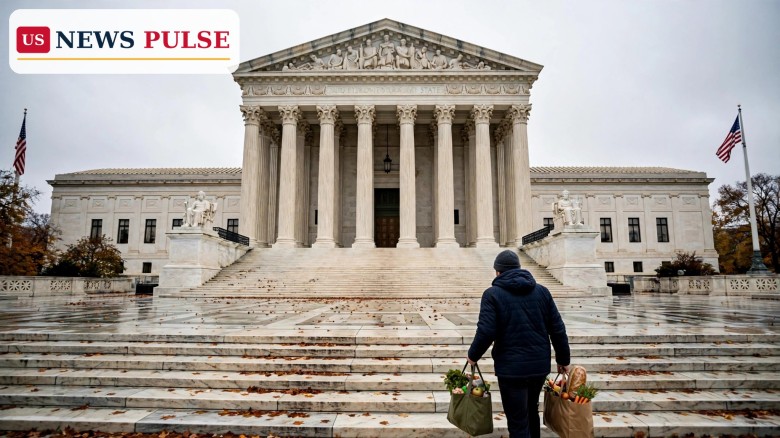
The Supreme Court SNAP payments fight took another turn on Tuesday, when the justices extended their block on full food assistance payments even as Congress moved closer to ending the government shutdown that created the crisis. The court extended an administrative stay through the end of the day on Thursday, keeping a lower court order that would have required full November benefits on hold for a few more days while the House prepares to vote on a Senate-passed funding deal.
For the nearly 42 million Americans who rely on the Supplemental Nutrition Assistance Program, the ruling means the same patchwork that has defined November so far will continue, at least briefly: some states have paid full benefits, some have paid partial benefits, and some recipients have received nothing yet. The justices offered no substantive ruling on whether the administration must pay the full amounts, choosing instead to buy time while lawmakers try to reopen the government and restart the programme on its normal footing.
The Supreme Court's brief Tuesday order extended the administrative stay first issued by Justice Ketanji Brown Jackson, who handles emergency appeals from the Boston-based 1st US Circuit Court of Appeals. Jackson's original stay was due to expire a few minutes before midnight on Tuesday. The new order keeps it in place through Thursday, although Jackson herself dissented from the extension, without explaining her vote in the order.
The stay blocks an order from US District Judge John McConnell in Rhode Island, who had ruled that the administration must move faster to deliver food benefits and had criticised its decision not to pay the full November amounts. McConnell found that the administration had acted arbitrarily and capriciously when it decided against fully funding the month's benefits, and he pressed officials to use available funds to get money out quickly. The administration appealed first to the 1st Circuit, which declined to block McConnell's ruling, and then to the Supreme Court.
The groups challenging the administration told the justices in a brief earlier on Tuesday that SNAP beneficiaries had now gone ten days without the help they need to afford food, and that millions of Americans, including children, were going hungry. The administration countered that the lower court was out of line, arguing that it would require the US Department of Agriculture to transfer about $4 billion from one fund to another, and warning that court orders on food aid risked injecting the federal courts into the political branches' closing efforts to end the shutdown.
The food aid crisis began when the government shutdown left the programme without its normal appropriation. Administration officials initially said recipients would receive no November payments because the lapse in funding effectively meant there was no programme to pay. That position prompted lawsuits from Democratic-led states and cities, private groups and SNAP recipients, who argued that federal law required benefits to keep flowing.
Two federal judges ruled that the agency must at least tap into contingency funds to provide partial benefits, or use its discretion to fund the month in full. The USDA opted for partial benefits, but warned that recalculating allotments could take weeks or months for some states. Under a separate court order that was not before the Supreme Court, those partial payments went ahead, so the question before the justices was narrower: whether the administration could also be compelled to pay the full benefits.
The sums involved are large. A full month of SNAP typically costs between $8.5 billion and $9 billion. The administration has pointed to a contingency fund of about $5 billion, while critics say other nutrition funds could be used to close the gap. Households receive around $350 a month on average, according to reporting on the programme, although for many families that assistance is spent quickly. Because benefits are staggered through the month, the timing of any interruption differs by household and by state, which is why some recipients felt the shortfall immediately while others are only now reaching their normal payment dates.
Alongside the food aid battle, the shutdown's wider effects have mounted. Flight cancellations have grown as air traffic controllers and Transportation Security Administration officers work without pay, and federal services from national parks to immigration courts have been disrupted. The SNAP fight became one of the most visible and tangible consequences of the standoff, precisely because it touches weekly grocery shopping for tens of millions of families.
It is important to be precise about what the Supreme Court did and did not decide. The Tuesday order is an administrative stay, a short-term procedural pause, not a final judgment on the merits of the case. It does not rule that the administration is right, nor that the lower courts were wrong. It simply preserves the status quo for a few more days while the court considers the emergency appeal, and while Congress considers a deal that could make the dispute disappear.
That distinction matters for recipients. The stay does not cancel benefits that states have already paid, and it does not stop states that have chosen to pay full benefits from doing so. What it does is prevent a federal court order requiring full payment from taking effect nationwide while the stay lasts. In practice, that leaves the existing patchwork in place: full payments in at least 16 states, partial payments in at least five, and nothing yet in others, with each state following its own guidance and timetable.
Advocates say that patchwork is itself a problem. Carolyn Vega, a policy analyst at the advocacy group Share Our Strength, has noted that it could be easier for states to make full payments quickly than to top up partial payments later, because topping up requires recalculations and technical adjustments. That is one reason challengers urged the court to let the full-payment order take effect immediately, rather than waiting for a political deal that might still slip.
The court's decision landed in the middle of a fast-moving political day in Washington. The Senate had broken weeks of gridlock late on Monday night, passing a bipartisan funding package by 60 votes to 40, with seven Democrats and one independent joining 52 Republicans. The senators who crossed party lines included Jeanne Shaheen, Dick Durbin, Tim Kaine, Maggie Hassan, Angus King, Jacky Rosen, Catherine Cortez Masto and John Fetterman.
President Donald Trump signalled his support for the deal on Monday, telling reporters: "We'll be opening up our country very quickly." At a Veterans Day ceremony, he also saluted House Speaker Mike Johnson for what he called the "big victory" of the government being on the verge of reopening after a lengthy shutdown.
Democratic leaders in the House were far less enthusiastic. House Democratic leader Hakeem Jeffries said on Tuesday evening that it was his "strong expectation" that House Democrats would oppose the bill, which is expected to come before the House on Wednesday. Democrats unveiled a proposed amendment calling for a three-year extension of enhanced tax credits that make health insurance coverage more affordable for millions. The proposal has no chance of passage in the Republican-led House, but Democrats said it gave them another chance to argue that they are trying to protect people from large premium increases next year. "We only lose the fight if we give up the fight," said Representative Teresa Leger Fernandez of New Mexico.
California Governor Gavin Newsom said on Tuesday that he was stunned by the senators' decision to break with Democrats and end the shutdown, warning that they were not alarmed enough about the president's shattering of norms. "I'm not coming in to punch anybody in the face, but I'm not pleased that, in the face of this invasive species that is Donald Trump, who's completely changed the rules of the game, that we're still playing by the old rules of the game," Newsom said in an interview at the COP30 climate conference in Brazil. "And in my core, I'm stunned."
Democratic Wisconsin Governor Tony Evers took a different tone, saying he would not criticise the Democratic senators who voted for the deal. "They have good reasons for doing it," Evers told the Associated Press. "I'm not here to complain about them." He added that it was hard to say whether the deal would make it easier or harder to extend health care tax credits that expire on January 1, because Republicans had been clear that they did not want to act.
Not all of the friction is between the parties. Some lawmakers have criticised a provision in the funding bill that would allow Republican senators to sue the federal government for $500,000 for secretly obtaining their phone records during former special counsel Jack Smith's investigation. Representative Chip Roy of Texas called it self-serving and self-dealing, saying: "I think there's gonna be a lot of people, if they look and understand this, they're going to see it as self-serving, self-dealing kind of stuff. And I don't think that's right." Roy said he was trying to find a way to force the Senate to repeal the provision without amending the bill in the House, which could delay reopening.
The SNAP case matters for three reasons at once. First, it is about food. For families living pay cheque to pay cheque, a missed or partial grocery benefit is not an abstract budget line; it is meals that must be found somewhere else, often at food banks that are already stretched. The challengers' claim that beneficiaries have gone ten days without help captures why courts, states and charities have treated the timetable as urgent.
Second, it is about the limits of emergency power during a shutdown. The administration argues that without an appropriation, it cannot simply invent funding, and that courts should not direct transfers between federal funds. The challengers argue that contingency and nutrition funds exist precisely for moments like this, and that refusing to use them is a policy choice dressed up as a legal necessity. Whichever side ultimately prevails, the case will shape how future shutdowns affect benefit programmes.
Third, it is about whether Congress can still break a deadlock before the courts have to. The Supreme Court's decision to extend the stay only through Thursday reads, in effect, as a bet that the political process will resolve the immediate crisis. If the House passes the deal on Wednesday and the president signs it, the legal fight over November benefits may be overtaken by a reopened government and a restored funding stream. If the House balks, the court will face the same question again, with more families affected and less patience left.
The immediate timetable is tight. The House is expected to take up the funding package on Wednesday, beginning with a procedural rule vote and then a final vote on sending the bill to the president's desk, possibly on Wednesday evening. If it passes, agencies would begin restoring operations, and SNAP would restart on its normal funding basis, although how quickly full payments reach every recipient would vary by state.
Wednesday will also bring the long-awaited swearing-in of Representative Adelita Grijalva, a Democrat who won a September 23 special election in Arizona. She is due to be sworn in at 4 p.m. by Speaker Johnson, after a delay of nearly two months while the House was kept out of session during the shutdown fight. Grijalva has said her first act will be to provide the final signature needed for a discharge petition to trigger a vote on releasing files related to Jeffrey Epstein.
States are not waiting passively. Connecticut lawmakers are pushing ahead with a plan to set aside $500 million in state reserves to backstop delays in federal food and heating assistance, with a vote scheduled during a special legislative session on Wednesday and Thursday. Even if the federal government reopens soon, state officials say the fund could help address wider federal funding cuts in the tax and spending law Republicans call the One Big Beautiful Bill Act.
The funding package itself, if enacted, would keep the government funded at current levels through January 30, while providing full-year funding for the Department of Veterans Affairs, the USDA, including SNAP, and congressional operations. It guarantees back pay for furloughed and essential federal employees, and it sets up a Senate vote in mid-December on extending Affordable Care Act premium tax credits. That December vote is the concession that persuaded some Democrats to break ranks, even though many of their colleagues wanted a firmer guarantee.
If the House rejects the package, or amends it in a way the Senate cannot accept, the shutdown will continue, the Supreme Court stay will expire on Thursday, and the justices will have to decide whether to keep blocking full SNAP payments, let the lower court order take effect, or rule on the emergency appeal. For recipients, that would mean at least several more days of uncertainty, and for states, another round of conflicting guidance.
No. The court extended a temporary stay that blocks a lower court order requiring full November benefits. It did not rule on the merits, and it did not cancel benefits that states have already paid.
Under the Tuesday order, the stay runs through the end of the day on Thursday. Justice Ketanji Brown Jackson, who issued the original stay on Friday, dissented from the extension.
Nearly 42 million Americans receive food stamps. An estimated 27 million should have received their allotments by Monday, according to Code for America, and households receive around $350 a month on average.
Yes, reopening the government would restart the programme on its normal funding basis. How quickly full payments reach each household would still vary by state, and states that paid partial benefits may need time to top them up.
The House is expected to vote on Wednesday, starting with a procedural rule vote and then a final vote on the Senate-passed package, possibly on Wednesday evening. If it passes, the bill goes to the president for signature.
Related coverage on US News Pulse: Trump's $1 million voter fraud reward, why a Fed pause looks likely despite high inflation, and the suspension of visa-free travel for Chinese nationals to the Northern Mariana Islands.
Leave a Comment



 | Today's Date: