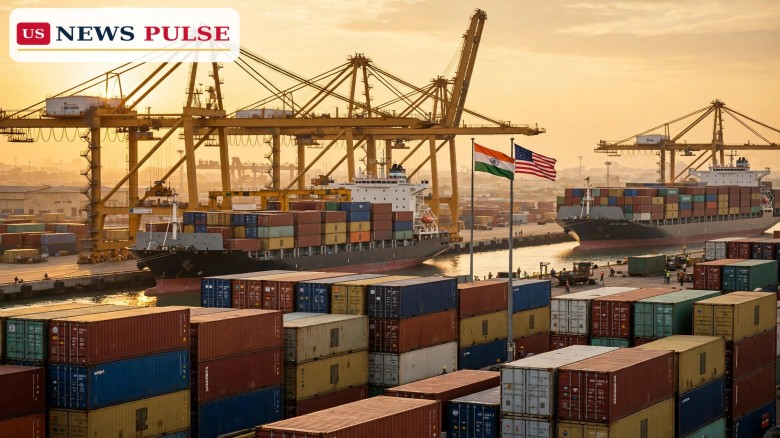
The White House said on Tuesday that the United States is engaged in "productive talks" with India on a "historic trade deal", hours after India's commerce minister said most of the negotiations are already concluded and only fine-tuning remains. The upbeat signals from both capitals have raised hopes that one of the world's most consequential trade negotiations could finally cross the finish line, just one week before Americans vote in the November 3 midterm elections.
Key Points:
The White House statement came in response to Goyal's remarks at the India-Netherlands Business Forum in The Hague on Monday, where the minister said the long-running talks had reached their final stages. "Representatives of the Trump administration continue to engage in productive talks with Indian officials to secure a historic trade deal that puts Americans and America First," spokesman Matthew Middleton told the IANS news agency.
Middleton also stressed the personal chemistry at the top of the relationship. "President Trump and Prime Minister Modi have a close personal relationship, and both leaders remain committed to lifting bilateral ties to new levels," he said.
Goyal is travelling in Germany and the Netherlands with a business delegation, and used the Hague forum to frame the talks as nearly done. He noted that India has concluded nine free trade agreements in the last four and a half years, presenting the US deal as the next step in that run of openings. The minister met US Trade Representative Jamieson Greer on the sidelines of the G20 Trade Ministerial in Milwaukee on October 1, and a team led by Commerce Secretary Rajesh Agrawal held talks with US officials in Washington from October 15 to 17.
Rubio, during his visit to Mumbai on October 20, had already signalled that a landing zone was in sight. "We're very, very close. I would say we're about as close as you can be without [an] agreement. I think there's a small number of items to wrap up, so I think that will happen shortly," he told reporters, while noting that the State Department does not directly negotiate trade deals but is deeply involved in the process.
The United States and India formally launched negotiations on a Bilateral Trade Agreement (BTA) on February 13, 2025. On February 7, 2026, the two sides announced a framework for the first phase of the agreement, covering reciprocal and mutually beneficial trade.
Under that framework, Washington agreed to cut its tariff on Indian goods from 50 per cent to 18 per cent. The 50 per cent figure was made up of a 25 per cent reciprocal tariff plus an additional 25 per cent penalty linked to India's purchases of Russian oil; the oil penalty was subsequently rolled back. In return, India committed to eliminate or reduce tariffs on all US industrial goods and a wide range of food and agricultural products, including tree nuts, fresh and processed fruit, soybean oil, wine and spirits, dried distillers' grains and red sorghum for animal feed.
The ground then shifted under the negotiators. On February 20, the US Supreme Court struck down the reciprocal tariffs imposed under the International Emergency Economic Powers Act, removing the legal basis for the 18 per cent rate. Washington responded on February 24 with a blanket 10 per cent tariff applicable to all countries for a 150-day period, and on March 11 and 12 the US Trade Representative launched two Section 301 investigations covering about 60 economies — one into alleged structural excess capacity and one into goods produced with forced labour. India was included in both, and a US Section 301 duty on Indian goods of 10 per cent has been in force since July 24, 2026.
More uncertainty arrived on September 18, when President Trump signed the Lindsey O. Graham Sanctioning Russia and Iran Act of 2026, authorising tariffs of up to 100 per cent on certain major purchasers of Russian oil and gas, subject to provisions and exceptions in the law. Trump later signed an order implementing the act and waiving its tariffs on buyers of Russian oil, but India's External Affairs Ministry has said such measures could affect bilateral relations as well as the international energy market.
Against that shifting backdrop, the mood music has seesawed. Goyal told reporters on September 24 that the deal was almost "done and dusted", subject to India securing a competitive advantage at least equal to rival exporters. Greer, a week later, was more cautious, describing the talks as in the "short strokes" while signalling that a further leaders' call may be needed before anything is signed. Finance Minister Nirmala Sitharaman has said talks reached a plateau, while External Affairs Minister S. Jaishankar has said they are nearing a "landing point". Dairy access for US products remains one of the biggest remaining obstacles, according to recent reporting.
At its core, the negotiation is an exchange: lower and more predictable US tariffs on Indian goods in return for wider access for American products in India. Washington is keen for India to buy more American energy and technology, and Indian exporters are seeking relief from US tariffs. India's headline offer — $500 billion of US energy products, aircraft and aircraft parts, precious metals, technology products and coking coal over five years — is its main lever for securing that relief.
For New Delhi, the decisive question is comparative advantage. India wants its exporters to receive better tariff treatment than competitors such as Vietnam, Bangladesh, Thailand, Indonesia and other ASEAN nations, as well as Sri Lanka and Pakistan. When the February framework was finalised, India held such an edge over those rivals; the subsequent tariff changes have forced both sides to re-examine the arithmetic, and Goyal has said implementation will depend on clarity about India's competitive position. The February joint statement itself contains a clause allowing either side to modify its commitments if the other's agreed tariffs change — a safety valve both sides have now had reason to use.
The commercial stakes are already visible in the trade data. India's merchandise exports reached $43.81 billion in August 2026, up from $34.74 billion a year earlier, with exports to the US growing 21.83 per cent year on year. The US remains India's largest trading partner, which is why a deal would mark one of the most significant shifts in India-US economic relations in decades.
"Representatives of the Trump administration continue to engage in productive talks with Indian officials to secure a historic trade deal that puts Americans and America First," White House spokesman Matthew Middleton said.
"We have concluded most of the discussions and are fine-tuning the agreement," Commerce Minister Piyush Goyal said at the India-Netherlands Business Forum in The Hague.
"We're very, very close. I would say we're about as close as you can be without [an] agreement. I think there's a small number of items to wrap up, so I think that will happen shortly," Secretary of State Marco Rubio said in Mumbai on October 20.
Finance Minister Nirmala Sitharaman has expressed hope that the agreement would be concluded at the earliest, in the interest of global trade and bilateral economic ties, while External Affairs Minister S. Jaishankar has described the talks as nearing a "landing point". Greer, by contrast, cautioned on October 2 that a deal was not imminent — a reminder that "close" in trade diplomacy can still mean weeks of legal drafting.
A completed deal would reshape trade between the world's largest and fifth-largest economies, locking in tariff rates for Indian exporters, opening Indian markets to US farm and industrial goods, and anchoring a $500 billion purchasing pipeline for American energy, aircraft and technology. It would also be a political prize for Trump one week before the midterms, demonstrating a major trade win after a year in which his tariff policy has been repeatedly reworked by the courts and by Congress.
For markets, the timing matters too. The rupee has been under pressure, trading near 96.3 per dollar at the start of October, and foreign investors sold heavily through September. A credible deal could steady sentiment, though analysts caution that the details — above all the final tariff rate India secures relative to its rivals — will matter more than the announcement itself. The talks are unfolding alongside other trade tensions, including Washington's warning to the European Union over a record Airbus loan, covered in our report on the transatlantic aircraft trade truce, and a Federal Reserve decision expected this week, covered in our report on why a rate pause looks likely despite high inflation.
Negotiators will now work through the fine-tuning Goyal described, with legal drafting of the first tranche under way and a possible leaders' call between Trump and Modi still on the table as the final step. Watch for three things: whether dairy access is resolved or deferred, whether India secures the tariff advantage over rival exporters it has demanded, and how the Section 301 duties and the Russia sanctions law are treated in the final text.
If those pieces fall into place, an announcement could come quickly — and with the midterms on November 3, both governments have an incentive to show progress. If they do not, the talks could drift into another round of drafting, with trade ministers from the UK and Canada due to visit India next week and the broader BTA still to be negotiated after any interim deal. Either way, the White House's choice of the word "productive" and Goyal's "most discussions concluded" suggest this negotiation is closer to its end than at any point since February.
As of October 27, 2026, the White House says talks are "productive" and Commerce Minister Piyush Goyal says most discussions have been concluded, with both sides fine-tuning the agreement. Secretary of State Marco Rubio described the sides as "very, very close" on October 20.
Speaking at the India-Netherlands Business Forum in The Hague on Monday, Goyal said: "We have concluded most of the discussions and are fine-tuning the agreement." He was in the Netherlands as part of a visit to Germany and the Netherlands with a business delegation.
India has indicated it intends to buy $500 billion worth of US products over five years, covering energy, aircraft and aircraft parts, precious metals, technology products and coking coal. The commitment is India's main lever for securing tariff relief for its exporters.
When the framework was announced in February, the US cut tariffs on Indian goods from 50 per cent to 18 per cent. The Supreme Court then struck down the legal basis for those reciprocal tariffs, and a 10 per cent Section 301 duty on Indian goods has been in force since July 24, 2026, forcing further negotiation.
Dairy access remains a key obstacle, along with India's demand for a tariff advantage over rival exporters, the treatment of Section 301 duties and the Russia sanctions law, and the need for final legal drafting and possibly a leaders' call before anything is signed.
Leave a Comment



 | Today's Date: