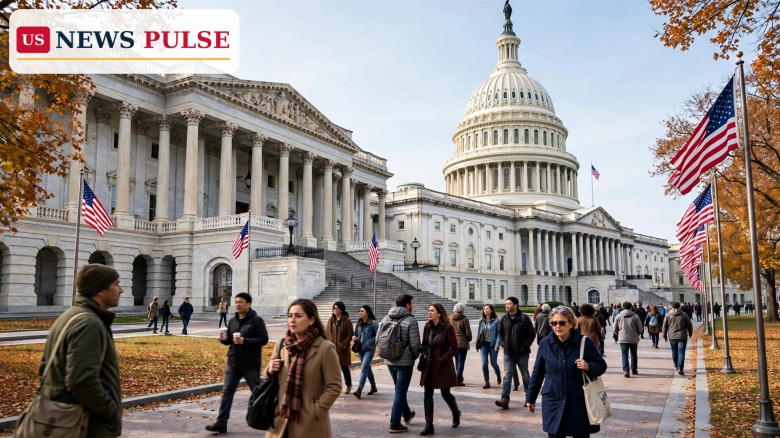
A 37-year-old Illinois man has been charged in federal court after investigators linked him to four letters containing a white powder that were sent to members of Congress, in a case disclosed just one week before the November 3 midterm elections. Matthew G. Unglesbee, of Quincy, Illinois, faces charges of mailing threatening communications and mailing false information and hoaxes, according to court records unsealed on Monday, October 26, 2026.
The powder letters to Congress at the centre of the case did not contain a hazardous substance, investigators said. Testing found the white granular material was not harmful or toxic, and court records say Unglesbee told FBI agents the substance was salt. The distinction matters: prosecutors are not alleging a chemical or biological attack, but they say the mailings still triggered hazardous-materials responses, disrupted congressional offices, and carried the unmistakable threat implied by a powder-filled envelope.
The case arrives at a moment of heightened sensitivity around threats to public officials. Reuters reported that Unglesbee told the FBI he sent the letters after reading stories about other suspicious mailings sent to state election officials and lawmakers' offices ahead of the midterms, while denying that he sent those earlier letters. Investigators have said they have not identified the sender responsible for the separate wave of white-powder letters sent to senators and secretaries of state across the country.
According to court records filed in the U.S. District Court for the Central District of Illinois, four letters containing a white powdery substance reached the district offices of three Chicago-area members of Congress. The offices belonged to Democratic Representatives Jan Schakowsky, of Skokie, Mike Quigley, of Chicago, and Brad Schneider, of Lincolnshire. Schakowsky's office received suspicious mail twice within a week, prompting hazardous-materials teams and the FBI to respond.
The first three envelopes contained a white granular substance and handwritten notes reading "HA HA", court records say. A fourth envelope, reported two days later, contained a similar substance and a note reading "HAH enjoy the gift." The envelopes had handwritten addresses and were postmarked in Springfield. Their return addresses named Unglesbee and matched an address listed for him in government records, according to the reporting of the court documents.
At one House member's office, a staffer felt a substance inside an envelope, called 911 and alerted other congressional offices, according to accounts of the court records. That sequence — a staffer opening or handling suspicious mail, an emergency call, and a warning to other offices — is exactly why powder letters are treated as serious incidents even before laboratory results come back. Until testing is complete, no recipient can know whether the powder is harmless, and emergency responders must treat it as a potential threat.
The FBI investigation began after an anonymous tip received on October 16. The tipster told investigators about hearing Unglesbee discuss mailing suspicious substances to lawmakers. Federal agents subsequently investigated after congressional offices received the envelopes. During an interview at his home on Sunday, October 25, Unglesbee allegedly admitted mailing the four letters, according to the complaint.
Court records say Unglesbee told agents he had heard someone in a restaurant discussing news reports about similar mail sent to lawmakers, including Senator Amy Klobuchar and Senate Minority Leader Chuck Schumer. He denied involvement in letters sent to members of Congress outside Illinois. Investigators also say a search of his home uncovered a fifth, empty envelope addressed to another member of Congress's Washington, D.C., office.
Unglesbee was arrested on October 25, the complaint was unsealed and an initial appearance was held on October 26, and a detention hearing was scheduled for October 28 at 3 p.m. in Springfield before Magistrate Judge Douglas J. Quivey, according to reports of the court scheduling. The Adams County Sheriff's Office said Unglesbee was being held in its jail on state charges of harassment through electronic communications, a separate matter from the federal complaint.
Reuters reported that a lawyer for Unglesbee could not immediately be identified. The complaint is an accusation, not a conviction: Unglesbee is presumed innocent unless proved guilty in court, and the laboratory result — no dangerous substance found — travels with the headline, because this report does not establish an anthrax attack or a hazardous chemical exposure.
Powder letters occupy a particular place in American public life because the threat they imply is instantly understood. A white powder in an envelope does not need to contain a dangerous substance to force an office to evacuate, to summon hazardous-materials crews, to shut down mail handling, and to frighten the people who open the mail. That is why federal law treats mailing false information and hoaxes as a crime in its own right, separate from any charge that would apply if a dangerous substance had actually been sent.
The Illinois case is unfolding against a wider, still-unsolved pattern. In the weeks before the November 3 midterms, suspicious mail containing a white powder was reported as having been sent to senators, members of Congress and secretaries of state in several states. Those mailings, and the news coverage of them, form the backdrop that investigators say Unglesbee himself cited: he told agents he acted after hearing about similar mailings in news reports and in conversation. Prosecutors have not accused him of sending those other letters, and investigators have not publicly identified who did.
The timing sharpens the concern. The midterms on November 3, 2026, will decide control of both houses of Congress, and election officials and lawmakers' offices are already operating under heightened security. Threats against election workers and public officials have become a recurring feature of American election cycles, and law-enforcement agencies have repeatedly warned that even hoax threats consume emergency resources and can deter people from public service. A hoax that forces a congressional office to call in a hazardous-materials team does not only affect the staff in that room; it pulls responders away from other calls and it signals to other offices that they, too, could be next.
Illinois is also a focal point in this election cycle for other reasons. The state is home to closely watched races and to the Chicago-area offices at the centre of this case, and its congressional delegation spans some of the most prominent Democratic voices in the House. Schakowsky, Quigley and Schneider are all sitting members of Congress whose district offices serve as the everyday point of contact between constituents and Washington. An attack — real or hoax — on a district office is therefore also an attack on that ordinary channel of democratic contact.
The legal framework is straightforward in outline, even as the details of this case remain to be tested in court. Mailing threatening communications is a federal offence, and so is conveying false information or perpetrating a hoax involving a purported biological or chemical threat. Prosecutors do not need to prove that anyone was physically harmed to bring those charges; they need to prove that the defendant knowingly sent the communications and that the communications carried the threatening or hoax character alleged. What the defence argues, and what evidence the government presents beyond the admissions attributed to Unglesbee in the complaint, will emerge as the case proceeds.
The most important discipline in a case like this is to separate what prosecutors allege from what has been proved. The complaint alleges that Unglesbee mailed four letters, that the letters contained a white granular substance, that three carried notes reading "HA HA" and a fourth carried a note reading "HAH enjoy the gift", and that the envelopes were postmarked in Springfield on October 19 with his name and address in the return-address section. Those are allegations drawn from court records, reported by multiple outlets.
The complaint also alleges, according to the same reporting, that Unglesbee acknowledged mailing the letters during an FBI interview at his home, that he said the substance was salt, and that he described the mailings as a joke while acknowledging that recipients could take the envelopes seriously and request hazardous-materials teams because of concerns about anthrax. That reported acknowledgement matters legally, because it goes to whether he understood the likely effect of what he sent. It does not, on its own, settle the case: admissions attributed in a complaint are tested in court, and a defendant may challenge how an interview was conducted or what was actually said.
What the laboratory testing established is narrower, and it cuts in the defendant's favour on one point: the substance was not harmful or toxic. No dangerous substance was found. That finding does not erase the disruption or the fear, and it does not by itself defeat a hoax charge, which turns on the false threat rather than on actual danger. But it is the reason this article describes the case as a hoax case rather than as a biological attack, and it is the reason readers should be wary of any social-media version of this story that implies otherwise.
Two further details from the court records deserve attention. The first is the fifth envelope: investigators say a search of Unglesbee's home found an empty envelope addressed to another member's Washington office. Prosecutors have not said whether that envelope was ever mailed or what it was intended to contain, and its presence in the home is, at this stage, simply part of the evidence investigators collected. The second is the anonymous tip of October 16, which preceded the offices' receipt of the letters in the timeline reported by investigators. How the tipster knew what they claimed to know, and what investigators did with the tip before the letters arrived, are questions the court record may clarify as the case develops.
No statement from the three Illinois lawmakers named in the court records was included in the initial Reuters and court-record reporting of the charges, and no defence lawyer had been identified at publication, so this article does not attribute reactions to them that have not been reported. What is on the record are the words prosecutors attribute to the letters themselves — "HA HA" and "HAH enjoy the gift" — and the account, attributed to the complaint, of what Unglesbee told agents: that the substance was salt and that he regarded the mailings as a joke.
Law-enforcement handling of the case is visible in the response itself. Hazardous-materials teams and the FBI responded to the incidents at the district offices, the FBI opened an investigation after the October 16 tip and the offices' reports, and the U.S. Attorney's Office for the Central District of Illinois brought the federal complaint. The Adams County Sheriff's Office confirmed the separate state custody position. Those institutional responses are, in effect, the official reaction so far: the mailings were treated as a federal criminal matter, investigated promptly, and charged within days of the arrest.
The wider reaction will likely come in the days ahead, as the detention hearing on October 28 brings the case back into a courtroom and as lawmakers, election officials and postal-security officials consider whether the Illinois charges change anything about the unsolved national wave. For now, the most consequential public statement in the case may be the one investigators attribute to the defendant himself — that he knew recipients could interpret the envelopes as threats and call in hazardous-materials teams. If that account holds up in court, it will be difficult to present the mailings as a harmless prank that nobody could have foreseen frightening anyone.
This case matters for three reasons that go beyond one defendant in Quincy. First, it tests how quickly and how visibly the federal system responds to threats against Congress in an election week. A charge brought within a day of an arrest, with a detention hearing days later, sends a signal that hoax mailings will be treated as federal crimes, not dismissed as jokes, even when no one is hurt and no dangerous substance is found.
Second, it clarifies the boundary between a hoax and a harmless act. The law does not require actual danger for a hoax charge, and for good reason: the harm of a powder letter is inflicted at the moment of opening, when staff must assume the worst, evacuate, and call emergency services. If the only cases ever charged were those involving real pathogens, the incentive to send hoax letters would be unchecked, and every office would still have to respond as if each letter were real.
Third, the case is a reminder that the national wave of suspicious mail remains unsolved. The Illinois charges answer one set of questions — who sent these four letters, according to prosecutors — while leaving the larger question open. Until the sender or senders of the letters to senators and secretaries of state are identified, election officials and congressional offices will continue to treat every suspicious envelope as a potential incident, and the cost in time, money and anxiety will continue to accumulate.
There is also a democratic cost that is harder to quantify. District offices exist so that constituents can walk in, call, and be heard. When those offices must treat their own mail as a threat, when staff must be trained to handle suspicious envelopes, and when hazardous-materials teams become a regular presence, the everyday work of representation becomes harder. That is the practical damage a hoax inflicts, even when the powder turns out to be salt.
The immediate next step is the detention hearing scheduled for October 28 at 3 p.m. in Springfield, where a magistrate judge will consider whether Unglesbee should remain in custody while the federal case proceeds. That hearing may also clarify whether a defence lawyer has been appointed or retained, and whether the government will seek to present additional evidence about the fifth envelope or about the timeline of the October 16 tip.
Beyond that hearing, the case will follow the ordinary federal criminal process: arraignment, discovery, motions, and, if no plea is reached, trial. Prosecutors will need to prove the charges beyond a reasonable doubt, and the defence will have the opportunity to challenge the complaint's account of the interview, the identification of the sender, and the interpretation of the notes. The state harassment charge in Adams County will proceed on its own track.
Separately, the FBI investigation into the wider wave of suspicious mail continues. Any development there — an arrest, a new set of letters, or a statement that the waves are unrelated — would change the context of the Illinois case, and this article will be updated if that happens. For now, the public should treat any report of a new powder letter with the same caution this case demands: verify the source, wait for laboratory results, and do not assume that a white powder is either harmless or dangerous until testing says so.
Congressional offices and election officials, meanwhile, are expected to maintain the mail-screening and safety procedures already in place for the election period. Anyone who receives a suspicious envelope should not open it further, should avoid touching the contents, should wash their hands, and should contact local law enforcement — the standard guidance that applies whenever an unknown powder is found in the mail.
Matthew G. Unglesbee is a 37-year-old man from Quincy, Illinois, charged in federal court with mailing threatening communications and mailing false information and hoaxes, according to court records unsealed on October 26, 2026. He is presumed innocent unless proved guilty.
Four letters sent to Illinois congressional district offices contained a white granular substance. Testing found no harmful or toxic substance, and court records say Unglesbee told agents the substance was salt.
The offices of Representatives Jan Schakowsky in Skokie, Mike Quigley in Chicago and Brad Schneider in Lincolnshire. Schakowsky's office received suspicious mail twice within a week.
No injuries or hazardous exposures have been reported in connection with these four letters, and testing found no dangerous substance. The harm alleged by prosecutors is the threat, the disruption and the emergency response the letters triggered.
A detention hearing was scheduled for October 28 at 3 p.m. in Springfield. The federal case will then proceed through arraignment and the ordinary pre-trial process, while a separate state harassment charge is pending in Adams County.
Related coverage on US News Pulse: James Comey's third criminal case and the DOJ leak allegations, DOJ charges over illegal voting in five states ahead of the midterms, and Democrats demand a special counsel over the Epstein files.
Sources: Reuters, October 26, 2026; U.S. District Court for the Central District of Illinois complaint as reported by Reuters, The Chicago Focal and other outlets, October 26-27, 2026. This is an allegation-based report: the defendant is presumed innocent unless proved guilty.
Leave a Comment



 | Today's Date: