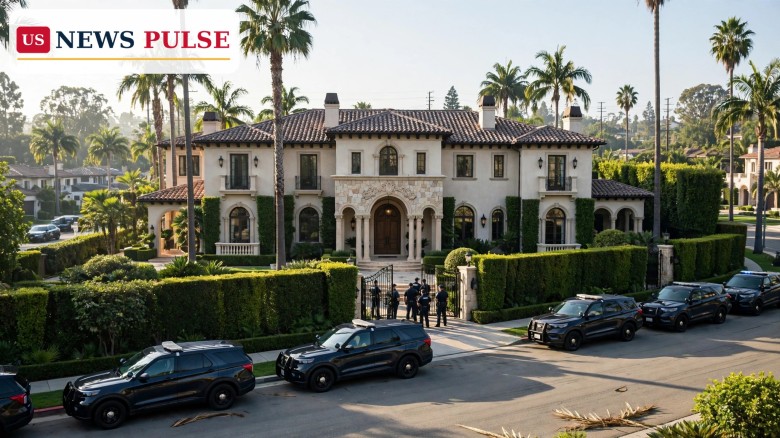
FBI agents searched a Beverly Hills mansion on Tuesday morning, October 27, 2026, in the latest dramatic step in the federal criminal investigation into former Democratic congressman Eric Swalwell, according to multiple news reports, in a case that has already cost Swalwell his seat in Congress and his campaign for governor of California. The raid, at a luxury home on North Roxbury Drive, is the third major public law-enforcement action in the inquiry in less than three months, following the seizure of Swalwell's phone and laptop at San Francisco International Airport in August and a search of his Washington home the next day, and it comes one week before the November 3 midterm elections.
The search began early on Tuesday morning at a mansion in Beverly Hills, California, and was still under way when the first reports emerged, with agents seen carrying boxes and evidence from the property, according to accounts of the scene. Fox News first reported that federal agents were actively searching a mansion believed to belong to Cloobeck, and the Daily Caller, citing a law-enforcement source, confirmed that the FBI had raided a Beverly Hills mansion in connection with the Swalwell investigation. The New York Post, which obtained photographs of the raid, identified the address as 1014 North Roxbury Drive and reported that the house belongs to Cloobeck.
Other outlets were more cautious about the ownership question. A law-enforcement source told the Daily Mail that the early-morning raid took place at Cloobeck's mansion, while other reports described the property only as linked to the inquiry and noted that the FBI had not publicly detailed what agents were seeking. That caution matters: in a sealed-warrant search, the public record at the time of reporting consists of what sources say and what can be seen from outside, not the warrant itself, and the precise scope of Tuesday's search may only become clear if court filings are later unsealed or the FBI issues a statement.
What is not in dispute is the sequence. Tuesday's raid is the latest in a chain of federal actions that began in August, when Swalwell was surrounded by FBI agents as he got off a plane at San Francisco International Airport and had his mobile phone and laptop seized. Agents executed additional warrants the following day at his home in Washington, D.C., where they seized other potential evidence, a source previously told the Post. Swalwell was not arrested or detained at the airport, and he has not been charged in connection with any of the allegations against him.
The Post added one detail that has drawn particular attention: sources told the paper that Tuesday's raid is linked to a sex worker. The paper did not name the person or explain the connection further, and no other outlet reviewed for this article independently confirmed that detail. It should therefore be read as a single-outlet, source-based claim, not as an established fact about the investigation, and this article does not repeat any further unattributed detail about it.
Swalwell's political career unravelled in April 2026, after CNN and the San Francisco Chronicle published accounts from several women accusing him of sexual misconduct. One former staffer accused him of raping her when she was too intoxicated to consent, according to the Chronicle. Another woman accused him of drugging and sexually assaulting her in 2018, while two others alleged he sent them unsolicited images of his genitals. The Daily Caller, in its Tuesday coverage, put the total at at least six women, including a former unnamed congressional staffer, with allegations ranging from unwanted advances to sexual assault and rape. The difference between the counts reflects different reporting at different times and different definitions of what counts as a separate allegation, and it is a reminder that the public record is still developing.
Swalwell has consistently denied wrongdoing. He nevertheless resigned from Congress soon after the allegations surfaced and withdrew from California's crowded Democratic primary for governor, ending a campaign that had made him one of the most prominent names in the race. At the time he stepped down, he was a former congressman from California who had built a national profile as a prosecutor-turned-politician and, earlier, as a manager in Donald Trump's second impeachment trial. His resignation left both his House seat and his gubernatorial ambitions behind, and it shifted the California governor's race, already crowded, into a contest without one of its best-known entrants.
The investigation is not confined to the FBI. Swalwell is under investigation by multiple prosecutors for the sexual assault allegations, including in New York and California, according to the Post. He was also investigated by the Manhattan District Attorney's Office, the Los Angeles County Sheriff's Department and the House Ethics Committee, the Daily Caller reported. Separate inquiries by different authorities do not necessarily mean separate charges will follow; they reflect the fact that alleged conduct in different places, at different times, can fall under different jurisdictions, and that a federal civil-rights theory can sit alongside state criminal inquiries into the same underlying claims.
The most revealing public clue about the FBI's theory so far comes not from Tuesday's raid but from August's airport seizure. The Post reported that the FBI warrant used to seize Swalwell's phone and laptop cited a federal civil-rights statute that can be used to prosecute public officials who abuse their government power, suggesting investigators may suspect Swalwell used his official role to silence women who accused him of sexual misconduct. That is an interpretation of the warrant's cited statute, not a statement of charges, and it does not establish that any such silencing occurred. No charging document has been made public, and Swalwell has not been accused in court of violating that statute.
Tuesday's choice of location is itself a clue to the direction of the inquiry. Swalwell frequently lived and stayed at Cloobeck's Beverly Hills mansion, the Post reported, and even filmed a video response to the misconduct allegations from inside the home. Cloobeck, a timeshare billionaire who ran for governor himself before dropping out to make way for Swalwell, was one of Swalwell's largest benefactors: he spent more than $1 million to support the gubernatorial campaign, gave the maximum direct contribution of $39,200, and provided a private trip to France in 2024 valued at about $31,000. When the allegations surfaced, Cloobeck changed his mind about his protege, booted him out of the house and told the Post: "I am no longer associated with a man that takes advantage of women. I support women's rights."
Cloobeck has legal troubles of his own, which are separate from the Swalwell inquiry and should not be conflated with it. He was charged with three felony counts of attempting to dissuade or prevent a witness or victim from testifying, and one misdemeanour count of making annoying phone calls, the Post reported. All of those charges stem from his former partner's criminal case, in which she is accused of using dating apps to steal from wealthy older men. Cloobeck has denied wrongdoing in that matter, and the charges against him do not make him a suspect in the Swalwell investigation, nor does the search of a home he owns establish that he is under investigation in that case. Investigators frequently search a location because they believe evidence may be there, not because the owner is a target.
That distinction is worth keeping in mind as Tuesday's raid is discussed. A search warrant authorises agents to look for specified items in a specified place; it is not a charge, a conviction or a finding of fact. The FBI has not said whether Cloobeck is a subject, a witness or neither in the Swalwell case, and it has not said what, if anything, was taken from the Beverly Hills house. Until a court filing or an official statement fills those gaps, the honest summary is that agents searched a home closely associated with Swalwell's recent life, in a case about serious allegations he denies, and that the public does not yet know what they found.
Official reaction on Tuesday was, by the nature of a sealed investigation, limited. The FBI had not publicly detailed the raid at the time of the first reports, and neither Swalwell nor Cloobeck issued a new statement about Tuesday's search in the coverage reviewed for this article. That silence is normal in the early hours of a search: neither the agency nor the people associated with a searched property typically comments before the scope of the operation is clear, and lawyers for people under investigation routinely advise against public statements while a search is under way.
The clearest on-the-record voice in the story remains Cloobeck's break with Swalwell in April, when he told the Post he was no longer associated with a man who, in his words, takes advantage of women, and that he supports women's rights. That statement, made when he ejected Swalwell from the mansion, now reads as the backstory to Tuesday's raid: the house where Swalwell sheltered during the first days of the scandal, and where he recorded his denial, is the house agents entered on Tuesday morning. Whether agents were looking for devices, documents, or something else connected to Swalwell's stay there has not been confirmed.
Swalwell's own position has not changed in the coverage reviewed: he has denied wrongdoing, and he has not been charged. That denial, and the absence of charges, are central facts of the story, not footnotes to it. In a case built on allegations reported by news organisations and investigated by multiple authorities, the difference between an allegation, an investigation and a charge is the difference between a claim that must be tested and a conclusion that has been reached. No court has reached a conclusion about Swalwell's conduct in this matter.
Tuesday's raid matters for three reasons. First, it shows the Swalwell investigation is active and widening, not winding down. An investigation that had gone quiet after August's airport seizure and Washington search would have looked very different from one that, two months later, sends agents into a billionaire donor's mansion in Beverly Hills. The move suggests investigators believe there is still evidence to collect, and that at least some of it may be in a place Swalwell lived, rather than in his own homes or devices alone.
Second, it matters because of who Swalwell was. He was not a marginal figure: he was a sitting member of Congress running for governor of the largest state in the country, and his fall reshaped the California governor's race and removed a prominent Democratic voice from national politics. A federal investigation into a former congressman, conducted under a civil-rights statute aimed at abuses of official power, raises questions that go beyond one man's conduct, about how institutions respond when allegations are made against people who hold, or held, public office, and about whether the tools used to investigate them are equal to the seriousness of the claims.
Third, it matters because of timing. The raid came one week before the midterm elections, in a cycle in which California's governor's race and the control of Congress are both at stake, and in which voters are already casting ballots in record early numbers. That timing does not imply a political motive — federal investigations follow their own timelines, and sealed warrants are typically executed when a judge approves them and agents are ready — but it guarantees the raid will be read politically, by supporters and critics alike, and that it will feature in the final week's campaign arguments whether or not investigators intended it to.
For readers, the practical takeaway is narrower and more important: this is a developing story, and the early reports are incomplete by design. Sealed warrants, unnamed sources and an agency that has not commented leave gaps that only court filings, official statements or further reporting can fill. Treating Tuesday's raid as a verdict, in either direction, would go beyond what the public record currently supports.
The next steps will likely be quiet before they are loud. If agents seized devices or documents, forensic examination can take weeks or months, and any decision about charges would follow that review, along with a decision by prosecutors about whether the evidence meets the standard for a criminal case. If no charges follow, the investigation could close without public explanation, as many federal inquiries do. If charges are brought, they would be filed in court and Swalwell would have the opportunity to answer them there, with the presumption of innocence that applies to every defendant.
Other authorities may also move. The state investigations in New York and California, and any remaining House Ethics matters, proceed on their own tracks, and their outcomes do not depend on the FBI's timetable. Cloobeck's separate criminal case will likewise continue independently, and its resolution will have no automatic bearing on the Swalwell inquiry, whatever its outcome.
In the short term, watch for three things: any FBI or Justice Department statement about Tuesday's search; any court filing that unseals part of the warrant or an inventory of seized items; and any statement from Swalwell or his lawyers responding to the raid. Any one of those would move the story from source-based reporting to a documented record. Until then, the verified facts are the raid itself, the location, the history of the August seizures, the April resignation, and Swalwell's denial — and the rest remains, properly, described as reported rather than established.
FBI agents searched a mansion in Beverly Hills on Tuesday morning, October 27, 2026, in connection with the federal investigation into former Representative Eric Swalwell, according to Fox News, the Daily Caller and the New York Post. The house is reported to belong to billionaire donor Stephen Cloobeck.
No. Swalwell has not been charged in connection with the allegations against him, and he has repeatedly denied wrongdoing. He was not arrested or detained when FBI agents seized his phone and laptop at San Francisco International Airport in August 2026.
The FBI has not publicly said what agents were seeking at the Beverly Hills house. Swalwell frequently stayed at the mansion and filmed a denial video there, and Cloobeck was one of his largest campaign backers before cutting ties in April 2026. A search of a property does not mean its owner is a suspect.
Several women have accused Swalwell of sexual misconduct, including a former staffer who accused him of rape, another woman who accused him of drugging and sexually assaulting her in 2018, and others who alleged he sent unsolicited intimate images. Swalwell denies all of the allegations, and none has been tested in court in this investigation.
In August 2026, FBI agents stopped Swalwell at San Francisco International Airport and seized his phone and laptop, then searched his Washington, D.C., home the next day. The Post reported the seizure warrant cited a federal civil-rights statute covering public officials who abuse government power.
Related coverage: James Comey's third criminal case and the Justice Department's leak inquiry, the Kansas Senate race and the final week before the midterms, and the early voting surge past 30 million ballots.
Leave a Comment



 | Today's Date: