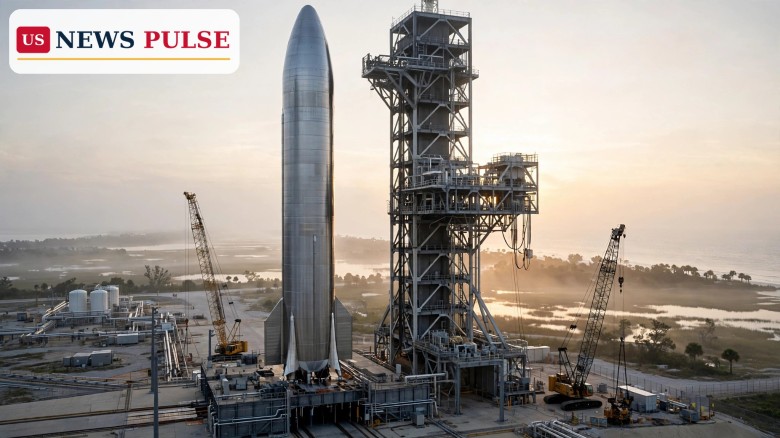
SpaceX has paused rocket launches from Florida for at least six weeks, leaving the Space Coast unusually quiet as the company finishes preparing for the Florida debut of Starship, its giant next-generation rocket. The SpaceX Florida launch pause was confirmed by a senior company executive last week, and it means no rocket of any kind is currently scheduled to lift off from Kennedy Space Center or Cape Canaveral Space Force Station in the near term.
For a state used to rockets thundering overhead several times a month, the silence is striking. Florida set a record with 109 launches in its last full record year, according to Florida Today, but 2026 has already seen a marked slowdown. The most recent Florida launch, a Falcon 9 flight on October 20, was only the 60th mission of the year, and SpaceX now says the next Falcon 9 from the Cape is six weeks away.
Speaking at the Cocoa Village Playhouse on October 21, Dontchev addressed the slowdown directly. "I think you Floridians are noticing we're not launching Falcon 9 as much right now, right?" he asked the audience, according to Florida Today. "We have a six-week gap before the next Falcon 9."
That gap began the day after the last launch. On October 20, a Falcon 9 lifted off from Cape Canaveral Space Force Station on the Bandwagon-5 rideshare mission, sending 32 payloads, including small satellites and other technology, to orbit on a southeast trajectory over the Atlantic. The predawn liftoff was the second in a row with the potential to produce the glowing "jellyfish" effect in the sky, as exhaust catches sunlight high above the dark ground. It may also be the last Florida launch for some time.
The pause is not a response to a failure. No accident or anomaly was cited. Instead, SpaceX is deliberately clearing its Florida schedule while it completes the groundwork for a much larger rocket, and while the rest of the industry is also, for different reasons, on the ground. The result is a Space Coast with no firm launch date on the books at all, a rare state of affairs for a region that has become synonymous with frequent spaceflight.
The slowdown did not start this month. On August 25, SpaceX flew its final planned Falcon 9 mission carrying Starlink satellites from Florida. That flight, Starlink 10-49, carried 29 satellites from Space Launch Complex 40 and was the 100th Falcon 9 launch of 2026. Dontchev marked the moment himself, calling it "the end of an era" for Falcon 9 Starlink launches on the East Coast and confirming that future Starlink missions from Florida would fly on Starship, while the West Coast team would continue launching Starlink from Vandenberg.
Since then, Falcon 9 flights from Florida have been limited largely to rideshare missions and flights carrying astronauts and cargo to the International Space Station. Starlink deployment, the workhorse activity that once filled the Florida manifest week after week, moved west. In early October, for example, SpaceX launched 27 Starlink satellites from Vandenberg after three scrubs, continuing the constellation build-out from California while Florida wound down.
The numbers tell the story of the transition. Florida recorded 109 launches in its record year, but the pace in 2026 has fallen well short of that, with only 60 missions by October 20. The six-week gap now extends that drought into December, and with no other provider ready to step in, the total for the year will end far below the record.
Starship is the reason for the pause, and its scale explains why the preparation takes so long. Fully stacked, the rocket stands more than 400 feet tall, making it the largest rocket ever flown. To date it has launched 14 times, all from Starbase, SpaceX's headquarters site in South Texas. For years, however, the company has been preparing to expand Starship operations to Florida, with launches planned at both Kennedy Space Center and Cape Canaveral Space Force Station.
Dontchev said the Starship launch infrastructure at Kennedy Space Center's launch pad 39A "is effectively complete at this point," with engineers applying lessons learned from the second, newest Starship launch tower at Starbase. Doors will soon be installed at Gigabay, the black 380-foot facility near Roberts Road at Kennedy Space Center designed for stacking and preparing Super Heavy boosters for liftoff.
The logistics are as large as the rocket. Crews will manufacture Starship boosters and ships in Texas, then transport them horizontally aboard SpaceX's barge, You'll Thank Me Later, around the Florida peninsula to Port Canaveral and the Kennedy Space Center Turn Basin for offloading. It is a supply chain built for a vehicle too big to move by road, and it has to work flawlessly before the first Florida flight.
Regulators have already done much of their part. On January 29, 2026, the Federal Aviation Administration selected its preferred environmental alternative for Starship-Super Heavy operations at launch complex 39A. The environmental review assessed a proposal for up to 44 Starship launches, 44 Super Heavy landings and 44 Starship landings per year. The decision does not itself grant a vehicle-operator licence, which carries separate safety, risk and indemnification requirements, but it removed a major hurdle.
Dontchev's remarks were the clearest public signal yet that the Florida pause is deliberate and temporary, not a problem to be fixed. "If you haven't seen a signal that it's 'game time' on Starship, that's it," one industry summary of his appearance put it, reflecting the sense among space watchers that the company is now fully committed to the transition.
On the purpose of the new rocket, Dontchev was expansive. Starship will deploy larger and more powerful Starlink satellites, carry NASA astronauts toward the Moon under the Artemis programme, and, in chief executive Elon Musk's long-term vision, carry people to Mars. "Eventually, we're going to fill that vehicle with 100 humans and send them to Mars," Dontchev said. Of the switch from Falcon 9 for crewed missions, he added: "It's going to be a whole 'nother vibe."
The business case for the switch is also clear. Starlink's next-generation V3 satellites were designed around Starship's payload volume. SpaceX estimates that a single Starship launch can deploy up to 60 V3 satellites, delivering roughly 20 times the total downlink capacity of a single Falcon 9 Starlink flight, with each V3 satellite designed to supply up to 1 terabit per second of bandwidth. Company chief financial officer Bret Johnsen has said Starlink connectivity revenue reached 5.2 billion dollars for the quarter, up 22 percent, and that V3 deployment in meaningful volume is expected through the end of the year and throughout 2027.
There has been no public complaint from Florida officials about the pause, and local space coverage has framed it as the price of a bigger prize: a Florida Starship programme that could bring larger, more spectacular launches than Falcon 9 ever offered. The Space Coast's tourism and hospitality businesses, which benefit from launch crowds, will feel the quiet weeks, but the prospect of a first Florida Starship flight before the end of the year gives them something to sell.
The pause matters first because it marks the end of an era. Falcon 9 is the most flown rocket in history and the vehicle that made routine, reusable spaceflight normal. Its Florida Starlink campaign built the largest satellite constellation ever deployed and turned launch-watching into a regular Florida pastime. The six-week gap is the visible moment when that era gives way to the next one, and there is no guarantee the transition will be smooth.
It matters second for the United States' Moon plans. NASA's Artemis programme depends on Starship to land astronauts on the lunar surface, and a Florida Starship capability would give the agency a second launch site for the giant rocket, alongside Starbase. Delays in Florida would not by themselves delay Artemis, but a successful Florida debut would de-risk a programme that has already been reshaped this year, with NASA revising its landing plans to target 2028.
It matters third for competition. With Blue Origin's New Glenn out of service while its Cape Canaveral launch complex is repaired and improved, and United Launch Alliance's Vulcan grounded since an anomaly on its last flight in February, the United States currently has no heavy-lift alternative ready to fill the Florida gap. That concentration of capability in one company, and one vehicle family, is a vulnerability as well as a strength, and the pause exposes it.
Finally, it matters for Florida itself. The Space Coast has built an economy around frequent launches: hotels, restaurants, tour operators, and the Kennedy Space Center Visitor Complex all benefit when rockets fly. A six-week drought, on top of an already slow year, is a real, if temporary, economic cost. The payoff, if Starship flies from Florida by year's end as hoped, would be a new chapter in which the world's largest rocket becomes a regular sight over the Atlantic.
The immediate next step is the completion of Gigabay and the arrival of the first Starship hardware by barge at Port Canaveral. SpaceX has said it hopes to launch Starship from Florida before the end of 2026, which would put the debut within weeks of the end of the Falcon 9 gap. No firm date has been announced, and the Federal Aviation Administration's planning advisory listed no Florida launch with a firm target date as of October 27.
Watch for three signals. First, the installation of Gigabay's doors and the movement of Super Heavy hardware in Texas. Second, the barge transit around the Florida peninsula, which is hard to hide and usually tracked by space enthusiasts. Third, any Federal Aviation Administration licensing action for a Florida Starship flight, which would confirm that the environmental approval is being converted into a flight licence.
In California, meanwhile, Falcon 9 will keep flying Starlink missions from Vandenberg, so the constellation will keep growing even while Florida is quiet. And at Cape Canaveral, Blue Origin has said it remains committed to launching New Glenn before the end of 2026, which could, if it happens, break the Florida drought from an unexpected direction.
If the six-week timetable holds, the next Falcon 9 from Florida would come in early December. By then, the question may no longer be when Falcon 9 returns, but whether Starship has already taken its place as the rocket Florida watches.
SpaceX is pausing Falcon 9 launches from Florida for six weeks to complete preparations for Starship operations, including finishing launch infrastructure at Kennedy Space Center pad 39A and the Gigabay booster facility, according to vice president of launch Kiko Dontchev.
The last Florida launch was on October 20, 2026, when a Falcon 9 flew the Bandwagon-5 rideshare mission from Cape Canaveral Space Force Station, carrying 32 payloads to orbit.
Dontchev said on October 21 that there would be a six-week gap before the next Falcon 9, pointing to early December. SpaceX also hopes to launch Starship from Florida before the end of 2026, but no firm date has been announced.
As of October 27, no. Blue Origin's New Glenn is out of service for launch complex repairs and improvements, United Launch Alliance's Vulcan is grounded after a February anomaly, and the Federal Aviation Administration lists no Florida launch with a firm date.
Starship is SpaceX's next-generation rocket, more than 400 feet tall when fully stacked. Its larger payload volume allows it to carry up to 60 next-generation Starlink V3 satellites per flight, about 20 times the downlink capacity of a Falcon 9 Starlink flight, and it is also the vehicle NASA plans to use for Moon landings.
Related coverage on US News Pulse: NASA's revised Artemis plan for a 2028 Moon landing, NASA ends the Swift Observatory mission after 22 years, and how SpaceX and Blue Origin are racing to return astronauts to the Moon.
Leave a Comment



 | Today's Date: