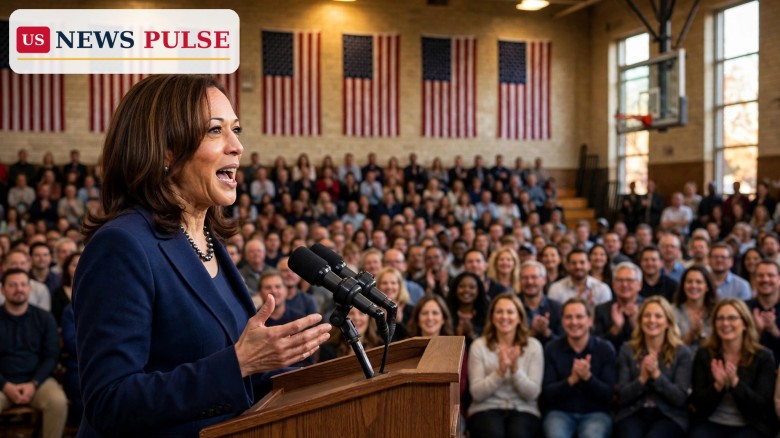
Kamala Harris 2028 speculation burst back into the open this week as the former vice president admitted she still has not decided whether to run for president again, telling CNN in Mississippi: "I go back and forth. I honestly go back and forth." The remark, made while she campaigned for Democratic Senate candidate Scott Colom one week before the November 3 midterm elections, instantly reframed a closing campaign blitz that has already taken her to more states than almost any other potential Democratic contender.
Harris spoke to CNN during a surprise stop at Coahoma Community College in the Mississippi Delta, where she greeted the student body representative with a disarming joke: "Nice to meet you, Madam President." She then travelled to a rural health clinic in Clarksdale and to a rally in Columbus, where more than 1,000 people filled a school gym, with an RSVP list closed because of the fire marshal. The visit was part of her campaigning for Colom, whose challenge to Hyde-Smith has drawn a new burst of national attention and outside money from both parties.
Backstage before her Columbus speech, and two days after her 62nd birthday, Harris reflected on the loss that still shapes Democratic politics. "There are so many people who were devastated with the outcome of that election — for good reason, for really good reason," she said. "That pain, it lingers, because every day we are witnessing events that we know didn't have to happen. Could have been different." After the interview ended, she asked to go back on the record with a line that has since travelled widely: "The American people want leaders who aren't just occupied with looking in the mirror. They want leaders who are looking at the people, you know? And they can tell the difference."
On the question every Democrat wants answered, she was candid about her indecision. Asked whether her answer could remain unchanged for six months or even a year, she said: "I don't know." She added a clear statement of motive if she does run: "I'll be very specific. If I run, my motivation is not to beat other Democrats. It's to actually do the job." That framing matters, because it separates a future campaign from a simple rematch narrative and presents it instead as a governing argument.
Harris became the Democratic nominee in 2024 after President Joe Biden dropped out 107 days before Election Day, and she lost to President Donald Trump. She had earlier run for the 2020 Democratic nomination, ending that campaign before any votes were cast. In her memoir, 107 Days, she later described Biden's decision to seek another term as "reckless," a judgment that still colours how many Democrats view the last cycle. Since then she has spent much of the past year on an extended book tour that took her to 27 states and, CNN reported, made her millions more than expected.
The midterm blitz is deliberately built around the Democrats' 2028 calendar. Her expanded closing stretch, shared first with the Associated Press, runs from October 21 to October 30. She opened on October 21 in Nevada with Aaron Ford, the state's first Black attorney general, who would be its first Black governor, and met Culinary Workers Union members. Nevada holds the second 2028 presidential nominating contest, after South Carolina. On October 22 she was in Mississippi with Colom, who would be the state's first Black US senator since post-Civil War Reconstruction. From there she headed to New Hampshire on October 24 to campaign with Senate nominee Chris Pappas and take part in a discussion on reproductive care and abortion rights; New Hampshire comes third in the Democrats' 2028 primary order.
She campaigned with Wisconsin gubernatorial nominee David Crowley on October 26, and finishes with a three-day swing in Georgia beginning October 28, campaigning with Senator Jon Ossoff, attending voter protection events and speaking on October 30 at the Fulton County Democratic Party's annual gala in Atlanta. While in Georgia she will also headline a virtual organising event with Florida Senate nominee Angie Nixon, who would be her state's first Black US senator. The itinerary follows earlier appearances in Michigan for Senate nominee Abdul El-Sayed and at a Detroit NAACP event, and a schedule that, by Election Day, will have taken her to multiple early primary states.
Harris has not hidden from the criticism. CNN reported that much of the political insider world has been clear in not wanting her to run again, or not wanting to hear from her again at all, citing donor cultivation, staff turnover and an overly cautious style during her previous campaigns, alongside the party's difficult year after Biden's collapse, the Gaza debate and Trump's return. She answered that criticism directly in Mississippi, with humour and defiance. "I'm sure there are many who think that I should just sit at home and eat bonbons and cook Doug's favorite foods," she said. "I could cook Doug's favorite foods and do this."
That line was also a response to a Wall Street Journal report that her husband, Doug Emhoff, had privately told some people he preferred she did not run again. Harris said Emhoff was upset at his feelings being portrayed inaccurately, and a person who has spoken directly with him told CNN his more precise feeling was that the moves the two of them have been making were not done with a plan to run again. Harris herself framed her activity differently: "I feel so strongly and therefore am compelled, and maybe propelled, into doing this, because I know that I can help. And how can I sit at home in the comfort of my home when I know there are things I can do to help? I don't know any other life but that — that's my point. I don't know any life that is not about, 'There's a problem, what can I do to fix it?'"
Yet the crowds tell a more complicated story than the insider scepticism. In Mississippi, Harris drew more than 1,000 people to a gym in Columbus, while Senator Raphael Warnock, who told CNN he is considering a presidential run and was a main engine of getting Democrats to focus on Colom's race, drew 100 people when he came to the state two weeks earlier. Representative Bennie Thompson, the lone Democrat sent to Washington from Mississippi, who connected Harris with Colom in January after bringing her book tour to Jackson, told CNN: "In this community, it transcends the fact that she lost the last election." Patrick Gaspard, a former Obama White House political director who filmed the Columbus crowd on his phone, offered a boxing analogy: "When Muhammad Ali was trying to regain the heavyweight crown, there were a lot of people who were saying they didn't want him fighting again, they didn't want him in the ring. They were saying that not because they were worried that Muhammad Ali would fall flat on his face — they were worried he would win."
Colom himself explained why he overruled consultants who initially opposed having Harris join his events, worried about nationalising the race. "The question is: why does Vice President Harris care more about healthcare in our hospitals than our junior senator? If she cares more than our junior senator, I want to bring attention to that issue because that matters," Colom told CNN after the rally. "You see how many people showed up, you see the excitement. People care about folks that are going to fight for the people." His campaign focus — 400,000 people in Mississippi without health insurance, rural hospitals closing, and mothers waiting for a limited number of ambulances — gave Harris a concrete local issue to carry, and a dozen reporters from across the state followed her to a maternal health clinic struggling to cover costs.
Other Democrats have been more cautious. Some candidates, including Rob Sand, running for governor in Iowa, and Adam Hamilton, running for Senate in Kansas, have said they do not want her to come, and Harris said she does not take that personally. "Oh, I want them to do whatever they need to do to win. I mean that sincerely," she told CNN. "I have run for local, state, and national office. I am not naïve. And I want to win, and I respect whatever decisions they need to make in order to do that." She also declined to draw a line against Nixon, who identifies as a democratic socialist, saying of the party: "We are, as we say, a big tent, and I don't think anybody should be kicked out."
Polling underlines the split. A June Reuters/Ipsos poll found 39 percent of Americans viewed Harris favourably, rising to 82 percent among Democrats but falling to 7 percent among Republicans and 33 percent among independents. That profile — dominant with the Democratic base, weaker with independents — is both her strength in a primary and the central question for a general election. Brookings senior fellow Elaine Kamarck described her role as a familiar election strategy, noting: "At the end of a campaign, you bring out your heavy hitters." Democratic strategist Scott Ferson suggested she could appeal to voters who turned away from the party in 2024 or stayed home.
The 2028 question matters now, not in 2027, because the field is already moving. CNN reported that Kentucky Governor Andy Beshear has discussed a plan to launch his campaign shortly after the December meeting of the Democratic Governors Association, when he wraps up his stint as its chair, although a senior adviser to his political action committee denied he had discussed such a plan, calling it "categorically false." Maryland Governor Wes Moore has started telling people that after November he will take another look at running, after months of public denials. Arizona Senator Mark Kelly and former Transportation Secretary Pete Buttigieg have been travelling the country stumping for candidates, including in early states, while New Jersey Senator Cory Booker has quietly banked 20 million dollars and started thinking through a South Carolina and Super Tuesday-focused strategy. Operatives for multiple likely contenders are already assembling opposition research files and asking around for staff.
Harris's own position is deliberately different. She did not, unlike Pennsylvania Governor Josh Shapiro, Illinois Governor JB Pritzker and Georgia Senator Jon Ossoff, hit the Hamptons fundraising circuit this summer. She has not launched the extensive engagement tour championing Black voting rights that an internal memo circulated among her advisers had proposed after the Supreme Court's Callais decision. Her motorcade is now just two cars, with no sirens. She flies commercial. She pays for staff and security out of the limited fundraising she is still doing off her old campaign email list, which has forced her to pick between stops she was asked to make and to stack several virtual appearances into days spent in a hotel room with a computer. "I have more access, you know? It's like, the bubble is smaller, and that's nice. Or there's not a bubble," she said.
Mississippi also offers a preview of a larger strategic argument. The state will not be an early stop on the 2028 presidential calendar, but its electorate could offer a preview of what might await Harris in South Carolina, which is set to host the first Democratic primary again and where Black voters are critical. Harris challenged the conventional wisdom directly: "Those are red states, we can't win there, therefore we won't go there, as opposed to reconditioning ourselves to think about the fact that there are a lot of people who live here who actually care about the things we care about and deserve to be heard and deserve to have us spend our time and resources sitting with them and listening to them." For a party debating whether to compete everywhere or concentrate on swing states, that is a real choice, not just a campaign slogan.
The immediate calendar is fixed: Harris's Georgia swing runs from October 28 to October 30, ending with the Fulton County gala in Atlanta, and the midterm elections follow on November 3. After that, the 2028 timeline accelerates quickly. Beshear has said he will have a conversation with his family at the end of the year when he is no longer Democratic Governors Association chair, and Moore is expected to take another look after November. Other Democrats could start campaigns in the next several weeks, CNN reported, and the December governors' meeting is a natural decision point for several of them.
For Harris, the next test is whether the midterm results strengthen or weaken her case. A strong Democratic night, especially in the races she campaigned in, would let her argue that her presence helps. A weak night would let critics argue the opposite. Either way, her own deadline is self-imposed and vague: she has said she does not know whether her indecision will last six months or a year. What she has ruled out is disappearing. "I feel so strongly and therefore am compelled," she said in Mississippi, and her schedule — Georgia this week, and a party that will be looking for its next standard-bearer the morning after November 3 — suggests that compulsion will keep her in the centre of the conversation whether or not she ultimately runs.
Is Kamala Harris running for president in 2028? Not yet. She told CNN she goes "back and forth" and has not decided, saying she does not know whether her indecision will last six months or a year.
Where has Harris been campaigning in the final midterm stretch? From October 21 to October 30 she has campaigned in Nevada, Mississippi, New Hampshire, Wisconsin and Georgia, with a Florida virtual event, after earlier stops including Michigan and Detroit.
Who is Scott Colom, the Mississippi candidate Harris campaigned for? Colom is the Democratic Senate nominee challenging Republican Senator Cindy Hyde-Smith. He would be Mississippi's first Black US senator since post-Civil War Reconstruction.
Who else might run for the 2028 Democratic nomination? Potential contenders mentioned in recent reporting include Andy Beshear, Wes Moore, Cory Booker, Pete Buttigieg, Mark Kelly and Raphael Warnock, who says he is considering a run.
When will Harris have to decide? There is no formal deadline yet. The practical pressure builds after the November 3 midterms and the December Democratic Governors Association meeting, when several rivals are expected to make their own decisions.
Related coverage on US News Pulse: Trump says he will respect midterm results only if elections are honest; Trump Texas rallies, Paxton, methane plan and a Talarico surge; American Forge Coalition mailers target battleground Republicans.
Leave a Comment



 | Today's Date: