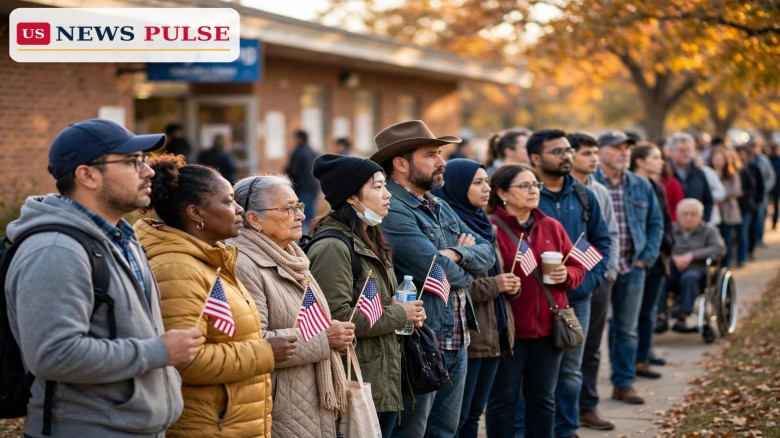
More than 43 million Americans have already cast their ballots in the 2026 midterm elections, an early voting surge that is running well ahead of recent midterm pace with just four days to go before Election Day on Tuesday, November 3. The figures, compiled by the University of Florida Election Lab and reported on Friday, October 30, show between four and five million early votes being cast every day, a tempo that has put overall turnout on course to challenge even presidential-year levels in some states.
The national picture landed on Friday morning as the final weekend of campaigning began. With less than a week until polls close, the Election Lab count showed more than 43 million ballots already in, driven by four to five million votes a day. Professor Michael McDonald, who runs the database, told the BBC that Texas has posted the highest above-average turnout rate in the country so far, and that Hispanic communities are turning out at a much higher rate than usual.
The surge is not confined to Texas. In the Northeast, more than 1.11 million people had voted early in New York by Wednesday evening and more than 903,000 in Massachusetts, according to state election boards. Vermont reported 131,611 early voters, a turnout rate of 26.1% before Election Day. In Albany County, New York, nearly 26,800 early ballots had already beaten the county's entire nine-day early voting total from the 2022 midterms.
Minneapolis confirmed on Thursday that it had set an early voting record for a non-presidential election. In Detroit, city clerk Janice Winfrey projected turnout of 40% to 45% for the November election, up from 34% in 2022, with about 70,000 votes already cast in the city, including 10,000 early votes and 60,000 returned absentee ballots out of 106,000 issued.
Early voting has boomed in the United States in recent years, a shift accelerated by the Covid pandemic, when more states expanded in-person and mail-in options. In the 2020 presidential election, more than two-thirds of all ballots were cast before Election Day, and half of those early votes arrived by mail. Voters are now increasingly choosing to vote in person even when they vote early, and to return mail ballots earlier than in past cycles.
McDonald suggested that concern about postal voting may be part of the reason, noting that postal votes are more likely to be disqualified over errors and that some voters worry about interference with the mail service, though he stressed there is no data proving the cause. The 2018 midterms set the modern turnout record for a midterm, beating a mark that had stood since 1914, and the current pace has put 2026 on track to challenge that kind of turnout.
The stakes explain much of the energy. The midterms will decide which party controls Congress for the remaining two years of President Donald Trump's second term. Republicans hold the Senate 53-47, so Democrats need a net gain of four seats to take the chamber. The Texas Senate race between Republican Ken Paxton and Democrat James Talarico has become one of the most closely watched contests in the country, with prediction markets giving Talarico an implied probability of about 69%, up from 61% when early voting opened on October 19.
Texas is the engine of the national surge. More than 5.8 million ballots have been cast in the Lone Star State, already about 1.75 million ahead of its 2022 total, with nearly 19 million Texans registered to vote. Dallas County set a single-day early voting record on day one of the period, with more than 88,000 ballots cast. In Hidalgo County, about 113,000 people have voted early, around 24% of registered voters, while Cameron County has logged about 54,000 votes, or 22%. Tarrant County cast more than 50,000 ballots on day one alone, roughly 21,000 more than on the first day in 2022.
The demographic detail matters as much as the headline totals. In the three states that require voters to submit their race when they register, North Carolina, Georgia and Florida, the data show rising votes from Hispanic and Black communities, while voting among white people is roughly on par with 2022 early voting. Texas does not require voters to give party affiliation or race, but McDonald pointed to border counties that are more than 90% Hispanic, where early voting alone is on course to beat their full 2022 turnout in some cases.
In the states that do record party affiliation, roughly half the country, Democrats have increased their share of the early vote compared with 2022, while Republican early voting is running at a generally similar level. Voting by people who chose no party has also risen. That last group is the great unknown of the count: the data show they voted, but not for whom.
McDonald linked the demographic pattern directly to the coalitions of the two parties. “That makes sense because communities of colour are more frequently part of the Democratic coalition, and whites are more frequently part of the Republican coalition,” he said. On the Texas border counties, he added: “When I look at those counties, what I see is some of them are going to beat their 2022 turnout in just the early vote alone.”
Detroit officials framed their projection in the same terms of a changing electorate. Winfrey said the city had looked at 2014, 2018 and 2022 alongside its absentee returns to reach the 40% to 45% forecast, and expected between 105,000 and 125,000 people to vote in person on Election Day, with 75,000 to 80,000 absentee ballots received by Tuesday. The city has already begun pre-tabulation, with about 27,000 ballots tabulated so far.
Analysts urged caution about reading the Texas numbers as a prediction. The Action Network noted that while Talarico's prediction-market price has risen sharply during early voting, drawing a direct line between surging turnout and shifting market odds would be premature, since historic participation does not guarantee a particular outcome.
A record early vote changes the final days of a campaign. When tens of millions of ballots are already banked, the fight shifts to the shrinking pool of voters who have not yet cast one, and to making sure mail ballots are returned correctly and on time. It also changes what Election Night looks like: states that count early votes first will report large early batches, while states that wait will see the picture move later in the evening.
Texas is the clearest test of whether turnout itself can move a state. If Talarico wins, it would be the biggest Democratic breakthrough in Texas since 1988; if he loses after record participation, it would be one of the party's most crushing disappointments of the cycle. Either way, the state's final early voting day on Friday will set the baseline against which Tuesday is judged.
The national party split in the early vote also matters for expectations. Democrats lead the early count in affiliation states, but Republicans have traditionally voted more heavily on Election Day itself, and unaffiliated voters, nearly a quarter of the early electorate in those states, could break either way. Nobody will know the result until the ballots are counted.
In Texas, in-person early voting ends on Friday, October 30. There is no voting on Saturday, Sunday or Monday in the state, and Election Day polls open from 7 a.m. to 7 p.m. local time on Tuesday, November 3. Voters in many areas must use their assigned precinct on Election Day, unlike early voting, when they could vote anywhere in their home county. Mail ballots must be postmarked by 7 p.m. or hand-delivered to the county elections office before polls close.
Elsewhere, early voting windows close on different days, with New York's running through Sunday. Campaigns will spend the weekend on get-out-the-vote drives and on the tele-rallies President Trump has substituted for cancelled in-person rallies in Kansas and Iowa, while the final in-person rally of the campaign trail takes place in Daytona Beach, Florida, on Friday evening.
Counting will then take over. Some states will report early and mail ballots quickly; others will take days, and close Senate races may not be called on Tuesday night. The early vote surge guarantees a huge first tranche of results, but not a fast finish.
More than 43 million ballots had been cast by Friday, October 30, according to University of Florida Election Lab data, with four to five million votes being cast each day.
No. The 44% Democratic, 31.2% Republican split covers only the roughly half of states that record party affiliation, and it shows who voted, not how unaffiliated voters voted. Republicans traditionally vote more on Election Day.
Friday, October 30 is the final day of in-person early voting in Texas. There is no voting on Saturday, Sunday or Monday, and Election Day is Tuesday, November 3, with polls open 7 a.m. to 7 p.m.
Polls have shown a close race between Republican Ken Paxton and Democrat James Talarico, and prediction markets give Talarico about a 69% implied chance, but markets are not votes and the margin is expected to be a handful of percentage points.
Some races will be called on Tuesday night, but close Senate contests and states that count mail ballots slowly may take days. Early votes are counted first in some states and later in others.
Related coverage: CNN Senate polls: Democrats lead in Michigan, Texas, Maine and Kansas before midterms; Trump reporter clash: ‘You are disgusting’ as Daytona rally ends sprint; DOJ Alaska subpoenas target Democrats in Senate race days before midterms.
Leave a Comment



 | Today's Date: