Households in eight Florida Panhandle counties can now apply for direct federal help after Hurricane Isaias, after FEMA individual assistance Florida approval unlocked the household aid programme that was left out of the first disaster declaration. The Florida Division of Emergency Management announced on Thursday, October 29, 2026, that Individual Assistance had been approved for Bay, Escambia, Gulf, Holmes, Okaloosa, Santa Rosa, Walton and Washington counties, three weeks after the Category 2 storm struck the Panhandle on October 9.
The decision closes the gap that frustrated Panhandle residents for days: the major disaster declaration signed on October 27 covered governments and nonprofits, but not households. Until Thursday, residents who tried to register for household aid found the programme still listed as under review, and some received automatic denials. Now the door is open, even if the application link itself was not yet live when the announcement was made.
The Florida Division of Emergency Management announced the approval on Facebook on October 29, according to the Pensacola News Journal. The announcement said the assistance provides federal resources to impacted Floridians for housing, home repairs and other disaster-related needs, and that residents can apply soon at DisasterAssistance.gov. The newspaper noted that the link was not yet active at the time of the announcement, so households cannot complete an application this instant, but they can prepare now.
The eight counties match exactly the list Florida asked for when Governor Ron DeSantis submitted the major disaster declaration request on October 16. That request sought Public Assistance for 15 counties and Individual Assistance for these eight. The October 27 declaration, numbered DR-4955, approved the government programme for all 15 counties and left household aid under review. Thursday's decision completes the second half of the request.
For residents, the practical difference is large. Public Assistance reimburses state, local and tribal governments and certain nonprofits for emergency work and the repair of public facilities, with the federal government paying 75 percent of eligible costs and the state paying 12.5 percent. Individual Assistance, by contrast, pays households directly. Its Individuals and Households Program helps people with uninsured or underinsured necessary expenses and serious needs, including temporary housing and basic home repairs. The wider programme also includes crisis counselling, disaster case management, disaster legal services for low-income survivors, and disaster unemployment assistance for people whose work was interrupted by the storm and who do not qualify for regular unemployment compensation.
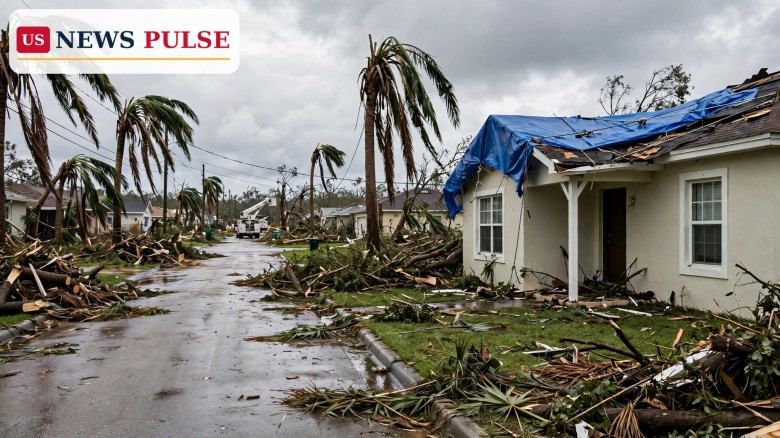
Hurricane Isaias came ashore near Destin on October 9 as a Category 2 hurricane, with much of the damage concentrated in Santa Rosa County and the western Panhandle. Gusts reached 117 mph at Oriole Beach, 116 mph at Santa Rosa Sound and 114 mph at Naval Air Station Whiting Field, and more than 400,000 customers lost power at the peak of the storm. Six storm-related deaths have been reported in Florida.
The financial toll is already large. Insured losses in Florida approach $582 million, with more than 55,000 claims filed statewide, including about 26,000 in Santa Rosa County and nearly 17,000 in Escambia County. Risk analysts at Moody's RMS estimated losses across multiple states at $2.5 billion to $4.5 billion. In Milton, in Santa Rosa County, an estimated 400,000 to 500,000 cubic yards of debris still awaited removal days after the storm, and Pensacola alone estimated its direct damage and cleanup costs at up to $47 million. The state says it has completed about 1,900 response missions and distributed more than 350,000 meals and 33,000 tarps since landfall.
The timeline matters for understanding why Thursday's announcement landed the way it did. An emergency declaration on October 9 covered immediate response work in 27 counties. DeSantis submitted the major disaster request on October 16, seeking roughly $237 million in federal resources. President Donald Trump signed the major declaration on October 27, twelve days later, approving Public Assistance for Bay, Calhoun, Escambia, Franklin, Gadsden, Gulf, Holmes, Jackson, Jefferson, Liberty, Okaloosa, Santa Rosa, Wakulla, Walton and Washington counties, with Brett H. Howard named as the federal coordinating officer. The incident period covered is October 6 to 12. Hazard mitigation funding remains under review.
FEMA individual assistance Florida applicants should understand both the promise and the limits of the programme before they apply. The maximum individual assistance payout is $44,800 for housing and $44,800 for other needs assistance, a combined ceiling of $89,600, but actual payments are typically a small fraction of that. Kevin Guthrie, who served as FEMA executive director until August, was quoted as saying: "Let's just be very candid, the average person is going to get a $4,500 payout from FEMA." The Pensacola News Journal reported that the average person receiving FEMA assistance in 2025 got $3,182 in cases of severe storms and $3,118 for hurricanes, while families of five or more secured payments averaging $4,800 and single-person residences received less.
FEMA also cannot pay for damage or expenses already covered by insurance, and it cannot duplicate benefits. Homeowners do not have to file their insurance claim before applying, but they will be required to provide their insurance settlement or denial before being considered for certain types of assistance. That makes the paperwork steps important: take photos of the damaged home and belongings, make a list of damaged or lost items, and file the insurance claim promptly so the FEMA file is not held up later.
When the application opens, residents will need a Social Security number, annual household income, contact information including the damaged home address, bank account information for direct deposit if approved, and insurance details including the type of policy and the insurer's name. Applications can be made online at DisasterAssistance.gov, through the FEMA app, by phone at 800-621-3362, or in person at a Disaster Recovery Center. FEMA teams may also visit neighbourhoods door to door; they carry official FEMA photo identification. Recovery centres remained open in Escambia, Okaloosa, Walton and Washington counties as the household decision arrived.
The timing of the approval has become part of the story. A review of federal records found that Trump approved disaster aid for the Florida Panhandle faster than he had approved all but four other requests in his current term that were not officially expedited, approving DeSantis's rebuilding-aid request in 12 days. By contrast, the same review found that Trump has slowed disaster aid in his second term, taking an average of 50 days to approve or deny requests from states, territories or tribes, exactly twice as long on average as in his first presidency. Six other disaster requests received before DeSantis sought help after Isaias were still awaiting action, three of them from tribal nations that rely heavily on federal help after disasters.
The White House did not answer questions about the timing of the Florida approval, but said there was no politicisation of the president's disaster relief decisions. Democrats renewed criticism that Trump had politicised disaster aid. Representative Frank Pallone of New Jersey said disaster relief under Trump came with a political loyalty test, recalling the recent denial of aid to New Jersey and three other Democratic-led states. House Homeland Security ranking member Bennie Thompson of Mississippi called the timing very suspicious while other states were still waiting.
The hurricane response has become an issue in the tight Florida governor's race, with both candidates campaigning in the Republican-leaning Panhandle, where the storm hit. The household-aid approval came the day after Democratic candidate David Jolly blamed Trump for a slow hurricane response, while Republican candidate Representative Byron Donalds vowed to secure aid quickly. Donalds has said: "I've been working closely with the White House to get this done, and President Trump delivered just days after receiving the request from the Great Governor DeSantis." His campaign spokesperson said he had worked closely with the president to deliver relief. Jolly said people were hurting and he was glad Trump had acted.
For Panhandle families, the practical effect is straightforward: thousands of households that were locked out of direct help for three weeks now have a route to money for a hotel room, a roof repair, a replaced appliance or another essential cost that insurance did not cover. With nearly 8,500 Isaias claims already closed without payment and many more still working through the insurance system, even a typical few-thousand-dollar FEMA payment can bridge the gap between a damaged home and a liveable one. The programme is designed for exactly that situation, uninsured and underinsured losses, rather than as a replacement for insurance.
For the wider country, the case is a test of how disaster aid is timed and perceived. Presidents sometimes approve residential aid and reconstruction aid separately, and the two Isaias approvals together cover a large share of the Panhandle's damage. But when one state's household aid arrives in days while six earlier requests, including three from tribal nations, are still pending, the contrast invites questions that go beyond Florida. Those questions will follow the administration into the next disaster, and into the election that Florida voters will decide on November 3.
The immediate next step is the activation of the DisasterAssistance.gov link for Isaias, which residents should check regularly along with the FEMA app and the helpline. Once applications open, FEMA inspectors will assess damage, and households should keep photos, lists and insurance correspondence ready. Residents who have not yet filed an insurance claim should do so, since the settlement or denial will be needed for certain assistance types.
Two decisions remain open: hazard mitigation funding, which helps communities reduce future risk, is still under review, and the longer recovery work funded by Public Assistance, debris removal, road and utility repairs and public building restoration, will continue for months. Voters in the Panhandle will also have their say on November 3, when the governor's race and other statewide contests will test whether the speed of the federal response changes minds in the counties the storm hit hardest.
Bay, Escambia, Gulf, Holmes, Okaloosa, Santa Rosa, Walton and Washington counties. These are the eight counties Florida requested household aid for on October 16.
Apply online at DisasterAssistance.gov once the Isaias link is active, through the FEMA app, by phone at 800-621-3362, or in person at a Disaster Recovery Center. You will need your Social Security number, household income, contact details, bank information and insurance details.
The maximum is $44,800 for housing plus $44,800 for other needs, but typical payments are far smaller. The average payout is around $4,500, and 2025 averages were $3,182 for severe storms and $3,118 for hurricanes.
No. FEMA cannot pay for losses covered by insurance and cannot duplicate benefits. File your insurance claim as well, and be ready to share the settlement or denial with FEMA.
Public Assistance reimburses governments and certain nonprofits for emergency work and public infrastructure repairs. Individual Assistance pays households directly for housing, repairs and other disaster-related needs.
Related coverage: Trump approves Isaias disaster aid for 15 Florida counties, King tides flood US coasts, and Daytona coastal flood warning for the Florida coast.
Leave a Comment



 | Today's Date: