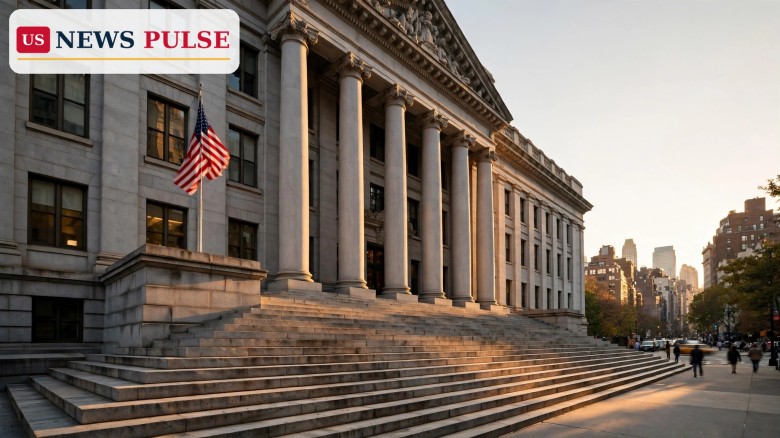
Judge Alvin Hellerstein dies at 92, closing a judicial career that ran for nearly three decades in Manhattan and touched some of the most consequential cases of the modern era. The senior federal judge died on Wednesday, October 28, 2026, surrounded by his family, according to a statement from Chief Judge Laura Taylor Swain of the Southern District of New York. No cause of death was given in the initial reports, and his funeral was scheduled for Thursday at Riverside Memorial Chapel in Manhattan.
Hellerstein was a rarity on the federal bench: a judge who kept a full, demanding caseload deep into his nineties while most of his contemporaries had long since slowed down or retired. Two weeks before his death he was still presiding over the prosecution of ousted Venezuelan leader Nicolas Maduro, and in August he delivered one of his last major rulings, again refusing President Donald Trump's effort to erase his hush-money conviction. His death leaves one of the country's most watched criminal trials, the Maduro case, in new hands just months before it was due to begin.
The news of Hellerstein's death broke on Wednesday, October 28, 2026, first through a published death notice and then through a statement from the court. Chief Judge Laura Taylor Swain remembered him as a "distinguished jurist" and praised his "energetic and dedicated service" to the court, which she said continued until his death. "He is greatly appreciated and will be sorely missed," she said. A court statement added that he "lived a life of commitment to public service and devotion to his community" and that his "example and work ethic will continue to be a model for this court."
Hellerstein died on Wednesday morning, the Associated Press reported, citing the court. The reports did not give a cause of death. His funeral was scheduled for Thursday at Riverside Memorial Chapel in Manhattan, the AP said. A court spokesperson told Reuters that Hellerstein was surrounded by family when he died.
The timing of his death is striking because he had been visibly at work until almost the very end. At a bail hearing for Cilia Flores on October 8, Hellerstein coughed and struggled to speak at times, telling lawyers: "I have a voice problem. As long as you can understand — hear me, I'll keep going." He remained resolute that he would preside over the Maduro trial, which he had scheduled for next June. The Associated Press reported that Judge Analisa Torres will take over the case, while Reuters reported that his cases were expected to be randomly reassigned to other federal judges in Manhattan.
Alvin Kenneth Hellerstein was a New York native, born in 1933, who obtained his bachelor's and law degrees from Columbia University. He served as a first lieutenant in the Judge Advocate General's Corps, the legal arm of the US Army, and then spent 38 years as a Manhattan litigator, joining the firm Stroock & Stroock & Lavan in 1960. President Bill Clinton, a Democrat, appointed him to the federal bench in 1998, and he served as a district judge until he moved to senior status in January 2011. Senior status normally allows a judge to carry a reduced caseload; Hellerstein, by contrast, kept a robust docket and worked until his death.
He was also an Orthodox Jew who spoke openly about how his faith shaped his approach to judging. In a 2020 podcast, he said he scheduled sentencing hearings for Fridays so he could reflect during the Jewish sabbath on whether the punishments he handed down were fair. "As a judge, and as a Jew, I consider that everything I do reflects God and affects His image," he wrote in a 2013 law review article. According to a January 2026 report in The Forward, he displayed in his chambers the verse from the Torah "Tzedek, tzedek tirdof" — "Justice, justice you shall pursue." He served as chairman and president of the Board of Jewish Education and advocated for Jewish refuseniks in the former Soviet Union.
Colleagues and lawyers also knew him for a quirky independent streak and strict discipline in his courtroom. He insisted that spectators wear pandemic-era masks for years after other judges stopped the practice, and in 2016 the New York Times ran a feature about his weekly tennis match with three rabbis. The combination — formality, independence and a willingness to spend hours with litigants in chambers — became his trademark.
The case that put Hellerstein back in the headlines in his final months was the prosecution of Nicolas Maduro. Maduro and his wife were captured in January 2026 in a surprise US military raid in Caracas, and brought to Manhattan to face a narco-terrorism conspiracy case. Just two weeks before Hellerstein's death, he presided over their arraignment on torture charges that had been added to that case.
The arraignment produced one of the most memorable courtroom exchanges of the year. Maduro twice defied Hellerstein's request that he enter a plea to the charges. Irked, the judge took matters into his own hands, interjecting that "a plea of not guilty will be entered on behalf of Mr. Maduro." Maduro has pleaded not guilty, and his trial on torture and drug trafficking charges is scheduled for next June. Maduro's lawyer, Barry Pollack, said in a statement: "We were saddened to learn of Judge Hellerstein's passing and offer our condolences to his family."
The reassignment of the Maduro case is now one of the most consequential immediate consequences of Hellerstein's death. A new judge will have to master a sprawling, politically charged prosecution, with a trial date already set for June, and with a defendant whose capture itself was an extraordinary military operation. Whoever takes the case inherits not only the legal questions but the intense public and diplomatic scrutiny that has surrounded it from the start.
Chief Judge Swain's statement set the tone for the tributes. "Judge Hellerstein was an insightful and dedicated lawyer," she said in a statement carried by Reuters. "His energetic and dedicated service to this court continued until his death. He is greatly appreciated and will be sorely missed."
Lawyers who appeared before him recalled a judge who took the human side of cases seriously, above all in the September 11 litigation. Some of his former clients had died in the attacks, and lawyers said he showed great empathy to victims and their families, meeting with them for hours in his chambers and rejecting what he felt were low-ball settlement offers. In March 2010 he rejected as insufficient a settlement that would have paid at least $575 million to thousands of people who fell ill working in the toxic ash of the trade center, acknowledging that he was breaking with tradition by getting so involved. "Most settlements are private. A plaintiff and defendant come together, shake hands, and it's done with," he explained. "This is different," he said. "This is 9/11."
Not every ruling drew praise. Others were dismayed when, in 2008, Hellerstein ended an effort to force New York City government to keep searching for human remains in debris moved from ground zero to a Staten Island landfill. That tension — between a judge willing to intervene forcefully and litigants who wanted a different outcome — ran through much of his career, and it was part of why his courtroom was so closely watched.
Hellerstein's death matters for three reasons, each tied to a different chapter of recent American history. First, the Maduro trial. The prosecution of a captured foreign head of state is one of the most sensitive criminal cases ever brought in a US courtroom, and it now loses the judge who had steered it through its first, most volatile months. The transition to a new judge, with a June trial date on the books, will be watched in Washington, Caracas and across Latin America.
Second, the Trump cases. Hellerstein handled multiple matters concerning the president, and his rulings repeatedly kept the hush-money conviction in state court rather than allowing it to be moved to federal court and dismissed on immunity grounds. In August 2026, in what became one of his last significant rulings, he wrote: "Paying hush money to an adult film star or engaging in a cover-up of an embarrassment are not subsumed in presidential immunity." That was the third time he had denied Trump's requests to move the case — the first after Trump's March 2023 indictment, the second after his May 2024 conviction and a subsequent Supreme Court ruling that presidents and former presidents cannot be prosecuted for official acts. The 2nd US Circuit Court of Appeals had ordered him to revisit the matter, saying he erred by failing to consider "important issues relevant" to the request, while expressing "no view" on how he should rule. He ruled the same way.
Third, the September 11 legacy. Hellerstein presided over dozens of wrongful death, injury and property damage lawsuits in a two-decade effort that shaped how the legal system dealt with the aftermath of the attacks. His insistence on scrutinising settlements, and on hearing victims directly, set a standard for how mass-tragedy litigation is handled. That legacy will outlast any single ruling.
Beyond those headline cases, his recent docket showed the same range. Last year he oversaw the trial of Charlie Javice, founder of an education startup, who was convicted of defrauding JPMorgan Chase out of $175 million by exaggerating the customer base for her financial aid startup. In 2024 he presided over the trial of hedge fund founder Bill Hwang, convicted of fraud and market manipulation after the collapse of his Archegos Capital Management caused more than $10 billion of losses for banks. In 2025 he presided over a civil trial at which a jury ordered French bank BNP Paribas to pay nearly $21 million for giving the Sudanese government access to the US financial system as it engaged in atrocities two decades ago. And in 2015 he ordered a New York City cable company to pay a Texas woman $229,500 for flooding her phone with 153 robocalls.
In 2020, during Trump's first White House term, Hellerstein ordered the release of the president's then-estranged former personal lawyer Michael Cohen, concluding that the Justice Department tried to revoke Cohen's home confinement and return him to jail in retaliation for writing a book. The government's action, he ruled, was retaliatory and a First Amendment violation. It was a ruling that captured his approach: sceptical of government power when it appeared to be used for an improper purpose, and willing to say so plainly.
The immediate next steps are personal and procedural. Hellerstein's funeral is scheduled for Thursday at Riverside Memorial Chapel in Manhattan, where family, colleagues and members of the legal community are expected to gather. The court will then move to reassign his pending cases, with the Maduro prosecution the most urgent. The AP reported that Judge Analisa Torres will take over that case; the trial remains scheduled for next June, though a new judge may revisit scheduling and pretrial deadlines as she gets up to speed.
For the Trump hush-money matter, Hellerstein's August ruling stands as his final word on the subject, unless it is appealed further. For the September 11 litigation, his work is largely complete — the cases he shepherded for two decades have mostly resolved — but his approach to settlement scrutiny remains a reference point for judges handling mass-harm cases.
Longer term, Hellerstein's career will be studied as an example of a particular kind of federal judge: appointed in a different political era, serving through six presidencies, and still deciding the biggest cases of the day in his nineties. In an age when the federal bench is often discussed in terms of age, ideology and appointment politics, his record — a Clinton appointee who ruled against a Republican president's immunity claim, freed a Trump critic on First Amendment grounds, and presided over the trial of a captured socialist leader — resists easy partisan labelling. That independence was, by most accounts, the point.
Alvin Hellerstein was a senior judge of the US District Court for the Southern District of New York, appointed by President Bill Clinton in 1998. He served for nearly three decades in Manhattan, presiding over cases involving Donald Trump, Nicolas Maduro, the September 11 attacks, and major Wall Street fraud trials.
Hellerstein died on Wednesday, October 28, 2026, at the age of 92, surrounded by his family, according to the court. No cause of death was provided in the initial reports from the Associated Press and Reuters.
The Associated Press reported that Judge Analisa Torres will take over the Maduro case. Maduro's trial on torture and drug trafficking charges is scheduled for next June, and he has pleaded not guilty.
Hellerstein three times rejected Trump's bids to move his state hush-money case to federal court and have it dismissed on presidential immunity grounds, most recently in August 2026, when he wrote that paying hush money or covering up an embarrassment is "not subsumed in presidential immunity."
After the 2001 attacks, Hellerstein presided over the vast majority of civil wrongful death, injury and property damage lawsuits arising from the World Trade Center attacks, including rejecting a 2010 settlement worth at least $575 million for workers who fell ill in the toxic ash, saying: "This is different. This is 9/11."
Related coverage on US News Pulse: James Comey's third criminal case: DOJ accuses ex-FBI chief of leaking in 2016 and Ex-NYPD sergeant Tiffany Howell sentenced to 4-12 years in fatal DUI crash.
Leave a Comment



 | Today's Date: