The midterm elections 2026 have reached their final, fiercest week, and the two most recognisable figures in American politics are now working opposite ends of the map on the same day. President Donald Trump is heading to Ohio on Wednesday, October 28, 2026, while former President Barack Obama is rallying Democrats in Georgia, six days before voters decide on November 3 which party controls Congress for the next two years.
It is a closing-week contrast that captures the whole election in miniature. Trump, who has spent the past few weeks criss-crossing the country for Republican candidates, is returning to a state he won comfortably, to defend a Senate seat his party cannot afford to lose. Obama, who kept a relatively low public profile for much of the cycle, has returned in the past week with sharply critical speeches about his successor, and is now lending his name to a Democratic incumbent in a state where every recent Senate contest has gone to a runoff.
Wednesday's duelling appearances were laid out by Reuters as the centrepiece of the final week. Trump is scheduled to speak in Chillicothe at 7 p.m. ET, at the Shoemaker Center on the Ohio University Chillicothe campus, his third rally in Ohio this month after stops in Vandalia, near Dayton, and Youngstown. He will appear alongside Husted, the Republican senator who took over Vice President JD Vance's seat when Vance moved to the White House, and who is now fighting Brown for a full term.
Obama, meanwhile, is due in Atlanta with Ossoff, who is seeking re-election against Republican Representative Mike Collins, and with Bottoms, the former Atlanta mayor who is running for governor against Republican businessman Rick Jackson. Bottoms is seeking to become the first Black woman elected governor in the United States. The Atlanta event is the headline stop of a Georgia push that also includes a three-day visit by former Vice President Kamala Harris beginning on Wednesday, with in-person early voting in the state due to end on Friday, October 30.
The two campaigns are not the only closing-week fronts. Vice President JD Vance is campaigning in Kinston, North Carolina, for Republican Senate candidate Michael Whatley, who faces former Democratic Governor Roy Cooper in the race to succeed retiring Republican Senator Thom Tillis, a seat Republicans have grown pessimistic about holding. In Michigan, Republican Mike Rogers spent the day campaigning with Senator Ted Cruz of Texas on a four-stop bus tour ending in Imlay City, while Democrat Abdul El-Sayed was scheduled to join Senators Gary Peters and Elissa Slotkin for an evening canvassing rally in Downriver, south-west of Detroit, for the seat Peters is vacating.
Trump's itinerary underlines how defensive the Republican map has become. After Mississippi on Monday and Texas on Tuesday, he is in Ohio on Wednesday and is expected in South Carolina, Florida, Kansas and Iowa in the coming days, keeping his focus on states he won handily two years ago. Obama's return, by contrast, is a late surge for a party that hopes turnout, rather than persuasion alone, will carry it over the line in the final days.
The stakes on November 3 are control of Congress. Republicans currently hold a 53-47 advantage in the Senate, and Democrats would need to pick up seats in traditionally Republican-leaning states such as Ohio, Iowa or Alaska to reach the 51 seats required for a majority. In the House, nonpartisan analysts generally favour Democrats' chances of capturing a majority, although the contest is far from settled, with four highly competitive House races in Pennsylvania alone expected to play a critical role in determining control.
The campaign is playing out against a difficult backdrop for the party in power. Reuters reported that Trump's public approval rating is near a record low, with Americans increasingly sour on the high cost of living and the war in Iran, threatening Republican majorities in both chambers. Trump has responded in recent weeks with steps meant to ease energy prices and with promises of billions of dollars in direct payments to millions of Americans, seeking to turn out supporters in rural areas of these states who like him but might not otherwise vote in a midterm.
Ohio illustrates why the Senate map is so unforgiving. The Husted-Brown contest is one of the most competitive in the country, with more than $400 million spent or reserved for campaign advertising as of October 8, according to an Axios report cited in Wednesday's coverage. A recent Suffolk University/USA TODAY Ohio poll put Brown ahead of Husted by three points, within the margin of error, a reminder that a state Trump won by a wide margin can still produce a knife-edge Senate race when the candidate, rather than the president, is on the ballot.
Georgia tells a different story about the same election. The state has been so competitive in recent federal cycles that its three most recent Senate matchups went to runoffs, yet this time nonpartisan analysts view Ossoff, the Democratic incumbent, as in a strong position to hold his seat. That confidence has not stopped either party from pouring resources into the state: Trump has already appeared in Dalton on October 16 and Perry on October 24, promoting Collins and Jackson, and told supporters that Republican turnout falters when he is not on the ballot, asking them to pretend that he is.
Ohio and Georgia matter for opposite reasons, and that is why both parties' biggest names are there on the same day. Ohio is a test of whether Republicans can hold a seat in a state where their presidential candidate is strong but their Senate candidate is in a dead heat. If Brown wins, it would be a major prize for Democrats and a sign that the party can compete in states that have drifted away from it at presidential level. If Husted holds on, Republicans will have protected one of the seats they most need to keep their Senate majority intact.
Georgia is a test of whether Democrats can hold what they have already won in a state that has become the country's most reliable battleground. Ossoff's re-election would show that the Democratic coalition that carried Georgia in recent cycles is still turning out in a midterm, when turnout traditionally falls. Bottoms' governor's race adds a second prize: a win would give Democrats the governor's mansion in a state that has been a Republican stronghold at state level, and would make history in the process.
Michigan shows how the same fight is playing out in a third battleground. Polling averages give El-Sayed a narrow edge over Rogers, but Michigan-based Republican strategist Dennis Lennox argued that Rogers remains well positioned, in part because of a field operation that Republicans have not had in the state in more than a decade. The Rogers campaign claims that, including allied groups, it has knocked on more than 7 million doors, a figure that, if it translates into turnout, could matter more than any late poll in a race decided by one or two points.
North Carolina, where Vance is campaigning for Whatley against Cooper, is the other side of the same coin: a seat Republicans are defending in a state where Democrats have a popular former governor as their candidate. Taken together, Ohio, Georgia, Michigan and North Carolina are the four states where the Senate majority is most likely to be decided, and where the final week of campaigning is therefore concentrated.
The mood among voters interviewed by Reuters was less about party loyalty than about broken expectations. Joshua Brazezicke, a 26-year-old property manager from Albrightsville, Pennsylvania, who recently switched his registration from independent to Democrat, said: "I just think the GOP has lost touch. They don't understand what's actually going on, and it feels like they've broken the promises to people." Pennsylvania is home to four highly competitive House races that will play a critical role in determining control of the chamber.
In Michigan, Lennox struck a different note about the ground game. "For the first time since the 2014 cycle, there's actually a real campaign in Michigan," he said, adding: "Mailers, texts, bus stops, in a one- or two-point ball game, they do make the difference." His point was that in a race this close, the unglamorous work of knocking on doors and getting voters to the polls can outweigh the national mood.
Obama's own recent speeches have provided the sharpest Democratic attack lines of the closing week. In Michigan recently, he criticised Trump over his White House renovations and for becoming wealthier while in office, part of a return to the campaign trail that has cast him as the party's most effective foil to the president. Trump, for his part, has framed the election as a choice about the cost of living and about whether voters trust Democrats to run the country, and has urged his supporters to vote as though he himself were on the ballot.
The campaigns are also fighting over the rules of the election itself. Reuters reported on Wednesday that the Trump administration has issued more than 100 subpoenas to state and local election officials in at least a dozen states, demanding records on tens of thousands of voters, as part of its pursuit of claims about illegal voting. On Tuesday, a judge appeared sceptical of a Justice Department request to block California from counting mail ballots from more than 20,000 registered voters whom the administration alleges are noncitizens. Separately, the Federal Election Commission's electronic filing system remains down more than 24 hours after the agency took it offline late on Monday to contain a security breach, leaving campaign finance officials unable to file timely spending reports.
This duel matters because midterms are usually decided by turnout, and turnout is decided by whether voters believe the election will change their lives. More than 36.4 million ballots had already been cast before Wednesday, according to the University of Florida's Election Lab, and Georgia's early-voting figures suggest that enthusiasm is high: 2,000,452 people had voted early in person in Georgia as of 4:30 p.m. on Tuesday, with another 97,382 absentee ballots accepted, for a combined total of nearly 2.1 million, already surpassing the 1,640,652 ballots cast during the entire early-voting period in the 2022 midterms.
It matters, too, because the result will shape the final two years of Trump's presidency. A Democratic House would give the opposition subpoena power, control of committees and the ability to block legislation, while a Republican Senate would preserve the president's ability to confirm judges and officials. If Democrats were to win both chambers, the balance of power in Washington would shift fundamentally; if Republicans hold the Senate, they will have a firewall even if they lose the House.
Finally, it matters as a test of two different theories of campaigning. Trump's theory is that his personal presence can lift Republican turnout in states he already won, even when his approval rating is low. Obama's theory is that a popular former president can energise a Democratic base that might otherwise sit out a midterm, particularly in states where the party's candidates are already competitive. On November 3, voters in Ohio, Georgia, Michigan and North Carolina will tell us which theory was right.
The next six days will be a blur of rallies, bus tours and canvassing. Trump is expected in South Carolina, Florida, Kansas and Iowa after Ohio, while Harris begins her three-day Georgia visit on Wednesday and Obama's campaigning continues through the weekend. In-person early voting in Georgia ends on Friday, October 30, and early voting continues in most other battleground states through the weekend.
Polls will keep coming, including the latest Marquette Law School statewide poll in Wisconsin, due on Wednesday, which will also examine voters' views on inflation, tariffs, the US-Israel war on Iran and Trump's presidency. Those numbers will be watched closely, but they will not settle anything: the Suffolk poll in Ohio, the Marquette poll in Wisconsin and the polling averages in Michigan all point to races within the margin of error, where turnout, not persuasion, is likely to decide the outcome.
On Tuesday, November 3, polls will close state by state, and the first results will come from the East Coast battlegrounds. Georgia, where the last three Senate races went to runoffs, could again take days to resolve if neither candidate clears 50 percent. Ohio, Michigan and North Carolina are expected to be called more quickly, but only if the margins are clear. Whatever happens, the closing-week duel between Trump and Obama will be remembered as the moment the 2026 midterms stopped being a collection of local races and became a national referendum on the direction of the country.
Trump is heading to Chillicothe, Ohio, for a rally at the Shoemaker Center with Senator Jon Husted, while Obama is rallying in Atlanta, Georgia, with Senator Jon Ossoff and gubernatorial candidate Keisha Lance Bottoms.
Election Day is Tuesday, November 3, 2026. Early voting is already under way in most states, with more than 36.4 million ballots cast nationally before Wednesday, according to the University of Florida's Election Lab.
Husted, who took over JD Vance's seat, faces former Senator Sherrod Brown in one of the closest Senate races in the country. Republicans hold a 53-47 Senate majority, and Democrats need to gain seats in Republican-leaning states to reach 51.
Democratic Senator Jon Ossoff faces Republican Representative Mike Collins for the Senate, while Democrat Keisha Lance Bottoms faces Republican Rick Jackson for governor. Georgia's last three Senate contests all went to runoffs.
Vice President JD Vance is campaigning in North Carolina for Michael Whatley against Roy Cooper, Mike Rogers and Abdul El-Sayed are fighting a close Michigan Senate race, and Kamala Harris begins a three-day Georgia visit on Wednesday. In-person early voting in Georgia ends on Friday, October 30.
Related coverage on US News Pulse: Ohio Senate race deadlocked: Brown leads Husted 47-44 in new poll; Ohio governor polls: Acton and Ramaswamy deadlocked as Trump rallies; Early voting surge: over 30 million ballots cast a week before midterms.
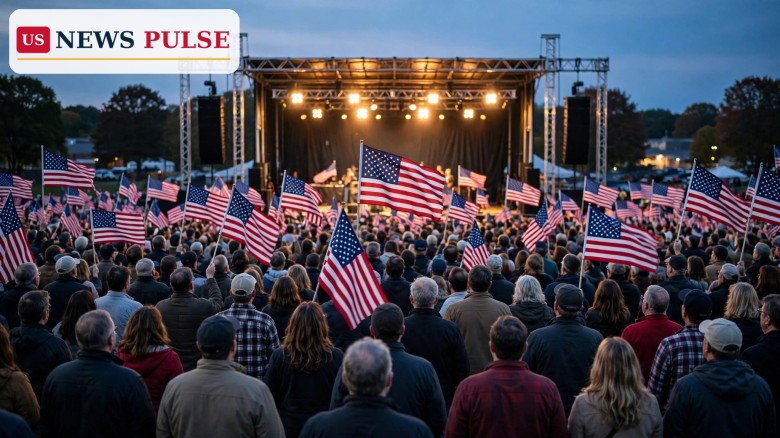
Note: the featured image is a generic illustration of a campaign rally crowd, not a photograph of the Chillicothe or Atlanta events.
Leave a Comment



 | Today's Date: