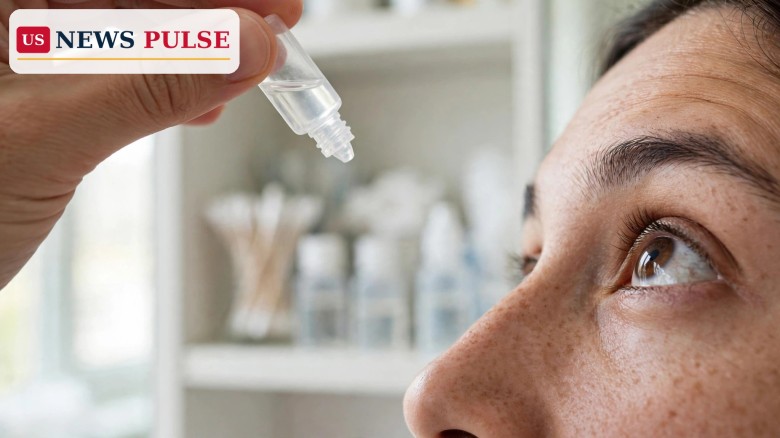
More than 4.8 million cartons of over-the-counter eye drops sold under some of America's best-known store brands are being recalled nationwide because the manufacturer cannot guarantee they are sterile. The eye drops recall covers artificial tears, dry-eye lubricants and redness relievers in 0.5-fluid-ounce bottles, and it reaches shoppers at Walmart, Walgreens, Kroger, Target, Publix, H-E-B and many other retailers. If you keep a bottle of store-brand eye drops in your medicine cabinet, in your car or at your desk, this is the week to check the label before you use another drop.
The recalling firm is K.C. Pharmaceuticals, Inc., of Pomona, California. The company started the recall on September 11, 2026, and the US Food and Drug Administration (FDA) classified it as a Class II recall on October 5, 2026. The FDA's enforcement record lists eight linked recalls, numbered D-0002-2027 through D-0009-2027, and puts the total at 4,848,342 cartons. The stated reason, in the FDA's own words, is a "lack of assurance of sterility" — the products may not have been manufactured under proper sterile conditions. The drops were distributed nationwide, and the affected lots carry expiry dates from November 30, 2026, to November 30, 2027.
The recall began quietly, as most drug recalls do: the company notified its customers by email on September 11, 2026, and the FDA's enforcement record then listed the eight product recalls. It was only when the FDA classified the action in early October that the scale became clear — nearly 4.85 million cartons, one of the largest eye-drop recalls in recent years. The Dry Eye Foundation, a nonprofit that tracks eye-drop safety, independently tallied the same total from the FDA table: seven of the eight recalls carry listed quantities that add up to 4,848,342 cartons, while the eighth, for a redness-relief product, is listed with no quantity.
The eight product families, with their listed quantities, are: Artificial Tears Sterile Lubricant Eye Drops (505,896 cartons); Sterile Eye Drops AC (182,016); Sterile Eye Drops Advanced Relief (208,896); Eye Drops Maximum Redness Relief (1,435,830); Sterile Lubricant Dry Eye Relief Eye Drops (1,327,248); Sterile Eye Drops Original (1,025,448); Sterile High Performance Ultra Lubricating Eye Drops (163,008); and Sterile Eye Drops Redness Relief, whose quantity was not specified and which includes Clear Eyes Redness Relief. All are 0.5-fluid-ounce (15 mL) bottles, the small squeeze bottles most people buy for dry eyes, allergies or redness.
Crucially, not every bottle under these brand names is recalled. The FDA record ties the recall to specific lot numbers and expiry dates. Examples visible in the record include lot AT25B01 expiring February 28, 2027, for the artificial tears product, and lots expiring from November 30, 2026, through November 30, 2027, across the range. A bottle with the same brand name but a different lot number is not part of this recall. That distinction matters: throwing away every store-brand bottle would be wasteful, but using a recalled lot without checking would be risky.
Eye drops are supposed to be sterile because they go directly onto the surface of the eye, one of the body's most vulnerable entry points. A contaminated drop can introduce bacteria or other pathogens where the eye has little defence, and an infection there can develop quickly. That is why the FDA treats sterility failures seriously even when no specific contamination has been named: the agency's concern is that the manufacturing process itself could not be trusted to keep the product sterile.
K.C. Pharmaceuticals has been here before. The company recalled about 740,000 units of eye drops in June 2023 and received an FDA warning letter in August 2023. It recalled more than 3 million eye drops in March 2026. Then, on August 12, 2026, the FDA issued another warning letter to its Pomona facility after an inspection found significant violations of current good manufacturing practice rules covering aseptic and sterilization processes, cleaning and maintenance of equipment, and more — including repeat violations cited in the 2023 warning letter. The September recall followed within a month of that warning letter.
The timing also coincides with a season when many Americans reach for eye drops more often. Autumn weed and grass pollen can still trigger itchy, irritated eyes, and dry indoor air as heating comes on adds to the discomfort. Store-brand drops are popular precisely because they are cheap and easy to find, which is why a recall touching 27 brands lands in so many homes at once.
The full brand list in the FDA record and in safety trackers runs to 27 names: Best Choice, Circle K, Clear Eyes, Crocodile Tears, Discount Drug Mart, Equaline, Equate, Exchange Select (military exchanges), Foster & Thrive, GeriCare, Good Neighbor Pharmacy, Good Sense, Grandall, H-E-B, Harris Teeter, Kroger, Leader, Lil' Drug Store, Medic's Choice, Mike Tyson, Pro-Mex, Publix, QC-Quality Choice, TopCare, Up & Up, Walgreens and Xpect, among others. The per-product breakdown in the FDA record shows, for example, artificial tears under Best Choice, Leader, Good Neighbor Pharmacy, Good Sense, Medic's Choice, Publix, Quality Choice, TopCare, Walgreens and Kroger; redness relief under Leader, Discount Drug Mart, Equaline, Colirio, Clear Eyes, Equate, Walgreens and Xpect; and maximum redness relief under Exchange Select, Harris Teeter, Tyson Mike, up & up, TopCare and Walgreens.
To check a bottle, find three things: the brand name, the product type (for example, artificial tears or redness relief) and the lot number and expiry date, usually printed near the cap or on the side of the bottle or carton. Compare the lot number and expiry date against the FDA enforcement record for recalls D-0002-2027 through D-0009-2027. If the lot matches, stop using the bottle. Ask your pharmacist or the retailer where you bought it about a replacement or refund, and keep the bottle until you have done so, so the lot details are available if you need them.
If you have already used drops from a recalled lot and your eyes feel fine, there is no specific instruction in the recall summaries reviewed for this article to seek emergency care — but watch for warning signs. Pain, redness, discharge, swelling, light sensitivity or any change in vision after using eye drops are reasons to contact an eye-care professional or another health-care provider promptly, and to mention the product you used.
The FDA defines a Class II recall as a situation in which use of or exposure to a product "may cause temporary or medically reversible health problems, or when the likelihood of serious health consequences is remote." That is the middle tier of the agency's three recall classes: it is not the most serious level, but it is also not a paperwork exercise. The classification reflects a real, if not immediately life-threatening, risk from a product that goes directly into the eye.
The FDA's August 2026 warning letter to K.C. Pharmaceuticals is the sharpest official statement in the record. It documents significant violations in the aseptic and sterilization processes at the Pomona plant, problems with cleaning and maintenance of equipment, and repeat violations from the 2023 warning letter — a pattern that, in the agency's view, meant sterility could not be assured. The recall record itself gives no specific illness figure for this action in the summaries reviewed, and this article does not invent one: the risk described by the FDA is the lack of sterility assurance itself, not a named outbreak tied to these lots.
Separately, the FDA has also warned about counterfeit eye drops found in US stores — a different problem from this recall, and one the agency says explicitly is separate from the K.C. Pharmaceuticals recall. Laboratory testing found two counterfeit products contaminated with bacteria, including a Colirio Ocusan redness-relief product contaminated with Staphylococcus bacteria. The FDA says such contamination may cause serious eye infections that could lead to partial vision loss or blindness, and it advises anyone who finds these products on a shelf not to buy them, to stop using them immediately, and to contact a physician if they have symptoms. Adverse events can be reported through the FDA's MedWatch programme, online or by phone at (800) FDA-1088.
This recall matters for three reasons. First, scale: 4.8 million cartons is an enormous footprint for a product people use without thinking, often several times a day. Second, trust: store-brand eye drops are bought on price and convenience, and shoppers reasonably assume that a bottle from a major retailer has passed the same sterility checks as a name brand. A recall of this size, from a manufacturer with two warning letters and two earlier large recalls, shakes that assumption. Third, vulnerability: the eye is an unusually direct route into the body, so a sterility failure is not comparable to a labelling error on a packet of biscuits. The consequences of a contaminated drop can be swift and, in the worst case, sight-threatening.
There is also a wider lesson in the sequence of events. The March 2026 recall of more than 3 million units, the August 2026 warning letter citing repeat violations, and the September 2026 recall of nearly 4.85 million more units describe a manufacturer whose sterility controls were questioned repeatedly before this action. Regulators, retailers and shoppers all have a role in what happens next: the FDA in enforcement, retailers in pulling affected lots from shelves, and shoppers in the unglamorous but effective step of reading a lot number.
The recall remains listed as ongoing in the FDA record, with distribution across the United States. Shoppers should expect retailers to continue removing affected lots, and anyone holding a matching bottle should contact the retailer or pharmacist for return or refund instructions. The FDA's enforcement record is the authoritative source for the full lot and expiry lists, and it is worth checking there rather than relying on a brand name alone.
What to watch next is whether the FDA takes further enforcement action against the Pomona facility, whether any additional lots are added to the recall, and whether retailers issue their own customer notices beyond the shelf removals already under way. If you use prescription eye drops, this recall does not cover them — it applies to the over-the-counter store-brand products listed above — but the same habit applies: check the lot, keep the packaging, and ask your pharmacist if you are unsure.
Are all store-brand eye drops recalled? No. Only specific lots of eight K.C. Pharmaceuticals product families are recalled. A bottle is affected only if its lot number and expiry date match the FDA record.
Which brands are involved? Twenty-seven store and private-label brands, including Walgreens, Kroger, Equate, up & up, Publix, Harris Teeter, H-E-B, Leader, Good Sense, TopCare, Best Choice and Clear Eyes Redness Relief.
What is the risk? A lack of assurance of sterility: the drops may not have been made under proper sterile conditions. The FDA classifies this as Class II, meaning temporary or medically reversible health problems are possible, while serious consequences are considered remote.
What should I do if my bottle matches? Stop using it, keep the bottle and packaging so the lot details are available, and ask your pharmacist or retailer about a replacement or refund. Seek eye care promptly if you develop pain, redness, discharge, swelling, light sensitivity or vision changes.
Does this recall cover prescription eye drops or the counterfeit products the FDA warned about? No. Prescription drops are not part of this recall, and the FDA says its counterfeit eye-drop investigation is separate from the K.C. Pharmaceuticals recall.
Related coverage on US News Pulse: Toothpaste Recall: 4.3 Million Tubes Pulled Nationwide, Check Your Cabinet Now; Miyoko's Butter Recall: Plant-Based Spread Pulled in 10 States Over E. Coli Fears; Darwin's Cat Food Salmonella Alert: FDA Warns Two Lots After Cat Hospitalised.
Sources: FDA enforcement record summaries via MedShadow, The Healthy, WECU News, the Dry Eye Foundation (eyedropsafety.org) and FDA counterfeit eye-drop warnings via CLSpectrum/EyeCare Business, October 2026. This article is for information only and is not medical advice; contact a health-care professional about any eye symptoms.
Leave a Comment



 | Today's Date: