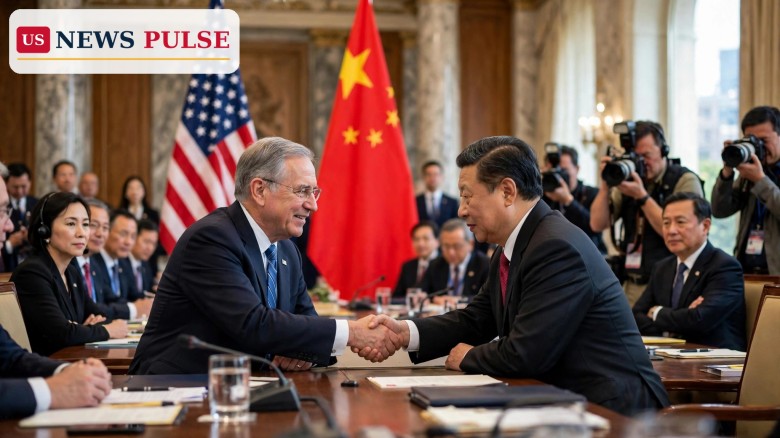
President Donald Trump says a meeting with Chinese President Xi Jinping on nuclear disarmament is already planned, telling reporters early on Wednesday, October 28, 2026, that the talks would be among the most important of his presidency. The Trump Xi nuclear meeting, announced as Trump returned to Joint Base Andrews from two midterm campaign rallies in Texas, would also cover bilateral relations, Trump said, and Russia could take part as well.
The announcement is striking for what it does not contain: no date, no venue and no confirmation from Beijing. China has not confirmed any meeting, and earlier this month its foreign ministry said it had no information to disclose about a proposed leaders' gathering. Trump has put a nuclear disarmament summit on the public agenda days before he heads to Asia, and weeks before the Asia-Pacific Economic Cooperation leaders' meeting in Shenzhen, China, on November 18-19, where the three leaders are all expected to be present.
Trump spoke to reporters at Joint Base Andrews near Washington after returning from Texas, where he had held two midterm election rallies on Tuesday, October 27 — in Corpus Christi and in Lubbock, for Texas Senate candidate Ken Paxton. Secretary of State Marco Rubio and special envoy Steve Witkoff travelled with him, and Trump said they had discussed both Russia and the war involving Iran during the trip.
On China, his words were unusually specific about intent and unusually vague about logistics. "We already have a meeting planned with President Xi Jinping of China. In addition, a meeting on nuclear disarmament is also planned," he said. "As I understand it, this is a very important, perhaps the most important, meeting. We are discussing the denuclearization of various countries."
Asked about the format, Trump said he was meeting Xi "on nuclear disarmament" and that "certainly, Russia would fit into it". That single line turned a bilateral announcement into a possible trilateral one, reviving an idea Trump first floated publicly in mid-October: a meeting of the leaders of the world's three prominent nuclear powers to discuss cutting their arsenals.
The disarmament idea did not appear from nowhere. On October 19, Trump said he was open to meeting Putin and Xi in China, identifying nuclear disarmament rather than Ukraine as his main focus, and saying he would try to end the Ukraine war whether or not President Volodymyr Zelenskyy took part. The Wall Street Journal reported that Putin had floated a meeting with Trump and Xi on the sidelines of the APEC leaders' meeting in Shenzhen. Kremlin spokesman Dmitry Peskov later said only that the possibility had been raised, and that no concrete proposal or agenda had been discussed. Rubio said he knew of talks about a meeting but did not know whether a final decision had been made.
China's response has been the most cautious of the three. Foreign ministry spokeswoman Mao Ning said Beijing had no information to share about the proposed meeting, while reiterating that China would keep promoting talks toward a political settlement of the Ukraine war. That is not a rejection — Beijing routinely declines to confirm leaders' schedules in advance — but it means the only public confirmation of a Trump-Xi disarmament meeting so far comes from Trump himself.
What is agreed, on the public record, is narrow: Trump wants a meeting, he wants disarmament on the agenda, and he wants Russia involved in some form. What is not agreed is almost everything else — the date, the place, the participants, and whether disarmament or Ukraine would dominate. The Shenzhen APEC meeting on November 18-19 is the obvious venue, since it puts all three leaders in the same city, and Trump is expected to travel to Shenzhen after a visit to Manila. But a meeting on the sidelines of a summit is not the same as a dedicated disarmament negotiation, and no government has announced a formal trilateral session.
That distinction matters because nuclear arms agreements are not made in photo opportunities. They require months of technical preparation: inventories, verification rules, inspection regimes and definitions of what counts as a weapon, a delivery system or a stockpile. Even holding a summit would not guarantee a practical outcome, Indo-Pacific security expert Chris Estep of the Foreign Policy Research Institute was quoted as saying in coverage of the proposal, adding that concrete results mattering more than the photo opportunity itself were even less likely.
Trump's own framing is the fullest statement available. "We are discussing the denuclearization of various countries," he said at Andrews, calling the planned meeting "very important, perhaps the most important". He has repeatedly presented himself as a peacemaker who can settle wars by personal negotiation, and the disarmament proposal fits that pitch — made six days before the November 3 midterm elections, when his party faces a difficult vote and voters are anxious about fuel, healthcare and housing costs.
Kyiv has been the most sceptical voice. Ukrainian Foreign Minister Andrii Sybiha warned that a meeting of the United States, Russia and China that excluded Ukraine would encourage Putin to keep fighting, and argued that Putin's presence at any negotiating table should depend on genuine steps toward peace, such as a ceasefire first. Ukraine has objected to talks about its war that exclude it, and Zelenskyy has insisted that no settlement can be imposed over Kyiv's head. Those objections do not block a US-China disarmament discussion, but they complicate any attempt to fold Ukraine into the same room.
Beijing and Moscow, meanwhile, have said little in public this week. Mao Ning's "no information" line and Peskov's "possibility raised" formulation are both ways of keeping options open without committing to a format neither capital has yet endorsed. That silence is itself informative: if a trilateral summit were settled, at least one of the three governments would normally confirm it. For now, the proposal exists mainly as an American announcement awaiting two replies.
The proposal matters even if no summit happens, because it reveals how Trump wants to frame the final stretch of his foreign policy: a president who talks directly to rival leaders about the world's most dangerous weapons, while also warning Gulf states about a possible new campaign against Iran and pressing for a Putin-Zelenskyy meeting. It also matters because the three countries involved are the world's prominent nuclear powers, and any serious discussion of their arsenals touches every other nuclear-armed state, every alliance built around extended deterrence, and every conflict — from Ukraine to Taiwan — in which nuclear signalling plays a part.
Watch three things. First, whether Beijing or Moscow confirms anything — a foreign ministry statement, a Kremlin readout, or a date attached to the Shenzhen APEC week. Second, whether the meeting, if it happens, is bilateral (Trump-Xi) or trilateral (Trump-Putin-Xi), and whether Ukraine is mentioned at all. Third, whether any preparatory work appears: lower-level talks, arms-control envoys travelling, or language in summit communiqués about nuclear risk reduction. Without that groundwork, a leaders' handshake in Shenzhen would be symbolism, not disarmament.
The window is short: APEC leaders meet on November 18-19, and a serious disarmament discussion cannot be improvised in the margins of a two-day summit. If the meeting is real, its shape should become visible within days, not weeks.
Has a Trump-Xi nuclear disarmament meeting been confirmed? Only by Trump. He said at Joint Base Andrews on October 28, 2026, that a meeting with Xi is planned and that a meeting on nuclear disarmament is also planned. China has not confirmed it, and no date or venue has been announced.
Would Russia take part? Trump said Russia would "certainly" fit into the discussion, and the idea of a trilateral Trump-Putin-Xi meeting was reportedly floated by Putin. But the Kremlin says no concrete proposal or agenda has been discussed, so a three-way format is not agreed.
When and where could it happen? The likeliest window is the APEC leaders' meeting in Shenzhen, China, on November 18-19, 2026, which Trump is expected to attend after a visit to Manila. No separate summit date has been set.
What would disarmament talks actually cover? Trump has spoken of "the denuclearization of various countries" without detail. Past arms-control talks have covered warhead numbers, delivery systems, verification and inspection — all of which would need months of technical preparation that has not been publicly reported.
Why are experts sceptical? Because a summit alone does not produce a verifiable agreement, and because the Ukraine war and Taiwan tensions give all three leaders reasons to keep their arsenals. Analysts quoted in coverage say concrete results beyond a photo opportunity are unlikely without prior negotiation.
Related coverage on US News Pulse: Putin-Zelensky meeting "very soon", Trump says progress made on Ukraine peace talks; US Iran war warning: Washington tells Gulf to brace for short, intense campaign; Melania Trump ceasefire brings hope to Oleshky as Ukraine aid mission begins.
Leave a Comment



 | Today's Date: