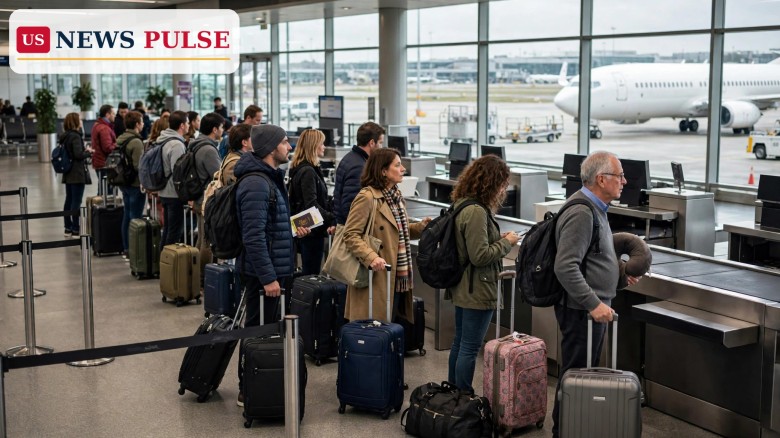
From 11:59 p.m. Eastern Standard Time on November 3, 2026, every passenger boarding a flight from any foreign country to the United States will have to sign a CDC Ebola attestation confirming they have not been in the Democratic Republic of the Congo (DRC) during the previous 21 days. The rule applies to everyone on board, including United States citizens, people who have never visited the DRC, and passengers who are only connecting through an American airport on their way to another country. Without a completed and signed declaration, airlines must refuse boarding unless the traveller holds a government exemption.
The order, issued by the U.S. Centers for Disease Control and Prevention (CDC) on October 22, 2026, is a response to the Bundibugyo Ebola outbreak in the DRC, which has now passed 10,000 confirmed cases and nearly 4,900 deaths. It is the broadest Ebola-related travel paperwork the United States has imposed in this outbreak: it covers commercial flights, general aviation and business aircraft alike, and it reaches passengers departing from every foreign country, not just from countries near the outbreak.
The CDC issued an order titled Requirement for Attestation for All Airline or Other Aircraft Passengers Arriving in the United States. It prohibits air carriers and aircraft operators from boarding any passenger on an aircraft destined for the United States from a foreign country unless that passenger presents a signed attestation, in paper or digital form, confirming they have not been present in the DRC during the 21 days before boarding. The order takes effect for flights departing at or after 11:59 p.m. EST on November 3, 2026.
The National Business Aviation Association (NBAA), which summarised the order for operators on October 27, stressed how wide its reach is. It applies to commercial flights, general aviation and business aircraft, and to passengers of every nationality. Flights that pass over the United States without landing are excluded, but a passenger connecting through a U.S. airport to another international destination is not. A parent or another authorised adult may complete the declaration for a child under 18.
Airlines and aircraft operators must verify that each passenger has completed and signed the declaration before boarding, and must retain copies for at least 42 days after the flight arrives in the United States. The CDC has provided a template attestation for operators to use, and travel-industry coverage has warned that a missed form could prevent boarding and disrupt onward plans, particularly for passengers using U.S. airports as connections.
The outbreak behind the order was declared in the DRC on May 15, 2026. It is caused by the Bundibugyo virus, a rare Ebola strain for which no vaccine or treatment has yet been approved. Government data released on Tuesday, October 27, put confirmed cases at 10,060 and deaths at 4,887, a crude fatality ratio of about 48.6 percent. Health authorities describe it as the fastest-growing Ebola outbreak in the DRC's history and the deadliest the country has recorded, surpassing the 2018-2020 epidemic. Globally it is now the second-largest and second-deadliest Ebola outbreak on record, behind only the 2014-2016 West African epidemic, which infected more than 28,600 people and killed more than 11,000.
The scale of the spread is what has alarmed international health agencies. About 80 percent of new cases are coming from outside the chains of transmission that health authorities are monitoring, while the Africa Centres for Disease Control and Prevention has said at least 95 percent of cases must come from the known contacts of infected people for the outbreak to be considered under control. Cases have also been reported beyond the DRC: Kenya has recorded nine cases, Nigeria confirmed its first case last week, and Uganda recorded 20 cases in May and June, most imported from the DRC, before the World Health Organization declared its outbreak over in August. Uganda has since ordered a 21-day quarantine for citizens returning from the DRC.
There is also a scientific race running alongside the containment effort. On October 23, responders launched the Tumaini trial in Bunia, the capital of the hardest-hit Ituri Province. Funded and supported by the Coalition for Epidemic Preparedness Innovations (CEPI), the adaptive Phase 2/3 trial uses a ring-vaccination approach, targeting people who have been in direct contact with confirmed Ebola patients. The first vaccine entering the trial is Ervebo, already licensed for the Zaire Ebola virus but not proven effective against Bundibugyo, with Bundibugyo-specific candidates from Moderna and from the University of Oxford with the Serum Institute of India expected to join shortly. Response work has been hampered by violence, community mistrust and access problems, including attacks that killed a nurse and wounded a health worker responding to a case.
The attestation itself is short, but its details matter, and several of them catch travellers out. First, the 21-day clock is counted from physical presence, not from a test or a symptom check. The CDC counts the day a traveller leaves the DRC as Day 0, and that traveller may board a flight to the United States beginning on Day 22, provided all other entry requirements are met. Second, presence includes transit: a stop at a DRC airport counts as presence even if the passenger never leaves the airport or the aircraft. Third, the form must be completed even by passengers who have never been near the DRC; the declaration is a confirmation of absence, not only a disclosure of travel.
United States citizens and nationals are not exempt from signing. Those who have been in the DRC should plan to remain outside the DRC for 21 days before entering the United States, including passengers with an intermediate stop in the DRC or on multi-stop itineraries via the DRC, regardless of whether they disembark. Travellers who have been in the DRC within 21 days of their flight will not be allowed to board a U.S.-bound flight unless they have received an exemption from the U.S. government. The order does not itself spell out a public application route for exemptions, so affected travellers will need to seek government guidance before travelling rather than arriving at the airport hoping to argue the point.
There is a separate rule for neighbouring countries. U.S. citizens and nationals who have been present in Uganda or South Sudan, but not in the DRC, within 21 days of arrival in the United States must enter only through designated airports for enhanced screening: Washington Dulles International Airport, Hartsfield-Jackson Atlanta International Airport, and John F. Kennedy International Airport. Previous CDC mandates to mitigate the risk of Ebola importation into the United States remain unchanged alongside the new attestation requirement.
Laura Everington, the NBAA's director of international operations and regulations, urged operators to prepare now rather than waiting for November 3. "Aircraft operators, regardless of the type of operation, should be prepared to provide and collect these attestations to all passengers departing from a foreign country to the U.S.," she said. "This requirement is not limited to commercial operations or flights departing certain countries - it applies to all flights from all countries arriving to the U.S."
The CDC's order itself states the enforcement position in plain terms. It prohibits "the boarding of any passenger who is not otherwise subject to an exemption on any aircraft destined to the United States from a foreign country, unless the passenger presents signed attestation in paper or digital format confirming that the passenger has not been present in the Democratic Republic of the Congo (DRC) during the 21 days prior to boarding a flight to the United States." The CDC's official order also states that knowingly providing false information can lead to criminal prosecution under U.S. law, a warning travel advisers have repeated because a careless or dishonest answer at check-in now carries consequences well beyond a missed flight.
The wider public-health context has been set by the numbers themselves. With 10,060 confirmed cases and 4,887 deaths reported by the DRC's Ministry of Public Health, and roughly four in five new infections arising outside monitored transmission chains, the attestation is best understood as one layer of a containment strategy that also includes the Tumaini vaccine trial, Uganda's 21-day quarantine for returnees, and enhanced screening at the three designated U.S. airports for travellers from Uganda and South Sudan.
The 21-day window is not arbitrary: it reflects the maximum recognised incubation period for Ebola, the period during which an infected person may develop symptoms after exposure. A declaration that reaches back exactly that far is designed to flag recent travel to the outbreak-affected country even when a passenger began their journey somewhere else entirely, which is why the rule applies worldwide rather than only to flights departing Africa.
For ordinary travellers, the practical risk is not Ebola itself but paperwork. A passenger flying home from London, Toronto, Dubai or Sydney who has never been to the DRC still needs a signed form, and a passenger who changed planes in Kinshasa without leaving the terminal is treated the same as someone who spent a week there. Business aviation is affected too: a private or corporate flight departing a foreign country for the United States must collect attestations just like a scheduled airline service. And because airlines must refuse boarding without a completed declaration, the cost of forgetting the form is a missed flight, not a fine at arrival.
The timing also matters. The order takes effect at 11:59 p.m. EST on November 3, the day of the U.S. midterm elections, and runs to December 18, covering the Thanksgiving travel period and the start of the winter holiday season, when international arrivals to the United States are at their heaviest. If the outbreak worsens, the CDC can extend the order; if it improves, it can rescind or modify it before December 18. Either way, the November 3 start date means airlines and passengers have only days to build the new check into check-in.
Between now and November 3, airlines and aircraft operators are expected to roll out the attestation in digital and paper form, using the CDC's template, and to train check-in staff to verify it before boarding. Travellers with international flights departing on or after the deadline should check with their airline before travelling, confirm whether the form will be offered at online check-in or only at the airport, and keep a copy until arrival, since operators must retain theirs for at least 42 days.
Travellers who have been in the DRC within 21 days of a planned U.S.-bound flight should not travel on the assumption that they can sign the form anyway: they cannot board without a government exemption, and the safe course is to wait until Day 22 after leaving the DRC or to seek official guidance first. Travellers from Uganda or South Sudan who have not been in the DRC should route through Washington Dulles, Atlanta or New York JFK for enhanced screening. Watch for CDC updates on exemptions, on whether the December 18 end date holds, and on case numbers from the DRC, which will shape whether the order is extended into 2027.
Yes. Every passenger on a flight departing a foreign country for the United States at or after 11:59 p.m. EST on November 3, 2026 must present a signed attestation confirming they have not been in the DRC during the previous 21 days, including passengers who have never visited the country.
Yes. The CDC counts airport transit through the DRC as presence, even if you stayed inside the airport or on the aircraft. The day you leave the DRC is Day 0, and you may board a U.S.-bound flight from Day 22.
No. The requirement applies regardless of nationality, including U.S. citizens, permanent residents and foreign visitors, and including passengers only connecting through a U.S. airport. U.S. citizens who have been in the DRC should remain outside the DRC for 21 days before entering the United States.
Airlines must refuse boarding to any passenger without a completed declaration, unless the passenger holds a government exemption. The CDC order states that knowingly providing false information can lead to criminal prosecution under U.S. law.
The order is scheduled to end on December 18, 2026, unless it is rescinded, modified or extended. Previous CDC Ebola travel mandates remain in force alongside it, so travellers should check for updates before flying.
Related reading on US News Pulse: the early flu season hitting the U.S. weeks ahead of schedule, the Taylor Farms salad recall over hidden allergens, and the Haifa smoked sprats recall over botulism risk.
Leave a Comment



 | Today's Date: