Grace Knowles was doing nothing more suspicious than driving home from a road trip when a police officer pulled her over, questioned her movements, demanded proof of where she had been, and then showed her a glowing heat map of her own travels. The reason, the officer told her, was that a surveillance system had scanned her licence plate and decided her driving pattern looked suspicious. The American Civil Liberties Union (ACLU) says AI traffic stops like this one are becoming a nationwide pattern — and that innocent drivers, not criminals, are most likely to be swept up.
The warning, published by the ACLU on October 26, 2026, argues that police use of artificial intelligence and automated licence plate readers (ALPRs) has crossed a line: from investigating vehicles already suspected of a crime to generating suspicion about people against whom police previously had nothing at all.
In September 2025, Knowles, then between jobs, set out from northern Virginia on a road trip that took her through Oregon, Texas and Louisiana. On her way to Florida, after leaving New Orleans one morning, she noticed a police car behind her. "I know I was going a normal speed, but he pulled me over anyway," she told the ACLU. "And he made up some excuse — that I'd been in the left lane too long."
The officer questioned her about where she was coming from and where she was going. "I'm just a girl doing a road trip," she said, explaining she had come from New Orleans. He then asked for proof. She showed him a pamphlet from a whiskey museum she had visited. "Here's my proof," she said. Only then, she said, did he relax — and explain himself.
"I just had to be sure because I'm not a regular cop, I'm part of the FBI, and when I scanned your plate I could see you had suspicious travel patterns," Knowles recalled him saying. He told her he thought she was lying about being in New Orleans because his system showed no hits there. He was, she said, working on a project investigating people for human trafficking or drug trafficking, and he told her stories of people his team had caught carrying large sums of money.
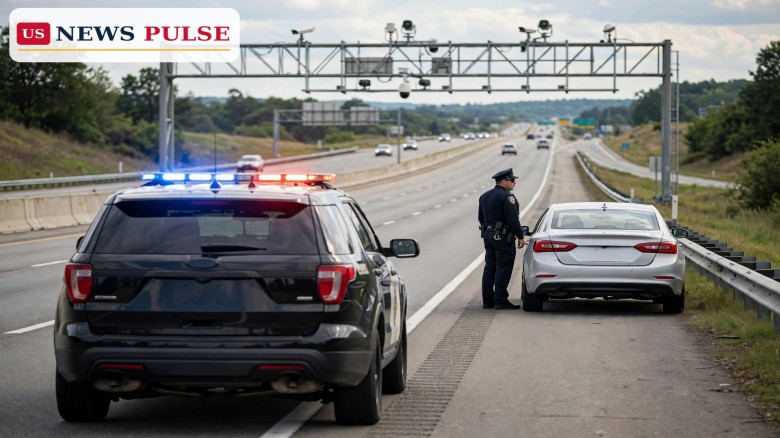
Shaken, Knowles asked how he could see her licence plates at all. "Well they're just everywhere," she recalled him saying. "They're in the road signs on top of highways — they're often on the back of those, and people don't even see them." He then invited her into his car to show her what he was seeing: "It was basically a heat map of the US, and I could see different circles where I'd been, and when he clicked on it, it was a photo of my license plate."
Knowles had never shared her story publicly before telling it to Jay Stanley, a senior policy analyst with the ACLU's Speech, Privacy and Technology Project, who wrote the organisation's October 26 report.
Automated licence plate readers are cameras mounted on patrol cars, poles and highway gantries that photograph passing vehicles and record their registration numbers, locations and timestamps. Combined across cameras, those records reconstruct where a vehicle has travelled and how often it visited particular places. Companies such as Flock Safety and Axon sell the systems to law enforcement agencies across the United States, and police have long used them to investigate known suspects.
What has changed, the ACLU argues, is the addition of AI. Stanley said he first noticed Flock touting AI-driven alerts in July 2025: the company boasted it could not only flag drivers whose travel patterns were "suspicious" but also track people's associations by analysing which vehicles were frequently seen together. Later, Wired obtained detailed files describing Flock's next-generation AI system, already in use by some police, which allows wide-ranging, open-ended AI queries of licence plate data — and not only plate readings, but also arrest records, case files and databases from the commercial data broker industry, packed with personal information on nearly everyone.
The ACLU says the shift matters because it reverses the normal logic of policing. Instead of starting with a suspect and looking for evidence, the system starts with everyone's movements and asks an algorithm to suggest suspects. "This represented a significant leap from using ALPR data to investigate suspicious vehicles to generating suspicion where none previously existed," Stanley wrote.
The technology is also arriving amid growing pushback. An August YouGov survey found 46 percent of respondents opposed law enforcement using the technology in their communities, while 38 percent supported it. There have been reports of the systems leading to mistakes and misuse by officers, and agencies including the Los Angeles Police Department have suspended or ended their Flock contracts amid the backlash.
Here is how the ACLU describes the new pattern. AI systems analyse large volumes of plate-reader data and flag travel histories they have been trained to treat as suspicious — a route, a frequency of visits, a pairing of vehicles. Officers can then act on the alert. Because an algorithm's hunch is not itself lawful grounds for a stop, the ACLU says, officers may look for a minor traffic violation to justify pulling the driver over. In a pretextual stop, someone is pulled over for a claimed, often invented minor infraction — drifting out of a lane, failing to use a turn signal — as cover for the real reason, which might be unconstitutional or which officers otherwise want to hide. Police even have names for these detentions, the ACLU notes, calling them "whisper stops" or "intel stops."
Knowles's case is not the only one. The Associated Press has reported that the Border Patrol is monitoring drivers nationwide inside the United States for "suspicious" travel patterns and working with other agencies to stop and search vehicles, in what amounts to a nationwide domestic, mass-surveillance-based intelligence operation. In one example cited by the ACLU, a driver for a small furniture-moving company was subjected to a pretext stop by a local officer acting at the direction of the Border Patrol about 100 miles from the Mexican border after driving from South Carolina. A search of his truck uncovered nothing illegal — but police still arrested him on suspicion of money laundering because he was carrying thousands of dollars of his own money in cash, which police seized. The ACLU notes it is possible Knowles was stopped under this same programme.
In March 2026, The Markup reported on a grandmother living in California who was interrogated by Customs and Border Protection officers while crossing the border about how often she visited local casinos, apparently based on her driving patterns. "It just seems suspicious," she reported they told her. In April 2025, a man was targeted for a stop because he drove back and forth between his home state of Wisconsin and Michigan, which local police noted was "a known source State for Marijuana as it is legal there." In other words, an entire neighbouring state was treated as a suspicious destination.
The ACLU's warning is blunt. "More and more people will be subject to police encounters as these AI algorithms inevitably sweep in far more innocent people than actual wrongdoers," Stanley wrote. "For many people, those encounters will be far more fraught, frightening and dangerous than what Knowles experienced."
Stanley argues the spread of plate readers has already led to widespread abuses by officers, and that AI surveillance tools layered on top of ALPR databases will open up possibilities for even more sophisticated forms of abuse, "such as those based on political or protest associations or travel."
The courts have begun to test the tactic. On September 28, a federal jury in San Antonio found Bexar County, Texas, liable over a traffic-stop programme that used plate-reader data. The case came from a March 2022 stop of Alek Schott, who sells oilfield supplies, on Interstate 35 near San Antonio. Schott was held for 76 minutes; the jury awarded him $76, a dollar a minute. His lawyers at the Institute for Justice, which represented him, are now asking the court for an injunction against the county's stops. The ACLU says a federal fusion centre tipped off local police that Schott was suspicious because he drove from Houston to Carrizo Springs and back the next day — a claim, that he had drifted over his lane line, which dashcam footage showed and the local officer later admitted was bogus. The Institute for Justice noted the same county had subjected thousands of other drivers to the same routine.
Flock did not immediately respond to a request for comment on the ACLU report. The ACLU post also does not include a response from the FBI, and it is not known whether Bexar County will appeal the jury verdict.
The stakes go beyond one road trip. If travel history alone can make a driver a suspect, then every journey — to a casino, to a neighbouring state, to a protest, to a clinic — becomes data that an algorithm may judge. The ACLU's core claim is that this flips a basic protection: police have traditionally needed a reason to single someone out before investigating them. AI-generated suspicion, the group argues, lets the investigation come first and the reason follow, dressed up as a lane violation.
There is also a practical danger the ACLU stresses: algorithms trained to spot "suspicious" patterns will inevitably flag far more innocent people than criminals, because unusual travel is common and criminal travel is rare. Each false flag is not just a data point but a roadside encounter — frightening at best, and, for many drivers, potentially dangerous. The report warns that as data on our movements is fed into AI systems constantly analysing whether we are suspicious, "we are effectively being watched and judged all the time. And eventually, everyone will absorb that fact, and feel the eyes of the authorities upon them whenever they travel. That kind of self-consciousness is not something people in a free democracy should have to live with."
Supporters of the technology counter that plate readers and AI help police find stolen cars, wanted suspects and trafficking victims faster than human observation ever could — and that a stop based on a flagged pattern can still be lawful if an officer observes a genuine violation. That argument is now being tested in courtrooms, council chambers and state legislatures, where the balance between safety and surveillance is being redrawn.
Several developments will show where this fight goes. First, the injunction ruling in the San Antonio case: if a federal judge bars Bexar County's stops, other counties using similar routines will face immediate legal pressure. Second, whether Flock's next-generation AI tool moves beyond its test group into wider police use — Wired reported the company is testing an AI tool with prewritten prompts, and the ACLU describes the system as already in use by some police. Third, whether cities and states follow Los Angeles in suspending or ending plate-reader contracts, or instead write new rules governing how AI flags may be used.
The ACLU's own prescription is sweeping: it calls for an end to licence plate surveillance, location tracking of any kind, and mass surveillance in general. Short of that, privacy advocates are pressing for rules requiring a warrant or reasonable suspicion before an AI flag can trigger a stop, public reporting of how often flags lead to stops, and bans on pretext stops altogether. Expect the debate to intensify as more drivers discover, like Knowles, that their road trips have already been watched.
It is a traffic stop triggered when an AI system flags a driver's travel history — recorded by automated licence plate readers — as "suspicious," even though police have no evidence the driver committed a crime. Officers often cite a minor alleged violation as the stated reason for the stop.
Plate readers themselves are widely used by US law enforcement and have generally been upheld, but stops based on their data are now being challenged in court, including the Texas case in which a jury found a county liable over a plate-reader-based stop programme.
Knowles, a woman in her twenties from northern Virginia, was pulled over in September 2025 during a road trip after leaving New Orleans. An officer who identified himself as an FBI special agent told her a scan of her plate showed suspicious travel patterns, then showed her a heat map of her own movements in his patrol car.
That is exactly what the ACLU warns is happening: travel patterns alone — trips to casinos, neighbouring states or repeated routes — have triggered stops, even when no crime was found. Whether such stops are lawful depends on the circumstances and is now being litigated.
Civil liberties groups advise drivers to stay calm, note the stated reason for the stop, and record what officers say about surveillance data, since the gap between the stated reason and the real reason is often central to legal challenges.
Related coverage: FEC hacking attempt shuts down election agency systems before midterms, Trump super-intelligence order vows to ban AI term in federal papers, and AI political ads top $137 million as deepfakes flood the 2026 midterms.
Leave a Comment



 | Today's Date: