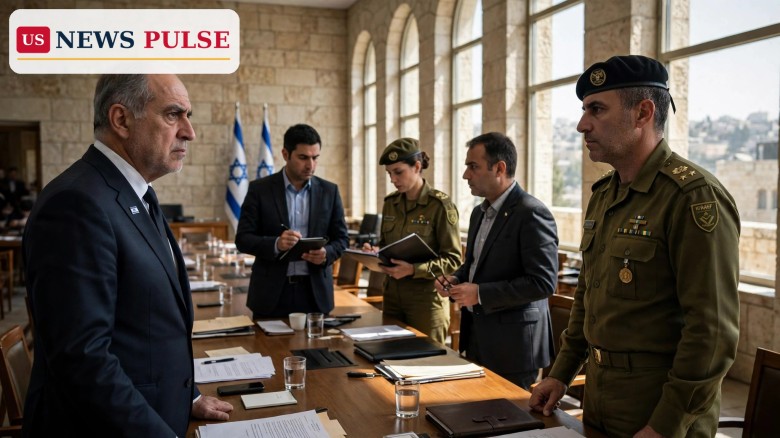
Israel's first election since the October 7, 2023 attacks ended in a deadlock on Tuesday night, with exit polls and early results giving neither Prime Minister Benjamin Netanyahu's bloc nor the opposition led by former military chief Gadi Eisenkot the 61 seats needed to govern the 120-seat Knesset. Eisenkot declared victory anyway, saying the preliminary results should give him the first right to try to form a government, while Netanyahu's Likud party pointed out that it remained the largest single party in the country.
Polls closed at 10 p.m. local time on Tuesday, October 27, and the television exit polls that followed told a story of a country split almost down the middle. Channel 12 put Eisenkot's bloc ahead 52 to 50 over Netanyahu's bloc, while Channels 11 and 13 projected a tie at 51 seats each. The Jerusalem Post later reported that initial voting results gave Eisenkot's bloc a 53 to 50 or 52 to 50 lead, even as Netanyahu edged Eisenkot in the head-to-head contest between their parties.
The pattern was consistent across the polls even where the exact numbers differed: Netanyahu's bloc had lost its majority, but Eisenkot's bloc had not won one either. In 2022, Netanyahu's bloc won 64 seats, later expanding to 68 when former Likud member Gideon Sa'ar defected from the opposition. Tuesday's projections of around 50 seats therefore represent a loss of roughly 14 seats for the governing bloc, a sharp rebuke even if it falls short of a clear opposition victory.
Eisenkot did not wait for the official count. In a statement on Tuesday night, the Yashar party leader declared victory, saying the preliminary voting results should give him the first right to form a government to replace Netanyahu. He had not yet spoken in public at the time, with coordination taking place behind the scenes with the rest of the leaders of parties in his bloc. His headquarters in Tel Aviv erupted into cheers when the first exit polls were announced, though there were a few seconds of nervousness when supporters saw that Netanyahu's Likud had the largest party.
The Central Elections Committee rejected a request from Netanyahu's Likud party to extend voting hours during the day. Counting continued through the night, and officials cautioned that exit polls can be wrong and that the final distribution of seats may change as counting progresses, particularly once the remaining ballots are tallied.
Tuesday's vote was Israel's first national election since the Hamas-led attack of October 7, 2023, and the wars that followed in Gaza, Lebanon and against Iran. Many Israelis saw the election as a referendum on Netanyahu's leadership during that period, and on the record of a government that took office in late 2022 promising judicial reform, security and stability, and instead presided over the worst security failure in the country's history.
Netanyahu, who is 77 and heads Likud, has served as prime minister for nearly 19 of the past 30 years and has repeatedly survived political crises that would have ended other careers. His opponents have managed to wrest the premiership from him only once since 2009, after four inconclusive elections in two years. That history is part of why his allies urged caution on Tuesday night: in Israel's system, a bloc that falls short of a majority can still survive for months in a caretaker government while negotiations drag on.
Eisenkot, a former chief of staff of the Israel Defense Forces, leads Yashar, a party whose name means "Straight" in Hebrew. His campaign drew its largest support from voters who blame Netanyahu for October 7, and from voters who blame him and his bloc for failing to draft the ultra-Orthodox, or haredi, sector into the military even after more than 1,000 Israeli soldiers died in recent years. On election day itself, Eisenkot began campaigning early in the morning at Ofakim and Nir Oz in the Gaza border region, calling attention to the failures of the previous government in preventing the Hamas invasion, before travelling north to Ashdod and voting in Herzliya in the afternoon.
The United States has followed the election closely. President Donald Trump renewed his endorsement of Netanyahu during the campaign, and the outcome matters in Washington because of the ongoing tensions with Iran, the fragile ceasefire arrangements in Gaza, and the American security relationship with Israel. A prolonged Israeli coalition negotiation would leave Washington dealing with a caretaker government at a moment of high regional tension.
The headline numbers from the Israel election results 2026 tell three stories at once. The first is the fall of the Netanyahu bloc, from 64 seats in 2022 to around 50 in the exit polls. The second is the rise of Eisenkot's bloc to a narrow lead, at 52 to 53 seats in some projections and 51 in others. The third, and potentially the most consequential, is the surge of the Arab-led parties to 17 or 18 seats, on the back of historic turnout among Palestinian citizens of Israel.
That third story is where the arithmetic gets difficult for both main contenders. Add the Arab parties to Eisenkot's bloc and the anti-Netanyahu camp reaches roughly 70 of the 120 seats. But neither Netanyahu nor Eisenkot has been willing to govern with Arab party support, and the obstacles are specific, not just rhetorical. The Jerusalem Post reported that Eisenkot faces the sensitive problem of convincing his coalition partners, most notably Avigdor Liberman of Yisrael Beytenu, to accept a government or minority support from Israeli-Arab parties, which Liberman refused during the campaign season. Some commentators said Liberman might reconsider because of the high voter turnout, but the Yisrael Beytenu leader is known for sticking to his stated principles.
Turnout itself was one of the clearest results of the night. The Central Elections Committee said about 77.7 percent of eligible voters cast ballots, up about 7.1 percentage points from the 70.63 percent recorded in 2022, and the highest turnout in a Knesset election since 1999, when 78.7 percent voted. High turnout is often expected to help the opposition, and on Tuesday it coincided with a surge for the Arab parties, whose supporters celebrated at the headquarters of the Joint List, an alliance of Arab parties, as the exit polls were announced.
None of these numbers is final. Exit polls are projections, not counts, and Israel's proportional system means that small shifts in the vote can move a seat from one party to another, or push a small party below the electoral threshold and redistribute its votes. That is why both camps spent Tuesday night claiming momentum while stopping short of claiming a government: the shape of the result is clear, but the exact seat count, and therefore the coalition arithmetic, is not yet settled.
Eisenkot framed the result as a verdict on the government itself. He said preliminary exit poll results showed "complete distrust in Netanyahu and the government of October 7," describing the projected results as a potential victory for Israel's "statist-Zionist majority." He added: "If these are the final results, this is a victory for the statesmanlike-Zionist majority in Israel." He promised to "act immediately to realize the decision of the people, to replace the Netanyahu government and to establish a Zionist mobilization government, at the earliest possible time."
Other opposition leaders went further. Yair Lapid, the current opposition leader, said: "Do not let anyone confuse you. The Netanyahu bloc has suffered a crushing defeat. This is a total collapse, and the public has told them to go home." Yair Golan, leader of the opposition Democrats, said Israeli voters had "fired the Netanyahu government," and wrote on X: "We have received a historic opportunity to establish a true government of change in Israel and we have no intention of giving it up."
Netanyahu's camp pushed back. Gideon Sa'ar, Israel's foreign minister and a member of Likud, criticised the "pronouncements of biased commentators" and said: "Likud is the largest party in Israel. It is always good to learn something from the past." His point was a practical one: in Israel's system, the largest bloc usually gets the first right to try to form a government, and can also take control over the Knesset pending the formation of a government. If Likud is the largest party, Netanyahu's supporters argue, the race for the mandate is not as settled as Eisenkot's declaration suggests.
From the Arab parties, the mood was celebratory. Yousef Jabareen, leader of the Joint List, called the election a "historic day" and said voters had delivered a "clear and sharp" message. "The 'government of bloodshed' must go!" he said in a statement. "We have proven that we are a political force that cannot be ignored, and that a future here cannot be built without our voice." Mansour Abbas, leader of Ra'am, or the United Arab List, also hailed the projected results, telling reporters, according to Channel 12: "We will transform the mandate we received into a new reality in the country."
Analysts urged caution. Ehab Jabareen, a Palestinian political analyst and researcher in Israel, told Al Jazeera that the early exit poll projections showed "a clear weakening of Netanyahu's bloc" but expressed caution about "declaring either a Netanyahu victory or the end of his political career." He added: "The exit polls suggest that his bloc has lost its majority, but they also suggest that his opponents face a difficult task in building one. If neither side can form a government, Netanyahu could remain in office as caretaker while the negotiations continue."
This result matters for three reasons. First, it ends the Netanyahu government's parliamentary majority, at least on the current projections. A government that entered the election with 68 seats in its broader camp is now projected at around 50, which means it cannot pass legislation or survive a confidence vote without partners it does not currently have. That is a fundamental change in Israel's politics, even if the next government has not yet been formed.
Second, it puts the Arab parties at the centre of Israeli politics in a way they have rarely been. With 17 or 18 seats, they are too large to ignore and too controversial, for both main blocs, to embrace. How Eisenkot handles that dilemma, and whether Liberman and other potential partners will accept any arrangement involving Arab party support, will decide whether a new government is possible at all, or whether Israel heads toward another election.
Third, it matters beyond Israel. The United States, Iran, and the Arab states are all watching to see whether Israel gets a stable government capable of making decisions on Gaza, on Iran, and on regional security. A caretaker government, or a weak coalition dependent on parties that disagree on the most basic questions of war and peace, would struggle to make those decisions. A prolonged negotiation, which Israel has experienced before, would leave that uncertainty in place for weeks or months.
The immediate next step is the official count. The Central Elections Committee will publish results as counting progresses, and the final distribution of seats may differ from the exit polls. Once the official results are known, Israel's president will consult with party leaders and ask the candidate with the best chance of forming a coalition to try first. That candidate normally has 28 days, with a possible 14-day extension, to build a government commanding 61 seats.
Eisenkot's first task will be to hold his bloc together and find a path to 61 that does not depend on partners who have ruled out the arrangement he needs. That could mean persuading Liberman to accept Arab party support from outside the government, persuading individual members of other parties to defect, or building a minority government that survives vote by vote. Each option carries political costs, and each has failed in Israel before.
Netanyahu's task is different but no easier. As the leader of the largest party, he can argue that he should get the first chance to form a government, and he can try to peel away members of Eisenkot's bloc or the Arab parties. But on the current numbers, his bloc is further from 61 than Eisenkot's, and his governing partners lost seats alongside him. If neither leader can reach 61, Israel could face another election, the sixth in a little over seven years, with Netanyahu remaining as caretaker prime minister in the meantime.
Watch also for the role of the smaller parties. In a proportional system with a threshold, the fate of parties near the cutoff can shift several seats at once. Watch for Liberman's public position in the coming days, for any statement from the Arab party leaders about what they would demand in return for support, and for the president's consultations, which will signal who the political establishment believes can actually govern.
No bloc won a majority. Exit polls and early results put Eisenkot's bloc at 51 to 53 seats and Netanyahu's bloc at 50 to 51 seats, with Arab parties at 17 to 18 seats. Eisenkot declared victory and claimed the first right to form a government, but the official count is still under way and neither side has 61 seats.
Sixty-one seats in the 120-seat Knesset. That is an absolute majority, and it is the threshold every prime minister must command to survive confidence votes and pass legislation.
Because they are projected to win 17 to 18 seats on historic turnout, and neither main bloc reaches 61 without them or without defectors from the other side. Both Netanyahu and Eisenkot have ruled out partnering with them, which is why the coalition arithmetic is so difficult.
About 77.7 percent, with more than 5.69 million of about 7.33 million eligible voters casting ballots. That is up from 70.63 percent in 2022 and the highest turnout in a Knesset election since 1999.
Netanyahu would remain prime minister in a caretaker capacity while negotiations continue, and if no government can be formed, Israel could hold another election. Israel has been through four inconclusive elections in two years before, in 2019 to 2021, so this is a familiar, if unwelcome, path.
Related coverage on US News Pulse: Israel Election 2026: Netanyahu Fights for Survival as Israel Votes Today, US-Iran Strike Plans: Forces Ready Within 96 Hours of Trump Order, Reports Say and Melania Trump Ceasefire Brings Hope to Oleshky as Ukraine Aid Mission Begins.
Leave a Comment



 | Today's Date: