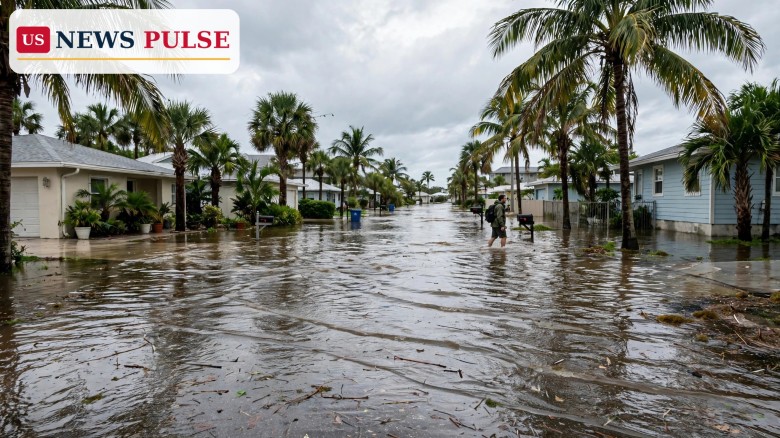
Record king tides flooded the California and Florida coasts this week, pushing seawater over roads, driveways and beaches in a multi-day event that set all-time tide records on both sides of the country. In San Diego and Los Angeles, the three highest tidal floods on record arrived in just three days. In Miami, the tide gauge at Virginia Key passed major flood stage on two consecutive days for the first time ever. The flooding came without a hurricane anywhere near the United States, driven instead by the year's highest astronomical tides, an October full moon known as the Hunter's moon, strong onshore winds and unusually warm ocean water linked to El Niño.
The king tide event built through the week of October 27, 2026, as the Hunter's moon combined with the year's highest predicted tides. King tides are the highest high tides of the year, occurring when the Sun, Earth and Moon line up during a full or new moon and their gravitational forces combine. When the Moon is also near its closest point to Earth, the tides climb higher still. This week's tides arrived on top of unusually warm sea surface temperatures and Kelvin wave activity associated with El Niño, lifting water levels well above predictions.
In Southern California, the scale of the event became clear in the tide-gauge records. A table of the top ten highest tide levels at San Diego, Los Angeles and San Francisco, compiled from data shared by Dr Jeff Masters, showed that the prior three days had produced the three highest tidal floods on record for both San Diego and Los Angeles. Both cities have now seen five of their top ten levels in the last four months. A San Diego tide gauge topped 8 feet, nearly 1.5 feet above the predicted level. San Francisco, where flooding was less severe than in the south, still set an October record earlier in the week.
On the ground, the water turned familiar streets into channels. Flooding forced the closure of a stretch of Pacific Coast Highway near Huntington Beach, where people were seen wading through knee-deep water and navigating flooded areas on paddleboards. Outside San Francisco, kayaks became the preferred way to cross inundated roadways. In Florida, flooding covered roads near Fort Lauderdale and South Hutchinson Island, and seawater spilled onto driveways in Fort Lauderdale neighbourhoods, in scenes captured in local reports of fish swimming across a flooded driveway.
Miami's numbers were just as striking. The Miami tide level exceeded major flood stage on two consecutive days for the first time ever. At Virginia Key, the peak water levels were similar to those seen in hurricanes Wilma and Irene, and the highest non-hurricane tide level ever recorded at the gauge since it was installed in 1994. Only Hurricane Irma holds a higher record at the site, about a foot above what was observed on Tuesday. Strong onshore winds along the Southeast coast added to the astronomical tides, pushing even more water toward the shore.
King tides are predictable. They return every year around the full and new moons nearest the equinoxes and the Moon's closest approach to Earth, and tide tables publish them months in advance. What made this week exceptional was not the astronomy alone but the combination of factors stacked on top of it. Warmer ocean water expands and raises sea level, El Niño-related Kelvin waves push warm water toward the coast, and onshore winds pile water against the shore. Heavy rain can make matters worse by overwhelming drainage systems just as rising ocean water makes it harder for floodwater to escape.
The event also unfolded during relatively benign weather, a point stressed by the Balanced Weather analysis of the week. There was no landfalling storm driving a surge, yet water levels rivalled those of named hurricanes at the Miami gauge. That is why coastal scientists treat king tides as a preview: they show, in calm conditions, where the water will go when a storm eventually adds wind and waves to the same high tide. Long-term sea-level rise is steadily raising the baseline, so a tide that once stayed below a seawall now spills over it.
Florida's Atlantic coast has lived with this pattern for years, and California is catching up fast. The five top-ten tide levels in four months at both San Diego and Los Angeles point to a shift rather than a single freak event. The National Weather Service issued coastal flood warnings and advisories across the affected regions, with advisories for San Diego and Orange counties running into Friday and San Francisco Bay-area advisories continuing into Saturday. Florida's Atlantic coast remained under flood warnings as the week ended, with impacts felt from Miami-Dade and Broward counties through the central Atlantic coast.
The record books tell the story most clearly. Three days, three record floods in San Diego and Los Angeles. Two consecutive days above major flood stage in Miami, something that had never happened before. Virginia Key's highest king tide in three decades of records, and its third-highest water level overall, behind only hurricane-driven peaks. San Francisco's October record. Each of these would be notable alone; together, in a single week and on opposite coasts, they mark what Balanced Weather called an unprecedented multi-day record coastal flooding event.
The comparison with hurricanes deserves care. Miami's peak this week matched the levels seen in hurricanes Wilma and Irene, but those storms brought destructive winds, rainfall and storm surge over a wide area, while this week's flooding came from tides and wind alone. The similarity is in the water height at one gauge, not in the damage. Even so, the height matters: roads closed, homes and businesses took on water, and beach erosion continued into the weekend as lingering onshore winds, rough surf and additional high tides kept flood and erosion concerns alive into early next week.
Claims circulating online during the event went further than the evidence, including suggestions of mass evacuations. No verified emergency announcement established a mass evacuation tied to this week's tides. The official warnings advised residents to avoid flooded roads, protect vulnerable property and stay away from dangerous surf. That distinction matters for readers sorting real risk from viral exaggeration: this was a serious, record-setting tidal flood, not an evacuation emergency.
Forecasters and analysts urged coastal residents not to treat the easing of the peak tides as the end of the story. Balanced Weather, in its October 30 recap of the event, warned that the worst may still lie ahead for California, noting NOAA tidal projections that the monthly high tidal cycles in late November and December will be significantly higher than this week's levels. Its assessment was blunt: "If high winds and waves accompany either of the upcoming high astronomical tidal cycles, we could be looking at a coastal flood event with major societal impacts well beyond what have already been seen."
The same analysis stressed that this week's floods happened during relatively benign weather and resulted from a combination of climate factors including long-term global warming. The Weather Company, reporting the closures and the record gauges, pointed to the same drivers: the Sun-Moon-Earth alignment, the Moon's close approach, onshore winds pushing seawater toward the coast, and, in California, warmer ocean water associated with El Niño adding to the coastal flooding threat.
Local response followed the familiar tidal-flooding playbook: road closures around the worst-hit stretches, including Pacific Coast Highway near Huntington Beach, and repeated warnings from the National Weather Service to avoid driving through flooded roads. No deaths or mass evacuations were reported in the coverage of the event, but the repeated flooding — day after day at high tide — left some coastal residents facing water in their streets for a second or third consecutive day.
This week matters because it shows how quickly "nuisance" tidal flooding is becoming something bigger. A decade ago, a king tide might have lapped at a seawall or briefly covered a low-lying car park. This week it closed a major coastal highway, pushed water into homes and businesses, and set records that had stood for decades — all without a storm. As sea levels rise, the gap between an ordinary high tide and a flooding tide narrows, and events like this one become more frequent, longer-lasting and harder to dismiss as a curiosity.
The economic stakes are also rising. Coastal property, roads, drainage systems and beaches all take damage from repeated saltwater exposure, even when no single event looks catastrophic. Beach erosion from this week's tides will take time and money to repair, and businesses in flooded neighbourhoods lose trading days with each high tide. For insurers and city planners, a week in which two major coastal cities set three all-time records in three days is data, not anecdote — and it will feed into decisions about seawalls, drainage, building codes and where it is safe to build.
The immediate outlook is for a gradual easing as the peak tides pass, but with flood and erosion concerns lingering into early next week where onshore winds and rough surf persist. A wet weather pattern developing across the western and middle parts of the country will bring additional flooding risks to parts of the Southwest and beneficial rains to the Mid-South as the weekend approaches.
The dates to watch are already on the calendar. California's next scheduled king tide window falls during Thanksgiving week, followed by another round at Christmas, December 23-25. NOAA projections suggest the monthly high tidal cycles in late November and December will be significantly higher than this week's levels. If those tides coincide with strong winds and waves, forecasters warn the result could be far more serious than this week's record event. Coastal residents in California and Florida should check local National Weather Service coastal flood products before those windows, avoid driving through flooded roads, and keep vulnerable property and vehicles clear of low-lying streets at high tide.
A king tide is one of the highest high tides of the year, caused by the combined gravitational pull of the Sun and Moon when they line up with Earth during a full or new moon, especially when the Moon is near its closest point to Earth.
San Diego and Los Angeles each recorded their three highest tidal floods on record in three days. Miami exceeded major flood stage on two consecutive days for the first time ever, and Virginia Key set its highest king tide and third-highest water level in about 30 years. San Francisco set an October tide record.
No. This week's flooding came from astronomical tides, the Hunter's moon, onshore winds and warm ocean water linked to El Niño, without any hurricane near the United States.
California's next king tide windows are Thanksgiving week and Christmas, December 23-25, 2026. Forecasters say those cycles could bring even higher water than this week's event.
Follow National Weather Service coastal flood warnings, never drive through flooded roads, move vehicles and valuables from low-lying streets before high tide, and stay away from dangerous surf and eroding beaches.
Related coverage on US News Pulse: Cross-country storm to blast 35 states and Phoenix Halloween rain forecast.
Leave a Comment



 | Today's Date: