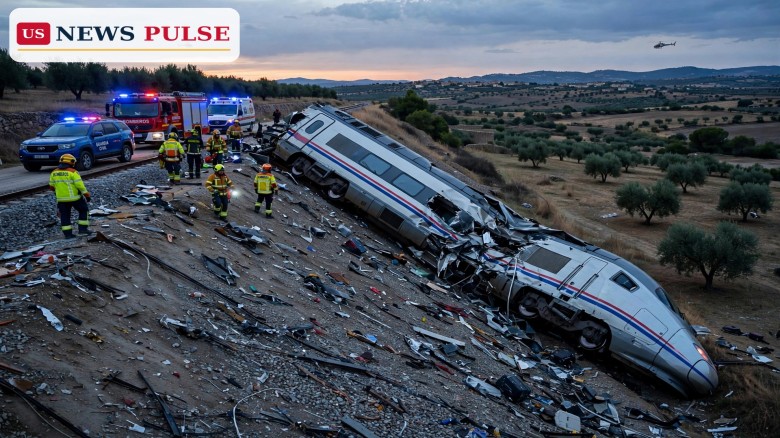
Spain train crash cause investigators now have their first official answer, and it points to a chain of failure rather than a single fault: a computer breakdown froze the signalling on a stretch of the Madrid-Seville high-speed line, and then a train controller wrongly ordered a Renfe train to drive straight past a red signal at about 124 miles per hour. The train slammed into a stationary Iryo service near Urda, in Toledo province, killing at least 68 people and injuring more than 100 in Europe's deadliest rail disaster since 2013.
Transport Minister Óscar Puente laid out the sequence at a press conference on Wednesday, October 28, 2026, hours after the morning collision. "There was a red signal prohibiting movement, yet the train was authorized to proceed," Puente said. "It is a decision made under inexplicable circumstances." A full investigation is now under way, and Prime Minister Pedro Sánchez has promised that any negligence "will come to light" and any safety-system failures "will be addressed with the utmost firmness."
The two trains were both travelling south from Madrid to Seville on the high-speed line when the disaster unfolded shortly before 9 a.m. local time, between the towns of Urda and Los Yébenes, about 130 kilometres south of Madrid. The Iryo train, carrying 151 passengers, had stopped on the track on the orders of ADIF, the state-owned company that manages Spain's railways, after a signal fault halted traffic in the area.
The Renfe train behind it was carrying 393 passengers. According to Puente, ADIF had taken manual command of the system after the computer failure, and a controller then gave the Renfe train an erroneous order to continue southbound despite the red light. With no speed restriction attached to that order, the train accelerated back to about 124 miles per hour between 8:36 a.m. and 8:52 a.m. before ploughing into the rear of the stationary Iryo service.
The impact derailed carriages from both trains. At least three carriages plunged down a gravel embankment beside an elevated section of track, and one carriage was shredded into twisted metal and debris. Rescue workers spent the day going carriage by carriage through the wreckage, searching for survivors and bodies, while the regional government of Castilla-La Mancha confirmed the death toll had reached 68 and warned it could still rise. At least 58 people needed hospital treatment, and the total number of injured passed 100.
Rail service between Madrid, Ciudad Real and Andalusia was suspended, and the emergency response grew through the day: dozens of fire trucks, ambulances and police cars, at least three helicopters, Civil Guard tents at the scene, and the sports centre in nearby Urda turned into a casualty and support hub. The regional government urgently appealed for blood donations in Alcázar de San Juan, Ciudad Real and Toledo, and the Civil Guard opened four offices in different cities to identify victims quickly. Passengers who escaped serious injury were bussed away from the scene, some with bandaged wounds and bloody noses, others wheeling suitcases and being handed water by volunteers.
Wednesday's crash is the third deadly rail incident to hit Spain's railway network this year, and the second major high-speed collision on the same Madrid-Seville corridor in nine months. In January 2026, a crash near Adamuz in Córdoba province killed more than 40 people after a train derailed because of a break in the track and crossed onto an adjacent line, striking an oncoming train. Days after that disaster, a commuter train derailed near Barcelona on a day of heavy rainfall, killing the driver and injuring dozens of passengers.
Before this year, Spain's rail safety record was among the best in Europe. European Union statistics show that in 2023 Spain had fewer than one railway death per one million inhabitants, the best record in the EU at the time, and most railway deaths across the bloc involve unauthorised people on the tracks rather than passengers or staff killed inside trains. Spain operates about 3,900 kilometres of high-speed track, the second-largest network in the world after China, and the Madrid-Seville line was the country's first high-speed route.
The January disaster had already triggered a fierce debate about investment in railway maintenance. After the Adamuz crash, Spain's train drivers' union, Semaf, raised concerns about high speeds causing vibrations and subsequent wear and tear along high-speed lines. Wednesday's crash will now intensify that debate, because the official account so far points not at track wear but at the safety system itself and the human decision taken once it failed. Sánchez travelled to the scene on Wednesday, and all 24 Copa del Rey football matches scheduled for the day were postponed as a mark of respect.
The decisive question in any rail disaster is what broke the chain of protections that is supposed to make a collision almost impossible, and Puente's account describes two breaks in sequence. First came the computer system failure affecting the LZB train management safety system along a 63-kilometre, or 40-mile, stretch of track. The failure automatically stopped all trains in the area, which is exactly what the system is designed to do when it can no longer guarantee safe separation between trains.
The second break was human. With the automatic system out of action, ADIF took manual command, and a controller authorised the Renfe train to proceed. That authorisation ignored the red signal and carried no speed restriction, so the train returned to full line speed. Puente described the decision as a breach of protocol made "under inexplicable circumstances," and said there will be a full investigation into the incident. What the investigation must establish is who gave the order, what information the controller had, whether pressure to restore service played a part, and why no second check caught the error before the train reached the stationary Iryo service.
The distinction matters for what happens next. If the failure was a single controller's error, the response will focus on training, staffing and manual-operation rules. If the investigation finds that the manual fallback procedures themselves were unclear, under-resourced or routinely stretched, the implications reach across the whole high-speed network, including the question of whether trains should be allowed to run at full speed at all when the automatic safety system is down.
Puente's press conference set the tone for the official response: blunt about the error, careful about blame before the investigation reports. "There was a red signal prohibiting movement, yet the train was authorized to proceed," he said. "It is a decision made under inexplicable circumstances."
Sánchez, speaking from the scene, framed the disaster as a national tragedy and a test of accountability. "Today, Spain is in mourning. All of Spain is in mourning," he said, expressing his "full solidarity" with victims' families. He added: "If there has been negligence, it will come to light. And if there have been failures in the safety system, they will be addressed with the utmost firmness."
Passengers described chaos inside the carriages. Miguel, who was travelling with colleagues in a rear carriage, told COPE radio: "We heard a massive roar, a truly enormous thud that went on for 10 seconds, as if the train were about to derail. Through the right-hand window, we could see a wrecked train." Yoander, 25, said: "I was sleeping, and when I woke up I was already crashing into the seats in front of me. I hit my face and my leg. I'm in pain, but there are people that need more help than I do."
Patricia, who was on the Renfe train, said her train had been stopped for about 20 minutes before the accident, with an announcement explaining there was a lot of traffic. "After that, we departed, and maybe not after even three minutes, there was a crash," she said. "Some people were hurled into the air… it was awful. Some of the train structure got into our carriage, and our carriage wasn't even the worst affected." Another surviving passenger, who declined to give her name, said three cars in particular "were in terrible shape": "One was on fire, in another there were people trapped and crying. And then in the main one impacted, there were people buried under debris."
Health Minister Mónica García had warned earlier in the day that the scale of the tragedy was clear from the physics of the impact. "It was a high-speed impact, so we are expecting this to be a tragedy," she said, as emergency workers focused on the two most damaged cars.
For readers in the United States, this disaster matters for three reasons. First, several Americans were injured, according to the US State Department, and the evacuated passengers included citizens of multiple nationalities, including Spain and Brazil. Spain is one of the most visited countries in the world by American travellers, and the Madrid-Seville line is a standard tourist route.
Second, the crash is a warning about what happens when a safety system fails and the human fallback fails with it. High-speed rail is expanding in the United States, and every system in the world relies on the same principle: automation keeps trains apart, and people take over only under strict rules when automation stops. The Spanish account suggests those rules were broken in the most basic way possible, by sending a train past a red signal at full speed toward a known obstruction.
Third, the disaster lands in the middle of a wider argument about infrastructure. Spain's network was a model of modern rail investment, yet it has now suffered two catastrophic high-speed crashes in nine months, plus a fatal commuter derailment. The investigation's findings on maintenance, computer systems and manual procedures will be studied by rail operators far beyond Spain, because the same equipment suppliers and the same safety philosophies are used across Europe and increasingly in the United States.
The immediate priority is the recovery operation and the identification of victims, with rescue workers continuing to search the wreckage carriage by carriage and hospitals across Castilla-La Mancha treating the injured. The Civil Guard's four victim-identification offices will work with families in the coming days, and officials have said the death toll may still rise.
The investigation will run in parallel. ADIF, Renfe and Iryo will all face questions, and the train controller's order will be examined against voice recordings, signalling logs and the manual-operation rulebook. Expect early findings on the computer failure itself, followed by a longer inquiry into why the manual authorisation was given and whether similar authorisations have been issued before without incident.
Service on the Madrid-Seville line will remain disrupted while the wreckage is cleared and the damaged track and signalling are repaired. Political pressure will also build: opposition parties are already demanding answers about rail investment and safety oversight, and Sánchez has staked his response on full accountability. For travellers, the practical advice is to check Renfe and Iryo service updates before heading to stations in Madrid, Ciudad Real and Andalusia, and to expect delays on the corridor for days.
What caused the Spain train crash? According to Transport Minister Óscar Puente, a computer failure in the LZB safety system stopped all trains on a 63-kilometre stretch of the Madrid-Seville line, and a controller then erroneously authorised the Renfe train to proceed past a red signal with no speed restriction. It reached about 124 mph before hitting the stationary Iryo train.
How many people were killed and injured? At least 68 people were killed, 44 on the Iryo train and 24 on the Renfe train, and more than 100 were injured. At least 58 people needed hospital treatment.
Where did the crash happen? Between Urda and Los Yébenes in Toledo province, about 130 kilometres south of Madrid, on the high-speed line connecting Madrid and Seville, shortly before 9 a.m. local time on Wednesday, October 28, 2026.
Is this Spain's first major train crash this year? No. It is the third deadly rail incident of 2026: a January crash near Adamuz killed more than 40 people, and a commuter train derailment near Barcelona killed the driver days later. It is Europe's deadliest rail disaster since the 2013 Santiago de Compostela derailment, which killed 80 people.
Were any Americans hurt? The US State Department said several Americans were injured in the collision. The evacuated passengers included citizens of multiple nationalities.
Related coverage on US News Pulse: Spain train crash kills at least 64 in high-speed collision near Toledo, US warns Gulf states of possible short, intense Iran war, and Flávio Bolsonaro arrives in Miami after fleeing Brazil election defeat.
Leave a Comment



 | Today's Date: