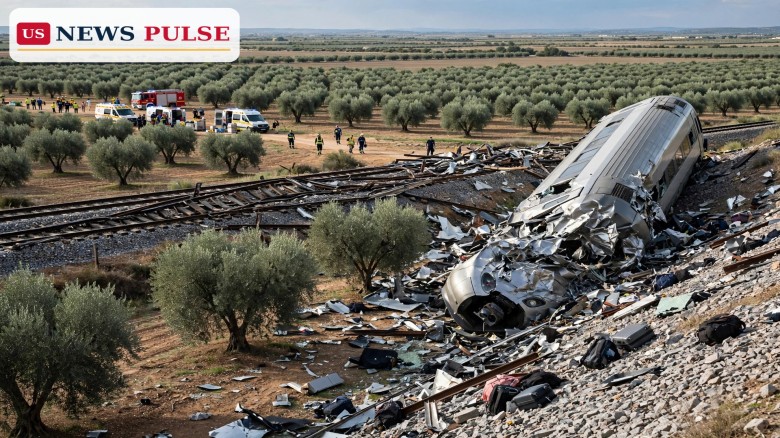
A Spain train crash killed at least 64 people on Wednesday, October 28, 2026, when a Renfe high-speed train slammed into the rear of a stopped Iryo train between the towns of Urda and Los Yébenes in Toledo province, about 130 kilometres south of Madrid. The collision derailed two carriages, shredded one car into twisted metal and debris scattered down a gravel slope, and left at least 80 people injured, around 50 of them seriously, according to Spanish officials and media reports. Authorities warned the death toll would surely rise further as rescue workers had still not reached the bottom of the wrecked carriages.
The two trains were travelling in the same direction, from Madrid to Seville in southwestern Spain, when the Renfe AVE service ran into the tail of the Iryo train, which had stopped on the line. Spain's rail infrastructure operator ADIF said the crash happened shortly before 9 a.m. local time, and rail service between Madrid, Ciudad Real and Andalusia was suspended. The central government's office for Castilla-La Mancha confirmed the death toll had risen to at least 64, after earlier counts of 10 and then 30, and the region's president, Emiliano García-Page, said rescuers expected more victims because "it has not yet been possible to reach the bottom of the carriages."
The collision happened on a flat stretch of railway surrounded by olive fields, on the high-speed line linking Madrid with Seville. According to Esther Padilla, spokesperson for the Castilla-La Mancha regional government, the two trains were heading in the same direction when one ran into the tail of the other, which had stopped, knocking two of its cars off the track. Spanish media reported that it appeared the Renfe train rammed the Iryo train. The impact left one carriage shredded into bits of metal and other material, with debris scattered down a gravel slope, and AFP reporters at the scene described one train embedded into another, with some carriages lying on their side in tangles of metal at the bottom of an embankment.
Passenger Ignacio Relaño was travelling on the Renfe train. He told state broadcaster TVE that his train had stopped momentarily on the line before it started again and then crashed into the Iryo train. "We all felt the train abruptly slowing down and then the impact," he said. "The car leaned to one side like it was about to tip over. I hit my nose, everything went flying, luggage, cell phones. Everything shook."
Spanish Health Minister Mónica García told TVE that emergency workers were focusing on rescuing survivors and bodies from the two most damaged train cars, and that the injured were being taken to hospitals across the region. "It was a high-speed impact, so we are expecting this to be a tragedy," García said. A military emergency brigade was deployed to help emergency services, firefighters and police, with nearly 100 military personnel called in, ambulances and medical helicopters shuttling to and from the site, and unscathed survivors put on buses. The mayor of Urda, Manuel Galán, said civil protection authorities had asked his town hall to prepare a sports pavilion to attend to passengers, while the mayor of nearby Los Yébenes, Jesús Pérez, told TVE that the accident appeared "serious."
The death toll rose through the morning as rescue teams reached deeper into the wreckage. Regional authorities first confirmed 10 deaths, with Padilla warning that "that number will surely rise." The state news agency EFE and other Spanish media later put the toll at at least 30, and the central government's office for Castilla-La Mancha then confirmed at least 64 dead, with at least 80 injured. Sources in the regional government told El País that 50 of the injured were seriously hurt. The government delegation in Castilla-La Mancha said 40 of the victims had been travelling on the stationary Iryo train and 24 on the Renfe service.
The crash is the second major train disaster in Spain this year, and it involved the same two companies. In January, 46 people died in southern Spain when an Iryo train jumped the track and hit an oncoming Renfe train, sending the first two cars of the impacted train plummeting down a four-metre slope. That crash was the deadliest in Spain since a 2013 derailment that killed 80 people, and it shook confidence in the country's extensive high-speed rail network. Wednesday's collision, on the busy Madrid to Seville corridor, will now test that confidence again, and investigators will have to explain how a high-speed train came to strike the rear of another train that had stopped ahead of it on the same line.
Spain is a world leader in high-speed rail. Over more than three decades it has laid some 3,900 kilometres of high-speed track for its 49 million residents, a network second only to China, which has 45,000 kilometres for 1.4 billion people, according to the International Union of Railways. Spain's railway union defines high-speed rail as trains running at 250 kilometres per hour (155 miles per hour) and above. Only recently did Spain open its rail network to private companies to compete against state-owned Renfe, and Iryo, an Italian-owned company, started operating in Spain in 2022.
That liberalisation is already part of the debate. A spokesperson for Spain's train workers' union, Joan Rodríguez, told TVE that the increased traffic brought by privatisation has put extra strain on rail infrastructure. "We are not convinced that the liberalization of the high-speed passenger rail service was matched by the necessary upkeep of the lines," Rodríguez said. "I am not saying it was a determining factor (in the crashes), but yes, the increase in use of the network is a factor to keep in mind."
The political timing adds to the pressure. Prime Minister Pedro Sánchez, who faced heavy criticism for the January disaster, is seeking to overturn unfavourable polls and extend his eight-year premiership in an early general election on November 29. How his government handles the investigation, the victims' families and the safety of the network in the next few weeks will be watched closely, and the opposition is likely to press him on whether the January crash led to any real change in how Spain runs its high-speed lines.
Prime Minister Pedro Sánchez cancelled his agenda to focus on the crash. He wrote on X that he was "dismayed by the serious train accident in Toledo." "Emergency services are working on site to attend to the affected passengers," Sánchez wrote. "All my thoughts are with the victims and their families."
Spain's King Felipe VI and Queen Letizia said in a short statement on X that they were following news of the accident. "We are deeply saddened and concerned by the train accident in Urda (Toledo)," the royal couple said. "We share in the grief of the families and loved ones of those who lost their lives, and we send our heartfelt support to the injured and all those affected."
European Commission President Ursula von der Leyen said: "My heart goes out to the victims' families and loved ones. Today, Europe mourns with you." Iryo said in a statement that it has "activated its security protocols and is closely working with authorities." Spain's soccer federation postponed all 24 Copa del Rey games scheduled for Wednesday as the country absorbed the scale of the disaster.
Related: Melania Trump ceasefire brings hope to Oleshky as Ukraine aid mission begins, Israel election 2026: Netanyahu fights for survival as Israel votes and Jordan Syria airstrikes kill 7 after church attack as border crossing shuts.
This crash matters first for the families of the dead and injured, whose loss is already among the worst in Spanish rail history. It matters second because it is the second catastrophe on the same network, involving the same two operators, within a single year, which turns a question about one accident into a question about the system: signalling, scheduling, maintenance and the pace at which a liberalised network has been asked to carry more trains. And it matters third because high-speed rail is central to how Spain moves — for commuters, for business and for tourism — so a suspension of the Madrid to Andalusia line and a crisis of confidence in the network have consequences far beyond the crash site.
Rescue work continues at the site as teams reach the lowest and most damaged carriages, and officials expect the confirmed death toll to change. The injured are being treated in hospitals across Castilla-La Mancha and beyond, and their conditions will be updated as families are informed. ADIF and the train operators will work to restore the Madrid to Seville line, while investigators from the rail authorities and the courts begin the work of establishing why the Renfe train struck the stopped Iryo train, including what the signalling and the drivers' records show. US News Pulse will update this story as the official toll and the investigation's first findings are confirmed.
What happened in the Spain train crash? A Renfe high-speed train rear-ended a stopped Iryo train near Urda in Toledo province on Wednesday, October 28, 2026, shortly before 9 a.m. local time, derailing two carriages and killing at least 64 people.
Where exactly did the crash happen? Between the towns of Urda and Los Yébenes in Toledo province, about 130 kilometres south of Madrid, at kilometre 118 on the high-speed line from Madrid to Seville.
How many people were killed and injured? At least 64 people died — 40 on the stationary Iryo train and 24 on the Renfe service, according to the government delegation in Castilla-La Mancha — and at least 80 were injured, around 50 of them seriously. Officials warned the toll could still rise.
What caused the crash? The cause is not yet known. Investigators will examine the signalling, the trains' records and why the Renfe train struck a train that had stopped ahead of it on the same line.
Is this Spain's first major train crash this year? No. In January 2026, 46 people died when an Iryo train derailed and hit an oncoming Renfe train in southern Spain, the deadliest Spanish rail crash since 2013, when 80 people died.
Leave a Comment



 | Today's Date: