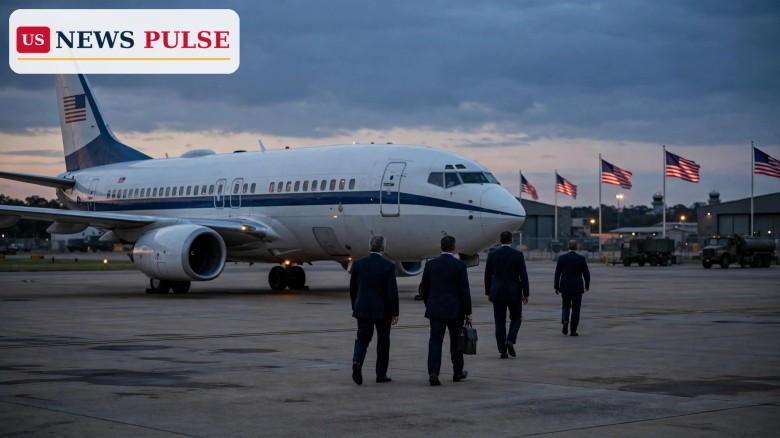
In a sharp Trump Vance Iran denial, President Donald Trump has rejected reports that he directed Vice President JD Vance to open peace talks with Iran, insisting instead that Vance's letter to Iranian security chief Mohsen Rezaei was about medical supplies. The denial, delivered to reporters at Joint Base Andrews on Wednesday, October 28, 2026, landed just five days before the November 3 midterm elections and only hours after Trump himself had confirmed that Vance sought his blessing before writing to Tehran's hardline security establishment.
The distinction Trump drew on Wednesday is now the story. He did not deny that Vance contacted Rezaei. He denied that he ordered a peace initiative, and he reframed the contact as humanitarian help for sick people in Iran. That framing sits uneasily alongside The Wall Street Journal's reporting, which said the letter was sent at Trump's direction, that the president was kept fully informed, and that it tested whether Washington and Tehran could agree on a framework for negotiations.
Asked by reporters at Joint Base Andrews on Wednesday whether he had instructed Vance to approach Iran about restarting peace negotiations, Trump answered: "No. They need help with medical supplies and various things. He asked me what I thought. I said, 'If you want to do that, that's okay'. Basically, it's getting supplies in to help people that are not well."
The question followed the Journal's report that Vance had opened a direct channel to Rezaei, one of Iran's most influential hardliners, in an attempt to revive negotiations even as Trump threatens to resume military strikes in the coming weeks. According to the Journal, as reported by Times Now, Business Today and Israel National News, the letter was designed to determine whether the two countries could find enough common ground to avoid another American offensive, and a person familiar with the matter said it was sent at Trump's direction with the president kept fully apprised.
Neither side has publicly confirmed the reported exchanges in full. A spokesperson for Vance declined to comment on the discussions, the White House directed questions to the vice president's office, and an Iranian Foreign Ministry spokesperson said he had no information about the reported outreach. Rezaei and Iran's Supreme National Security Council were unavailable for comment, Israel National News reported.
The timing matters because the two Trump statements arrived on the same day and point in different directions. The first confirmed a diplomatic approach made with the president's knowledge. The second denied that the approach was a peace initiative directed by the president, and recast it as medical assistance. What has not changed in either version is the fact of the contact itself, nor the fact that the letter's full contents have not been published.
The war between the United States, Israel and Iran began on February 28, 2026, when the United States and Israel launched joint strikes on Iran under the military operation known as "Epic Fury". The conflict killed Iran's Supreme Leader and many other officials, drew Iranian missile and drone strikes against Israel, American bases and American-allied countries, and saw Iran close the Strait of Hormuz, the waterway through which about a fifth of the world's energy supplies pass.
Diplomacy has repeatedly failed to produce a lasting settlement. A two-week ceasefire agreed on April 8, 2026, and mediated by Pakistan, briefly paused the fighting, and days later Vance, special envoys Steve Witkoff and Jared Kushner met Iranian negotiators for 21 hours in Islamabad, in the first face-to-face talks between the United States and Iran since the 1979 Islamic Revolution. Those talks ended without a deal. A memorandum of understanding reached in June collapsed just two weeks after it was signed, following disagreements over how shipping through the Strait of Hormuz would be restored, and subsequent negotiations mediated by Qatar and Pakistan have failed to break the deadlock.
The sticking points have remained constant. Washington wants Iran to make concessions on its nuclear programme upfront, while Tehran is demanding immediate economic relief. Vance, appointed by Trump as lead negotiator, has travelled abroad twice to meet Iranian counterparts, and in an interview with Reuters earlier this month he insisted Iran must take verifiable steps to reduce its uranium enrichment before the United States would agree to end the war.
Rezaei is a different kind of interlocutor from the officials who led earlier rounds. Those talks were handled by parliament speaker Mohammad Bagher Ghalibaf and Foreign Minister Abbas Araghchi. Rezaei, by contrast, is a veteran of Iran's war with Iraq in the 1980s who led the Revolutionary Guard for years and now runs the Supreme National Security Council, the body that coordinates defence and foreign policy. Earlier this month he warned that Iran could target the United Arab Emirates, as well as data centres and internet cables across the region, and on Sunday he met security chiefs from Saudi Arabia, Pakistan and Turkey in Tehran.
The Trump Vance Iran denial matters because it changes what the letter is allowed to mean in public, without changing what was reportedly written. If the letter was a test of a negotiation framework, then the United States has an active, if secret, diplomatic track running alongside its military preparations. If it was only about medical supplies, then that track is far narrower, and the administration can present itself as tough on Iran while still showing a humanitarian concern.
Both readings have political uses five days before an election. A peace initiative could soften the image of a president who has warned of renewed bombing after the vote, and reassure voters worried about fuel prices and the cost of the war, which the Pentagon has put at $47.1 billion for American taxpayers. A medical-supplies explanation, on the other hand, avoids the appearance of negotiating with a hardliner who has threatened to widen Iranian attacks, and it keeps the president's threat of force intact.
The denial also protects Vance, an early contender for the 2028 Republican presidential nomination who has publicly backed the war while privately expressing reservations about prolonging it. Before Trump launched the operation in February, Vance had argued for more robust diplomatic efforts. As lead negotiator he is now at the centre of both tracks: the public threat of strikes and the private search for a way to avoid them.
For Tehran, the ambiguity may be deliberate. Rezaei said last week that Iran would not negotiate with Washington until its core demands were satisfied, and Foreign Minister Araghchi has said Tehran "continues to give diplomacy a chance to succeed" while reviewing ideas with mediators based on a proposal it put forward last month, which Trump rejected. A letter that can be described in Washington as humanitarian help and in Tehran as a negotiation framework gives both sides room to talk without conceding anything in public.
Trump's full denial, as reported by Israel National News, was: "No. They need help with medical supplies and various things. He asked me what I thought. I said, 'If you want to do that, that's okay'. Basically, it's getting supplies in to help people that are not well."
His earlier confirmation on Wednesday was shorter and more casual: "He asked me what I thought and I said if you want to do that that's OK." Taken together, the two remarks confirm that Vance acted with the president's knowledge, but they leave open whether the president directed, merely approved, or simply tolerated the contact.
Vance's own stated conditions for ending the war have not changed. In his Reuters interview earlier this month he said: "If you don't want a nuclear weapon, then why do you need 60% enriched fuel? And if you want to show commitment to not building a nuclear weapon, don't build highly enriched fuel. That's a very basic threshold issue." He added: "We're not going to trade words for actions," while indicating the administration remained open to a negotiated settlement if Tehran agreed to substantive restrictions on enrichment.
Trump's broader language on Iran has alternated between diplomacy and threat throughout the week. Last week he said Washington was not negotiating with Tehran and suggested military action was imminent. At a campaign stop on Tuesday he accused Iran of dragging out efforts to reach a deal and warned that waiting until after the election would not help Tehran. He has also said the war will end only when he decides it should, telling a rally in Lubbock, Texas: "Whenever I want it to end."
This denial matters first because it is the clearest sign yet of a two-track American policy toward Iran in the final days of a midterm campaign. The military track is visible: Gulf allies have been warned to prepare for a short, intense campaign after November 3, an additional Patriot air defence system is being sent to Israel, munitions are being restocked, troops have been moved from vulnerable bases, and a third aircraft carrier strike group has been sent toward the Persian Gulf. The diplomatic track, by contrast, exists only in a letter whose contents have not been published and whose purpose is now publicly disputed.
It matters for American voters because the war has become a domestic issue as well as a foreign-policy one. Rising fuel prices, the $47.1 billion cost reported to Congress, and the prospect of another bombing campaign after the election all feature in the closing arguments of the midterm campaign, in which Republicans face the prospect of losing seats in both houses of Congress. How voters read the Vance letter — as a genuine search for peace, a humanitarian gesture, or a last-minute political signal — will depend heavily on which version of Trump's account they hear.
It matters for the region because Gulf governments warned to prepare for strikes are also watching for any sign that bombing can be avoided. The United Arab Emirates foreign ministry has urged all sides to "exercise wisdom and pursue political solutions" to keep the conflict from returning to full scale, and regional powers including Saudi Arabia, Pakistan and Turkey have already been drawn into the diplomacy around Rezaei's Sunday meeting in Tehran. A credible negotiation framework, even one whose details remain secret, gives those capitals something to point to when urging restraint.
Finally, it matters because it tests whether Iran's hardline security camp will talk at all. Rezaei's emergence as a potential interlocutor could reshape the diplomatic process, possibly sidelining Araghchi and Ghalibaf, but only if he engages. If he ignores or rejects the approach, the administration will be able to say it tried diplomacy — in whatever form — before returning to force.
The immediate question is whether Rezaei replies, and whether any reply becomes public. A response could take days or weeks, and it may arrive through an intermediary such as Pakistan or Qatar rather than directly. Watch for statements from Iran's Supreme National Security Council or its foreign ministry, and for any sign of renewed contacts involving Witkoff and Kushner.
The second question is November 3. If Republicans perform well in the midterms, Trump may feel freer to act on the military track he has been preparing. If they perform poorly, the political cost of a new war rises, and the letter — in either of its descriptions — may gain importance as an alternative. Either way, the period between the election and the seating of the new Congress in early January 2027 has been identified as the most difficult stretch of the conflict.
The third question is substance. Any negotiation framework will have to address the reopening of the Strait of Hormuz, Iran's nuclear programme and enrichment levels, and the future of Iranian attacks on shipping and Gulf targets. Those were the issues that sank the April talks and the July memorandum, and they remain unresolved. Until they are addressed, the letter is an opening move, not a breakthrough, and the denial is a reminder that even its purpose is still contested.
No. Trump denied that he directed Vance to start peace talks with Iran. He confirmed Vance contacted Rezaei, but said the contact concerned medical supplies and that Vance asked his opinion first.
According to The Wall Street Journal's reporting, the letter tested whether Washington and Tehran could agree on a framework for negotiations. The full contents and the exact timing of the letter have not been made public.
Mohsen Rezaei is the secretary of Iran's Supreme National Security Council and a former commander of the Islamic Revolutionary Guard Corps. He is a veteran of Iran's 1980s war with Iraq, and his influence in Tehran is described as rising.
As of Wednesday, Tehran had not publicly responded, and no Iranian official had confirmed receipt. Rezaei said last week that Iran would not negotiate until its core demands were met.
No. The White House has said only that no attacks will happen before the November 3 elections. Trump has said he may renew bombing afterwards, and the United States has warned Gulf states to prepare for a fresh campaign.
Related coverage on US News Pulse: Vance Iran letter: Trump confirms secret peace overture to Tehran hardliner; US Iran strike plans: forces ready within 96 hours of Trump order, reports say; Trump says Iran war ends "whenever I want it to end" as Tehran hits back.
Leave a Comment



 | Today's Date: