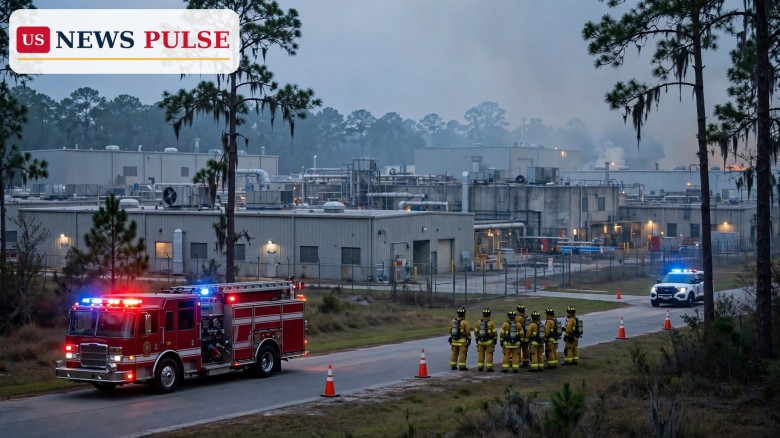
A Savannah River Site fire at a federal nuclear laboratory in South Carolina triggered a formal Site Area Emergency on Wednesday evening, October 28, 2026, shut down nearby airspace, sheltered workers behind barricades and set off a night of anxious questions about radiation — before officials lifted every protective measure later the same night and reported no detectable contamination. The Savannah River Site fire, which broke out in a single room at the Savannah River National Laboratory near Aiken, is now the subject of an official investigation into how it started, after a night in which one employee was hurt and taken to hospital with minor injuries.
By 9:45 p.m. on Wednesday, the Savannah River Site (SRS) said the emergency was over. Protective actions had been lifted, site barricades had reopened, and workers due on the next shift were told to report as usual on Thursday, October 29. Radiological surveys, the site said, indicated no detectable levels of contamination. That all-clear capped roughly four hours of emergency operations at one of America's most sensitive nuclear complexes — a site that made plutonium and tritium for nuclear weapons during the Cold War and now handles waste cleanup and nuclear materials management.
The first public sign of trouble came on Wednesday evening, when Savannah River Site officials announced that an event was in progress that had triggered emergency response activities at the Department of Energy facility. The site, a sprawling complex near Aiken on the South Carolina-Georgia border, employs thousands of workers and contains laboratories, waste facilities and materials-handling areas behind a secure perimeter.
According to reporting by local broadcaster WRDW and picked up nationally, the fire was confined to a single room at the Savannah River National Laboratory. An emergency dispatch associated with the incident described an "unfiltered ground-level radiological release" — language that immediately raised the stakes of what might otherwise have been treated as an ordinary industrial fire. At a nuclear site, any suggestion of an unfiltered release means material may have left a controlled area without passing through the filters designed to trap radioactive particles, and it is the kind of phrase that triggers the most serious precautionary response available.
Workers in the laboratory's Area A were ordered to shelter in place behind barricades for around 30 minutes, according to multiple sources cited by News 12. Employees in areas affected by the incident who were not involved in emergency response or shutdown operations were sheltered as a precaution, the site said. After some time, people were allowed to leave the area, but others were not permitted to enter. Barricades at site entrances were closed to incoming traffic, and the site said rail, river and air traffic in the vicinity were restricted while response efforts were under way.
The Federal Aviation Administration's temporary flight restriction drew particular attention. The FAA notice described the reason as a "U.S. Gov't Nuclear Incident," according to WSB-TV, and local media reported the restriction covered a 15-nautical-mile radius around the facility up to 10,000 feet above sea level, scheduled to remain in place until midnight on Thursday. Highway 125, the main road past the site, remained open throughout, officials confirmed — a detail that mattered to residents of Aiken and Jackson who watched the emergency unfold from outside the fence.
News of the incident spread quickly beyond South Carolina. Calls about traffic near the main gate off Atomic Road began reaching local newsrooms at around 6:15 p.m., according to News 12, and national outlets picked up the story as the FAA notice circulated online. For several hours, the publicly available information was thin: a fire, an emergency declaration, a flight restriction and a dispatch phrase about a radiological release, with no confirmed word on injuries, on the cause, or on whether anything radioactive had actually escaped.
The Savannah River Site was built in the early 1950s near Jackson, South Carolina, as part of America's Cold War nuclear weapons programme. For decades its reactors and separation plants produced plutonium and tritium for the nation's nuclear arsenal. That mission ended with the Cold War, but the site's legacy did not: today the Savannah River National Laboratory focuses on waste cleanup and nuclear materials management, work that involves some of the most hazardous material in the federal inventory and that keeps the site under constant security and safety scrutiny.
The site's history is precisely why Wednesday's fire drew such a fast and visible response. Facilities that handle radioactive material operate under emergency plans that escalate quickly, and a Site Area Emergency is a formal declaration that mobilises the site's own response force, notifies state and local government agencies and triggers protective actions for workers. Officials said they directed the response and notified the appropriate state and local government agencies, and advised nearby residents to monitor local broadcasts for instructions from state authorities.
Wednesday's incident also arrived at a moment of heightened public sensitivity about nuclear safety in the United States. The country is in the middle of a debate about the future of its nuclear weapons complex, the cleanup of Cold War sites and the expansion of civilian nuclear power, and any incident at a Department of Energy site is read against that backdrop. For residents of the Central Savannah River Area, however, the questions were more immediate: what burned, what — if anything — got out, and whether it was safe to go to work on Thursday morning.
The official account, as it stood on Thursday morning, was reassuring on the central question. "A fire was reported at the Savannah River National Laboratory but has since been extinguished," the Savannah River Site said in a statement posted on Wednesday evening. "No contamination has been reported outside the affected facility." A later update, issued at 9:45 p.m., went further: the Site Area Emergency was terminated at 9:45 p.m., protective actions had been lifted, site barricades had reopened, and radiological surveys indicated no detectable levels of contamination.
Reuters, citing a US Department of Energy spokesperson, added two further confirmed facts on Thursday: one person suffered minor injuries in the fire, and that employee was taken to hospital. The spokesperson, citing Savannah River Site officials, said the fire was extinguished and no contamination had been reported. The site did not say what caused the fire, and the cause remained undisclosed in the reporting available on Thursday morning.
What remains unresolved is the gap between the dispatch language and the all-clear. Local reporting cited an emergency dispatch describing an unfiltered ground-level radiological release, while the site's own statements reported no contamination outside the affected facility and, later, no detectable levels of contamination at all. Officials have not yet publicly explained that discrepancy in technical detail — whether the dispatch phrase reflected an initial, precautionary classification, a release that was contained within the building, or something else entirely. That explanation is likely to be the focus of the investigation now under way, and of questions from state officials and the public in the days ahead.
The Savannah River Site's own statements were the most authoritative account available on Wednesday night. In its initial notice, the site said officials had declared a Site Area Emergency at the facility near Aiken and were directing response efforts. Its follow-up statement carried the reassurance residents were waiting for: "A fire was reported at the Savannah River National Laboratory but has since been extinguished. No contamination has been reported outside the affected facility."
The site also told the public that there was no indication of consequences beyond the site's boundaries, a formulation repeated in national reporting on Thursday. And in its 9:45 p.m. update, it confirmed the emergency was over: "The Savannah River Site Area Emergency was terminated at 9:45 p.m. Protective actions have been lifted, and site barricades have reopened." Oncoming shift workers were told to report to work as usual, and all other employees were told to report as scheduled on Thursday, October 29.
A US Department of Energy spokesperson, speaking through Reuters, confirmed the human cost of the night: one employee with minor injuries, taken to hospital. No further details about that employee's condition were released. The site said that when more specific information is available, it will be provided through its official website and social media channels.
The Savannah River Site fire matters for three reasons. The first is straightforward public safety: the site stores and processes radioactive material, and any fire there must be treated as a potential radiological event until surveys prove otherwise. Wednesday's response — sheltering workers, closing entrances, restricting air, rail and river traffic — shows how seriously that principle is taken, and the all-clear shows why the precaution exists: to buy time for measurements before anyone declares the public safe.
The second reason is trust. The gap between a dispatch report of an unfiltered radiological release and an official finding of no detectable contamination is exactly the kind of discrepancy that erodes confidence if it is not explained clearly and quickly. Communities living beside nuclear sites accept a bargain — they live with the risk, and in return they expect candour when something goes wrong. A full, technical account of what the dispatch phrase meant, and what the surveys measured, will matter more than the all-clear itself.
The third reason is the site's future. Savannah River is central to the Department of Energy's cleanup mission and to ongoing debates about nuclear materials management in the United States. An incident that shuts airspace and shelters workers, even one that ends without detectable contamination, will feed into oversight hearings, safety reviews and budget arguments. How thoroughly the cause is investigated — and how openly the findings are shared — will shape those debates.
The immediate next step is the investigation into the cause of the fire, which the site has not yet disclosed. Investigators will examine the room where the fire broke out, the materials and equipment involved, and the sequence of alarms and protective actions that followed. They will also have to reconcile the dispatch language with the survey results, a technical question that may take days rather than hours to answer fully.
Workers returned to the site on Thursday morning under normal schedules, according to the site's 9:45 p.m. update, and Highway 125 remained open. The FAA's temporary flight restriction was reported to run until midnight on Thursday, so air traffic around the site may remain restricted into Thursday night even after the ground emergency ended. State and local agencies notified on Wednesday night will expect a fuller briefing as the investigation proceeds.
For residents of Aiken, Jackson and the surrounding Central Savannah River Area, the practical advice on Thursday was unchanged from Wednesday night: monitor local broadcasts and official site channels for instructions from state authorities, and expect further updates as more specific information becomes available. US News Pulse will update this story as officials release the cause of the fire and the results of the investigation.
A fire broke out in a single room at Savannah River National Laboratory on Wednesday evening, October 28, 2026, prompting a Site Area Emergency, sheltering of workers and restrictions on air, rail and river traffic. The fire was extinguished the same night and the emergency was terminated at 9:45 p.m.
An emergency dispatch described an "unfiltered ground-level radiological release," according to local broadcaster WRDW. Savannah River Site officials later said radiological surveys indicated no detectable levels of contamination and no contamination outside the affected facility. Officials have not yet publicly reconciled those two accounts in technical detail.
Yes. A US Department of Energy spokesperson told Reuters that one employee suffered minor injuries and was taken to hospital. No further details about the employee's condition were released.
Officials lifted all protective actions at 9:45 p.m. on Wednesday, reopened site barricades and told workers to report as scheduled on Thursday. Highway 125 remained open throughout. Residents were advised to monitor local broadcasts for any further instructions from state authorities.
The cause has not been disclosed. The Savannah River Site did not say what caused the fire, according to Reuters, and an investigation is expected to establish the cause and the sequence of events.
Related coverage on US News Pulse: New Jersey trooper shooting under investigation, Tallahassee teen charged as an adult in FAMU homecoming attack, and today's top US stories.
Leave a Comment



 | Today's Date: