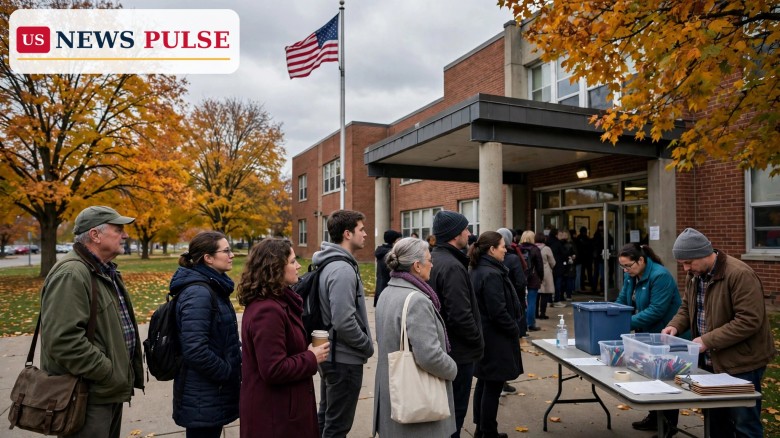
James O'Keefe and fellow conservative activist Cam Higby have been charged with felony unlawful voting and identity theft in Minnesota, after prosecutors said the pair used other voters' names at Minneapolis polling places during the state's August primary in a filmed attempt to test the state's voter-vouching rules. The James O'Keefe Minnesota charges were announced on Wednesday, October 28, 2026, by Hennepin County Attorney Mary Moriarty, six days before the November 3 midterm elections.
Prosecutors allege that O'Keefe, 42, of West Palm Beach, Florida, and Higby, 26, of Covington, Washington, entered polling places on August 11 wearing disguises and concealed cameras, gave poll workers the names of registered voters who had not authorised them to do so, and began the process of registering to vote in those precincts. Neither man received a ballot or cast a vote, according to prosecutors, who say the pair stopped when they were told they would have to sign oaths vouching for another person's residence. The charges are allegations, and neither man has yet entered a plea.
According to the criminal complaints and Moriarty's announcement, O'Keefe and Higby visited Minneapolis-area polling places on the day of Minnesota's primary election, August 11, 2026, as part of a video project examining the state's election procedures. The pair were disguised in what O'Keefe later described on social media as traditional Muslim attire, and they recorded their exchanges with poll workers using hidden cameras. Prosecutors say they presented themselves using the names of registered voters in those precincts, without those voters' knowledge or permission.
The system they were probing is known in Minnesota as vouching. It allows a person who lacks proof of their current address to register and vote on the same day if a voter already registered in that precinct vouches for them. A registered voter in the same precinct may vouch for up to eight other voters, and staff at residential facilities may vouch for residents. Moriarty said the process is often used by older voters who have moved into nursing homes and have not updated their driver's licences.
Prosecutors say the attempt did not get far. Election judges on duty noticed what Moriarty described as strange behaviour, raised concerns, and flagged the incidents to police. The living voters whose names were allegedly used told investigators they had no knowledge of the effort, Moriarty said. The men stopped short of signing the oath that voters sign before receiving a ballot, and they did not vote. That, Moriarty argued, does not change the legal question at the heart of the case.
The charges were filed as criminal complaints rather than through an arrest. Moriarty said the county clerk will send each man a copy of the complaint with the date of his first court appearance. Reports of the announcement said each charge is punishable by up to five years in prison, although the eventual sentence in any case would depend on the court's findings and Minnesota sentencing law. Neither O'Keefe nor Higby immediately responded to emailed requests for comment reported by national outlets, and court records available at the time did not name an attorney for either man.
O'Keefe is one of the best-known figures in American undercover political video-making. He founded Project Veritas, a right-wing activist group that targeted journalists and institutions with sting-style videos that critics said were often deceptively edited. He was fired by the Project Veritas board in 2023 and later founded O'Keefe Media Group, where he has continued to produce videos that he presents as exposing corruption. Higby, 26, is a fellow conservative activist and content creator who has worked with O'Keefe on video projects.
The August video was posted online shortly after the primary. In it, O'Keefe and Higby are shown speaking to poll workers, in some exchanges using altered accents and references to Muslim culture, while Higby wore garments covering his face and head. In an August social media post quoted in coverage of the charges, O'Keefe said: "We wanted to put the process to an extreme real-world test and document what election workers would tell us when confronted with the scenario firsthand." Moriarty said the videos posted online were deceptively edited.
Minnesota's vouching rule has been debated for years. Supporters say it protects access for voters who have recently moved, live in care facilities, or lack standard proof of address, and they point to the fact that a voucher must be a registered voter in the same precinct who attests to the other person's residence. Critics argue that same-day registration without documentary proof creates a risk of abuse. Wednesday's case sits squarely in that argument: prosecutors say the polling-place safeguards worked, because workers spotted the behaviour and no ballot was issued, while the pair's supporters say the prosecution itself proves the system is being used to punish people who expose its weaknesses.
The timing has also drawn attention. The charges were announced less than a week before the November 3 midterms, in a cycle already dominated by disputes over voter rolls, ballot access and election security. The Trump administration has in recent months sent several states lists of people it alleges are noncitizens on the voter rolls, and the president has repeatedly made claims about widespread voting fraud that courts and election officials have not substantiated. Minnesota officials, by contrast, have presented the O'Keefe case as a straightforward enforcement matter, not a statement about the coming election.
The prosecution's account rests on a distinction that Moriarty stressed at her news conference: the alleged offence was the misrepresentation itself, not a completed vote. Minnesota law, she said, provides that no individual shall intentionally misrepresent their identity when applying for a ballot. On that reading, giving a poll worker another person's name in order to start the registration process is enough to trigger the unlawful-voting charge, even if the person never signs the oath, never receives a ballot, and never votes.
That distinction is likely to be the central legal fight in the case. Defence lawyers in similar cases have argued that journalism, protest and attempts to demonstrate a vulnerability should not be treated the same as genuine attempts to cast an unlawful vote. Prosecutors answer that the polling place is a specially protected space, where the rules on identification are strict precisely because the ballot is the mechanism of democracy. Moriarty made that point directly: "There's no such thing as 'undercover' investigation in the polling place. You have to identify yourself as a journalist in the polling place, which they did not."
The identity-theft count follows the same logic. Prosecutors say the pair used the identifying information of real voters, including some who are deceased, without consent. The complaints do not allege that either man used the names to obtain money, credit or any other benefit outside the polling place, nor that any real voter was prevented from voting. The alleged harm, in the prosecution's framing, is to the integrity of the process and to the voters whose names were used.
Whether a court accepts that framing will matter beyond this case. Undercover reporting enjoys broad First Amendment protection in the United States, but that protection has never been absolute when the reporting itself involves conduct that would otherwise be a crime, such as trespass or fraud. The O'Keefe case will test where Minnesota courts draw that line for conduct inside a polling place, and the answer could shape how activist video-makers approach election-day stunts in future cycles.
Moriarty was blunt about the motive question. She said the charges were unrelated to the pair's political views or to the perception that their behaviour and disguises were derogatory or offensive. "Polling places are the heart of our democracy. Any attempt to disrupt or deceive our election workers will not be tolerated," she said in a statement posted alongside the announcement. She added: "You cannot give somebody else's name and misrepresent yourself. Whether or not they intended to vote is irrelevant."
She also sought to head off claims that the case was a political message. "This is not meant to send a message. It's meant for these particular people to understand that what they did was unlawful," Moriarty said. And she credited the election workers who raised the alarm, saying the episode showed that "the system for identifying misconduct and responding to it functioned well during the primary."
Minnesota Secretary of State Steve Simon backed that assessment in a statement after the announcement. "Minnesota's enduring tradition of high voter turnout and excellence in elections administration is due in part to the work we all do to keep polling places as 'islands of calm,'" Simon said. "These locations — our communities' schools, churches, and senior centers – are the heart of our democracy and as such should be places of safety and peace. Any attempt to disrupt or deceive our election workers will not be tolerated."
Supporters of O'Keefe and Higby reacted very differently. Some conservative commentators described the charges as lawfare and a witch hunt aimed at scaring off journalists, arguing that neither man voted and that the stunt had exposed a genuine vulnerability. One widely shared post argued that Higby had walked in wearing a burqa to show that staff would let him vote under a woman's name with no questions asked, and that the pair had been charged despite never voting. Those characterisations are disputed by prosecutors, who say the men never got a ballot precisely because poll workers intervened, and that the charges concern misrepresentation, not the act of voting itself.
The case matters first because it clarifies, or will clarify, the rules for election-day activism in Minnesota. If the prosecution succeeds, it will establish that using another voter's name to test a polling place is a felony even when no ballot is cast. That would be a significant deterrent to the kind of undercover election stunt that has become a staple of online political content. If the defence succeeds, it will instead suggest that such stunts, however deceptive, fall within the protection for journalism and political expression, and election officials will have to rely on other tools to keep polling places orderly.
It matters second because of where it sits in the wider 2026 election-security debate. This cycle has already seen federal subpoenas seeking voter records in more than a dozen states, a high-profile dispute in Alaska over a candidate with the same name as the Republican incumbent, and repeated claims from the White House about noncitizen voting. The Minnesota case is different from those stories in one important respect: it does not allege a conspiracy or a systemic failure. It alleges two individuals, on camera, doing exactly the thing they said they were testing. That makes it a cleaner test of the law, and a harder one to dismiss as partisan invention.
It matters third because it touches on trust. Minnesota consistently records some of the highest voter turnout in the country, and its election officials take pride in that record. A case in which well-known activists are accused of impersonating voters, even briefly and even without voting, risks feeding the very suspicion about elections that officials say they are trying to prevent. At the same time, a prosecution that is seen as selective or political risks feeding a different suspicion: that election law is enforced against some speakers and not others. How the case is handled in court, and how transparently, will shape which of those readings takes hold.
The next step is procedural. Each man will receive a copy of the criminal complaint and a date for his first court appearance, at which he will have the opportunity to enter a plea. No arrest has been reported, and no attorney had been named for either man in court records at the time of the announcement, so the first hearings may also clarify who will represent them and whether they intend to challenge the charges on constitutional grounds.
Watch for three developments. First, whether the defence files a motion to dismiss on First Amendment or vagueness grounds, arguing that the unlawful-voting statute was not meant to cover a journalistic test in which no vote was cast. Second, whether prosecutors release more of the underlying video or complaint details, including the specific names and precincts involved, which have so far been described only in general terms. Third, whether the case is resolved before or after the November 3 election, and whether either side tries to use its progress as campaign material in the final days of the race.
For related coverage, read our report on the Alaska ballot dispute: Trump demands Peltola off Alaska ballot in fake Dan Sullivan fraud row. Also read our coverage of the federal voter-record subpoenas: Trump noncitizen voter subpoenas hit 100 in a dozen states before midterms. And read our report on the closing-week campaign duel: Midterm elections 2026: Trump and Obama duel in Ohio and Georgia in final week. More US news is available on the US News Pulse homepage.
Each man faces felony counts of unlawful voting and identity theft in Hennepin County, Minnesota, over an August 11 primary polling-place visit in which prosecutors say they used other registered voters' names without permission.
No. Prosecutors say neither man received a ballot, signed a voter oath, or cast a vote. They stopped when told they would have to sign oaths vouching for another person's residence. Prosecutors argue the misrepresentation itself is the offence.
Vouching lets a person without proof of their current address register and vote on the same day if a voter already registered in that precinct vouches for them. A registered voter may vouch for up to eight people, and residential-facility staff may vouch for residents.
Reports of the announcement said each charge is punishable by up to five years in prison. Any actual sentence would depend on the court's findings, the men's records, and Minnesota sentencing law.
Each man will be sent a copy of the criminal complaint with the date of his first court appearance, where he can enter a plea. No arrest had been reported at the time of the charges, and no attorney was named for either man in court records then.
Leave a Comment



 | Today's Date: