The Ohio Senate race is deadlocked less than a week before Election Day. A new Suffolk University/USA TODAY Ohio Network poll, released on October 28, puts former Senator Sherrod Brown ahead of incumbent Senator Jon Husted by 47% to 44% — a lead inside the survey's margin of error of plus or minus 4.4 percentage points. With third-party candidates taking a combined 3% and independent voters breaking sharply for Brown, the contest for the remaining two years of Vice President JD Vance's old Senate term is, in the pollster's phrase, anyone's ballgame.
The Ohio Senate race has become one of the most expensive and closely watched contests of the 2026 midterms, and this final-week snapshot captures why neither campaign can claim comfort. Brown, the Democrat who represented Ohio in the Senate from 2007 to 2025, is trying to win back a seat he lost in 2024. Husted, the Republican appointed to the seat in January 2025 after Vance became vice president, is trying to keep it in his first election for the job. The winner will help decide which party controls the Senate for the rest of President Donald Trump's term.
The Suffolk survey, released on October 28, shows Brown and Husted essentially tied at the top of the ballot. Brown's three-point edge is smaller than the poll's margin of error, meaning the survey cannot distinguish a Brown lead from a dead heat. That is the central finding: after months of campaigning and hundreds of millions of dollars in advertising, Ohio's Senate special election enters its final days without a clear leader.
The smaller candidates matter precisely because the margin is so thin. Libertarian Bill Redpath draws 1.6% and independent Greg Levy, described in the Dispatch report as a socialist, also draws 1.6%. Together that is about 3% of likely voters — as large as Brown's lead over Husted. In a race decided by a point or two, where those voters land, or whether they vote at all, could be decisive.
Outside groups are already trying to shape that small pool. According to Federal Election Commission filings cited by the USA TODAY Ohio Network, a Republican-backed organisation has spent more than $2.2 million to boost Levy. Separately, Principled Patriots PAC, which FEC records link to the Democratic nonprofit Rapid Resist Action, sent text messages promoting Redpath over Husted, according to a screenshot obtained by the Statehouse Bureau. Levy's campaign called the effort "highly undemocratic." Neither manoeuvre is illegal on its face — outside groups routinely promote minor candidates — but both show how valuable a single percentage point has become in Ohio.
The final stretch is also a battle of surrogates. Former President Barack Obama headlined a Cleveland rally for Brown and Democratic gubernatorial candidate Amy Acton, while President Donald Trump was scheduled to make his third trip to Ohio on October 28. The Senate race took a back seat in recent days to the governor's contest, after Republican Vivek Ramaswamy aired an advertisement featuring Acton's estranged mother. But, as the Dispatch notes, the stakes in the Senate race have not changed at all.
This is a special election, not a regular six-year Senate term. Vance was elected to the seat in 2022 and resigned in January 2025 to become vice president. Governor Mike DeWine appointed Husted, then his lieutenant governor, to the seat on January 17, 2025. The winner on November 3, 2026, will complete the term Vance won in 2022, which runs to January 3, 2029. It is the first US Senate special election in Ohio since 1954.
The two main candidates could hardly be more different in profile. Brown, a Democrat, served three terms in the Senate, from 2007 until his defeat in 2024, and built his reputation on manufacturing, trade and workers' issues. Husted, a Republican, previously served as Ohio secretary of state from 2011 to 2019 and as lieutenant governor from 2019 to 2025, after earlier terms in the state House and Senate. He ran unopposed for the Republican nomination; Brown won the Democratic nomination against minimal opposition.
Cook Political Report analyst Jessica Taylor has noted the unusual dynamic: Brown, the challenger, functions more like the incumbent in this race, because Ohio voters know him from 18 years in the Senate, while Husted, the appointed incumbent, is comparatively new to the statewide stage in this role. Husted did win statewide elections as secretary of state, but those came in the strongly Republican years of 2010 and 2014, a very different political climate from a midterm in which the president's party typically faces headwinds.
Earlier polling told a similar story of a close race with a slight Brown edge. A CNN/SSRS survey in early October put Brown ahead 49% to 43%, and a Marist poll in late September put him ahead 51% to 43%. Other surveys have shown narrower margins or a Husted lead within the margin of error. The through-line is consistency: no poll has given either candidate a commanding lead, and the Suffolk result released October 28 fits that pattern exactly.
If one number explains the Ohio Senate race, it is the independent vote. Brown wins independent voters by 52% to 24% in the new Suffolk poll — a 28-point margin that dwarfs his three-point lead overall. That gap is the reason Brown leads at all, because Husted is evidently stronger among partisan voters. It is also the reason Husted's campaign still has a path: if enough independents drift to Redpath or Levy, or stay home, Husted's deficit shrinks fast.
David Paleologos, director of Suffolk's Political Research Center, put it bluntly in the Dispatch report: "In a general election anywhere, especially in Ohio, it's really the independents who are going to determine the outcome. But if a piece of those independents are voting third party, it's going to be harder and harder to win those over." That is the arithmetic both campaigns are now working with in the final days: Brown must hold his independent advantage, and Husted must peel off enough of it, or benefit from third-party defections, to close a three-point gap.
The voter interviews in the Dispatch report show why that independent bloc is so hard to move. Brenda Dorst, 60, of southeast Ohio, who plans to vote for Husted, said she used to vote Democrat but now feels the party has gone too far left: "I just know that the left is so far left that I can't risk a person that's a Democrat right now. I used to be a Democrat, always voted for Democrats. But it's just gotten too crazy." Hunter Morris, 22, of Alliance, leans the other way: he thinks Democrats could have chosen a better candidate than Brown and finds Brown insufficiently progressive on some issues, but calls Husted a "generic conservative" who will keep supporting Trump's agenda. "I'm familiar with Brown in the sense that he does represent a sense of normalcy," Morris said. "I trust him to a degree." Neither voter sounds enthusiastic; both sound decided. That is the texture of a race decided by turnout, not persuasion, in its final week.
The campaigns themselves have not yet responded in detail to the new Suffolk numbers in the reporting available at publication time, but the outside spending tells its own story. A Republican-backed group spending more than $2.2 million to boost an independent socialist candidate is not the move of a campaign confident of victory; it is the move of a campaign hunting for a point or two at the margins. The same is true of the Democratic-linked texts promoting the Libertarian. Both sides are playing for the same 3%.
Levy's campaign, at least, has reacted — calling the effort to boost his candidacy "highly undemocratic." The complaint cuts both ways in Ohio politics: minor candidates often welcome attention and money, but they rarely welcome the suggestion that they are being used as spoilers. Whether voters punish that perception or ignore it will only be visible in the final result.
Paleologos's assessment is the closest thing to a neutral verdict available: the race is anyone's, the independents will decide it, and third-party voting makes Husted's task harder, not easier. That framing also explains why the national parties have poured so much money into Ohio. Democrats need to flip four Republican-held Senate seats to claim the chamber for the rest of Trump's term, and Ohio — a state Trump won by about 11 points in 2024 — is both a long shot and a necessity in that maths. Republicans, meanwhile, cannot afford to lose a seat in a state their president carried comfortably, especially one vacated by the vice president.
The Ohio Senate race matters for three reasons beyond Ohio itself. First, Senate control. With the chamber narrowly divided, a single seat can determine whether the president's nominees and legislation advance or stall. A Brown victory would bring Democrats one step closer to a majority; a Husted victory would preserve a Republican firewall in a state the party expects to hold.
Second, the race is a test of whether a former senator can win a comeback in a state that has moved right. Brown is, in the words of Sabato's Crystal Ball cited in earlier Dispatch coverage, in the minority of former senators since 1946 to seek a comeback after losing re-election. If he wins, it suggests that personal brand and a record on jobs and trade can still overcome national partisanship in a midterm. If he loses, it suggests that even the best-known Democrat in Ohio cannot beat the state's Republican lean in a federal race.
Third, the money. Campaigns and their allies had already spent or reserved more than $379 million in advertising in Ohio by late September, according to AdImpact figures cited in earlier Dispatch reporting, and the total has only climbed since. Crypto-industry super PACs alone have directed tens of millions of dollars into the Senate race. Whatever the result, Ohio 2026 will stand as one of the most expensive Senate races in American history — and as a case study in whether that money moves votes or merely moves the margin by a point.
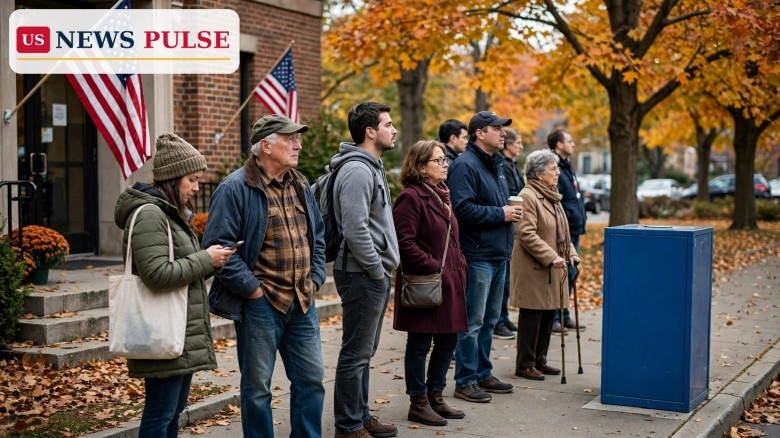
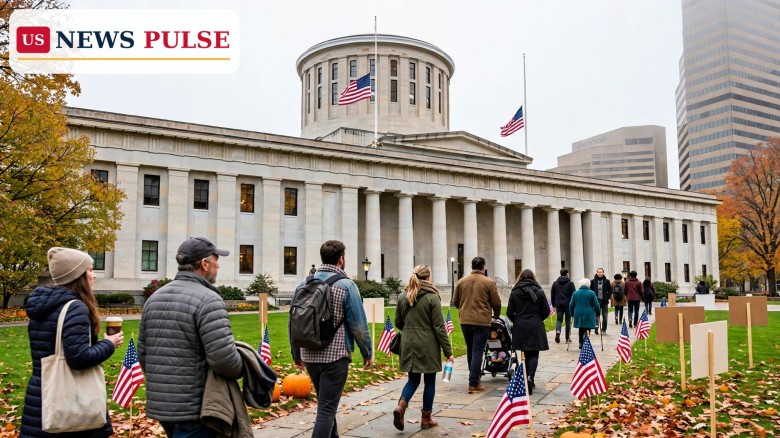
Early voting is already under way in Ohio and runs through October 30. Election Day is Tuesday, November 3, 2026. Trump is scheduled to campaign in Ohio on October 28, his third trip to the state this month, and both campaigns are expected to spend the final days on turnout: Brown in the Cleveland, Columbus and Cincinnati metropolitan areas, Husted in the state's more rural and Republican-leaning counties.
Watch three things in the final days. First, whether any new poll moves the race outside the margin of error — a lead of five points or more for either candidate would be the first real break of the campaign. Second, whether the third-party vote holds at 3% or collapses, as minor-candidate support often does when voters actually cast ballots. Third, the early-vote composition: in the first days of in-person early voting, Democrats made up a larger share of early voters than Republicans, a reversal from 2024, though early votes are not final results. If that pattern holds, it favours Brown; if Republican turnout surges on Election Day itself, as it did in 2024, it favours Husted.
The result, whenever it is known, will be close. In a race where the latest poll shows a three-point lead inside a 4.4-point margin of error, and where 3% sits with candidates who cannot win, the honest forecast is the one Paleologos gave: anyone's ballgame, decided by independents, in the final days.
Sherrod Brown leads Jon Husted 47% to 44% in the Suffolk University/USA TODAY Ohio Network poll released October 28, 2026 — a lead within the poll's 4.4-point margin of error, so the race is effectively tied.
Election Day is Tuesday, November 3, 2026. Early voting runs through October 30. The winner serves the remaining two years of JD Vance's Senate term, ending January 3, 2029.
JD Vance resigned his Senate seat in January 2025 to become vice president. Governor Mike DeWine appointed Jon Husted to the seat, and Ohio law requires a special election to fill the remainder of the term.
Libertarian Bill Redpath and independent Greg Levy each poll at 1.6% in the new Suffolk survey. Their combined 3% could decide a race this close.
Brown leads independents 52% to 24% in the Suffolk poll. Because partisan voters largely cancel each other out, the independent bloc — and whether any of it drifts to third-party candidates — is likely to decide the winner.
Related coverage on US News Pulse: Ohio governor polls: Acton and Ramaswamy deadlocked as Trump rallies Wednesday, Dark money midterms 2026: $1 billion in secret cash floods US races, and Maine Senate race: Collins and Jackson deadlocked one week before midterms.
Leave a Comment



 | Today's Date: