DOJ warns election officials in all 50 states that failing to preserve federal election records could put them behind bars, in a nationwide warning issued just days before Americans vote in the November 3 midterm elections. The letters, dated October 29 and signed by Acting Deputy Attorney General R. Trent McCotter, remind state officials that ballots, voter-registration records and other election materials must be kept for 22 months after a federal election — and that willfully breaking that rule is punishable by up to a year in prison and a 1,000-dollar fine.
The Justice Department itself confirmed the scope of the mailing on Friday, October 30, telling a federal court it had sent the notices "to all states." The disclosure came in a filing in a lawsuit brought by Democratic groups over the Trump administration's pressure on election officials, and it landed as early voting was already well underway across the country. Election-law experts who reviewed the letters said the warning breaks no new legal ground — the preservation rule dates to 1960 — but they questioned why the department's second-highest official sent an identical reminder to every state at the busiest moment of the election calendar.
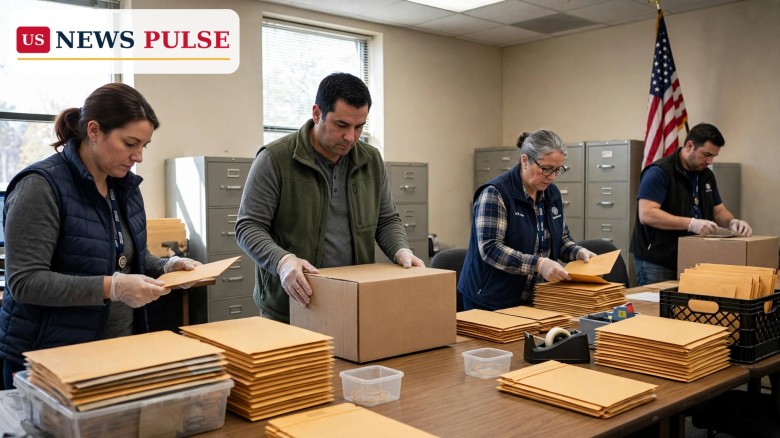
According to copies obtained by Votebeat and Democracy Docket, the letters sent to state election offices are virtually identical. McCotter opens with a direct appeal to the approaching vote: "Election Day is fast approaching, and I write to ensure that your office is protecting the integrity of your state's elections and following federal recordkeeping requirements." The letter then sets out the preservation duty in full. Under 52 U.S.C. Section 20701, officials must preserve for 22 months the records required for voting in a federal election that come into their possession. The department's list is deliberately broad: completed voter-registration forms, pollbooks, precinct sign-in sheets, copies of identification documents, mail-ballot requests and envelopes, and "the ballot itself," whether it was cast by mail, at a drop box or in person.
The warning that follows is equally blunt. "It is a crime to willfully fail to comply with Section 20701," McCotter wrote, adding that federal law also prohibits the willful theft, destruction, concealment, mutilation or alteration of election records. Multiple state election offices confirmed to Votebeat that they had received the identical letters, and officials familiar with the correspondence said they appeared to have gone to all 50 states. The department had not responded to Votebeat's questions as of publication about why the letters were sent days before Election Day, why McCotter personally signed them, or whether similar reminders had been issued before previous federal elections.
The nationwide mailing was revealed publicly on October 30, when the Justice Department disclosed it in a court filing. That filing was itself a response to an order from U.S. District Judge James Boasberg, who is hearing a lawsuit filed on October 20 by Democratic groups accusing President Donald Trump, the Justice Department and the Department of Homeland Security of unlawfully pressuring election officials to remove voters, withhold ballots and change election procedures while threatening criminal prosecution. At a hearing on Thursday, Boasberg ordered the administration to identify, by noon on Friday, every state where federal officials had sent formal communications since July 1 asking officials to remove specific registered voters, refuse to issue them ballots, or segregate or refuse to count ballots they returned.
The October 29 letters are the latest in a series of warnings from the Trump administration to the officials who run American elections, but they differ from the earlier rounds in important ways. A July mailing, signed by Harmeet Dhillon, the assistant attorney general overseeing the Civil Rights Division, warned officials they could face prosecution for knowingly allowing noncitizens to vote. September letters, signed by Eric Neff, the acting chief of the division's voting section, directed 29 states and Washington, D.C., to preserve records from the 2024 election in connection with litigation over access to voter-registration data. Dhillon described those notices at the time as standard litigation practice rather than threats.
The October letters, by contrast, cite an existing preservation requirement dating to 1960 without identifying a particular violation or a pending investigation. They were also signed by a more senior official: McCotter, the acting deputy attorney general and the department's second-highest-ranking official, who assumed the role in August. McCotter has recently played a direct role in the department's election litigation. Earlier in October he signed letters to California officials, including Secretary of State Shirley Weber and Los Angeles County Registrar Dean Logan, demanding that they investigate a federal list of suspected noncitizens who had received mail ballots. He gave officials 48 hours to review the list and instructed them to set aside ballots from voters whose citizenship could not be confirmed, warning that the department would seek emergency court intervention.
The department then sued California, asking a judge to bar the state from counting the ballots of voters on the list. State and county officials disputed the accuracy of the federal data, saying it included U.S. citizens and people who were not registered to vote. On Tuesday, U.S. District Judge David O. Carter verbally admonished the administration during a hearing, saying: "This court believes it would be wise that any threats to state and county elected employees cease immediately." In a written ruling on Wednesday, Carter rejected the department's request to force California to set aside ballots from roughly 20,000 voters and reiterated his warning: "These threats must stop." The Justice Department appealed, and has since issued grand jury subpoenas to California election officials. In Washington, the department separately threatened emergency court action unless officials withheld ballots from more than 400 people it alleged were noncitizens; Washington officials later said their preliminary review found the federal list included U.S. citizens and was unreliable.
Strip away the timing and the signature, and the October 29 letters restate a long-standing federal rule. Section 20701 of Title 52 requires election officials to preserve, for 22 months, records relating to voting in a federal election. That window is designed to keep the paper trail intact long after the results are certified, so that courts, investigators and the public can reconstruct what happened if a result is challenged. The rule does not tell officials how to count votes, whom to register or which ballots to accept; it tells them to keep the evidence.
The preservation duty also carries a second, less-discussed consequence. Under Section 303 of the Civil Rights Act of 1960, the attorney general can later demand access to records that officials were required to preserve, for inspection, copying and reproduction, provided any such demand is made in writing and states its basis and purpose. The administration has already used that authority in its broader push for election records, invoking Section 303 in litigation seeking access to Fulton County, Georgia's 2020 election materials after demanding records the county had been required to preserve — an effort that later became intertwined with the federal investigation and seizure of those records. In other words, a letter that says "keep everything" can be the first step toward a later demand to "show us everything."
Justin Levitt, a former Justice Department official and White House voting rights adviser under President Joe Biden, said he was unaware of any precedent for sending such a reminder to election officials nationwide. "Election officials know that they have an obligation to comply with this law — they know that real, real well — and this certainly looks like it's meant to intimidate rather than to inform," Levitt said. He added that there was nothing inherently improper about reminding officials of their legal obligations, but that such reminders are typically prompted by concerns about compliance or understanding of the law. "It is not itself improper," Levitt said. "But it's super weird that the deputy sent this letter, and it's super weird he sent the letter to everybody."
Joshua Douglas, an election law professor at the University of Kentucky, also questioned the timing, particularly when election officials are occupied with preparations for Election Day. "I have never seen the DOJ send this kind of letter across the country in the days before the election," Douglas said. He stressed that the letters impose no new legal requirements, but create another issue for election officials to deal with during an already demanding period. "At least they aren't targeting based on politics, but it feels very unnecessary and creates confusion," he said.
In its Friday filing, the department maintained that the preservation letters are separate from the voter-specific demands at issue in the Boasberg lawsuit. It said it sent the notices "to all states" on October 29, but asserted that they were not responsive to the judge's order because they do not ask officials to remove particular voters or withhold particular ballots. In the same filing, the department identified California and Washington as the states where it had sent communications falling within its interpretation of Boasberg's order, while the Department of Homeland Security separately identified California, Nevada, Pennsylvania and New Jersey as states where it had sent letters raising concerns about potential noncitizens on voter rolls. The administration argued those Homeland Security letters did not technically fall within the order because they asked states to verify voters' citizenship rather than explicitly directing officials to remove voters or withhold their ballots. The department also objected to broader definitions that could sweep in informal communications or warnings of potential civil or criminal penalties, and said it withheld informal oral communications not memorialised in any record.
The stakes in this dispute are less about the letter of the preservation law — which few election officials dispute — than about the climate in which the final days of the campaign are being run. More than 43 million ballots had already been cast in early voting before the final weekend, and election offices are simultaneously staffing polling places, processing mail ballots and preparing for Election Day itself. A warning of prison time, arriving from the department's second-in-command and landing in every state at once, inevitably competes for attention with that work, and critics argue that is precisely the point. Supporters of the mailing would counter that a uniform reminder, sent to all states rather than singled-out jurisdictions, is the opposite of targeting, and that stating a penalty that Congress itself wrote into law is information, not intimidation.
The episode also sits inside a much larger federal push into election administration ahead of November 3. The Justice Department has sued states over voter-registration lists, demanded voter records through subpoenas, challenged ballots cast by suspected noncitizens in California and Washington, and announced plans to deploy about 1,000 election monitors to polling places in all 50 states. Each step, taken alone, can be defended as enforcement of an existing law. Taken together, election officials and voting-rights advocates say, they create a pattern of federal scrutiny that did not exist at this scale in previous midterm cycles — and that courts are now being asked to police in real time, with a ruling in the Boasberg case possible as early as Monday, November 2, the day before the vote.
Three dates now matter most. First, Judge Boasberg is expected to rule on whether to block the administration's pressure tactics nationwide, after the Democratic plaintiffs asked him to bar officials from pressing states to remove voters, withhold ballots or change procedures under threat of prosecution. Second, Election Day itself arrives on Tuesday, November 3, when the roughly 1,000 federal election monitors are due at polling places across all 50 states and the preserved records at the heart of the October 29 letters begin their 22-month clock. Third, the California litigation continues, with the department's appeal of Judge Carter's refusal to segregate ballots and its grand jury subpoenas to California officials still pending. If any state is found to have destroyed or altered records, the department's own letter has already spelled out the criminal exposure it says follows. If no such case emerges, the letters will stand as a highly visible reminder — and, for critics, a warning shot — in the final days of a midterm campaign already defined by disputes over who votes and whose vote counts.
What did the Justice Department's October 29 letters say? They told election officials in all 50 states to preserve federal election records for 22 months under 52 U.S.C. Section 20701, warning that willfully failing to comply is punishable by up to a year in prison and a 1,000-dollar fine.
Do the letters create a new rule? No. Experts note the preservation requirement dates to 1960 and the letters impose no new legal duty; the controversy is about their timing, their nationwide scope and the seniority of the official who signed them.
Which records must be preserved? Voter-registration forms, pollbooks, precinct sign-in sheets, identification copies, mail-ballot requests and envelopes, and the ballot itself, whether cast by mail, drop box or in person.
Why are courts involved? Democratic groups sued on October 20, accusing the administration of pressuring officials to remove voters or withhold ballots under threat of prosecution. Judge James Boasberg ordered the administration to disclose its state-by-state communications, and the department revealed the 50-state letters in its Friday filing.
What happens on Election Day? Voters cast ballots on Tuesday, November 3, with about 1,000 federal monitors planned at polling places nationwide and the 22-month preservation clock starting on the records created in this election.
Read more on US News Pulse: Early voting surge: 43 million ballots cast as Texas smashes records before midterms, DOJ election monitors: 1,000 federal observers to watch polls in all 50 states, and DOJ Alaska subpoenas target Democrats in Senate race days before midterms.
Leave a Comment



 | Today's Date: