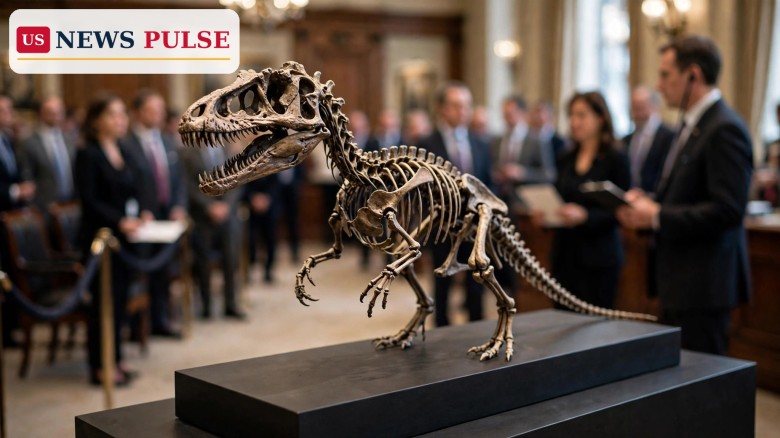
A rare dinosaur skeleton once dismissed as a teenage Tyrannosaurus rex has become the second most valuable fossil ever sold at auction. Nanotyrannus Jodi, a small, sleek predator that stalked the American West around 67 million years ago, sold for $47.3 million at Sotheby's in New York on Tuesday, October 27, 2026, after a fierce 12-minute bidding war among six contenders bidding online and by telephone.
The result blew past Sotheby's pre-sale estimate of $6 million to $9 million by more than five times, and it landed just short of the all-time auction record for a fossil: $50.1 million paid in July 2026 for Gus, an exceptional Tyrannosaurus rex skeleton sold by the same auction house. Jodi now ranks ahead of Apex, the Stegosaurus that fetched $44.6 million at Sotheby's in July 2024. The winning bidder has not been identified, and where Jodi will go next, and whether scientists will ever be able to study it again, remains unknown.
The sale took place in Sotheby's New York saleroom on Tuesday, with bidding conducted online and by telephone. Sotheby's told the Associated Press that six interested parties competed for roughly 12 minutes before the hammer fell at $40.5 million, which rose to $47.3 million once fees were added. The auction house had expected the skeleton to fetch at least $9 million, according to BBC reporting, and its published estimate range was $6 million to $9 million.
Jodi is mounted as an "excellent exhibition-ready" skeleton, in Sotheby's words, comprising around 191 fossil-bone elements. It stands about 9.6 feet (3 metres) tall on its armature and stretches 19.6 feet from nose to tail. Its most prized feature is what Sotheby's called a "beautifully preserved, virtually complete skull", holding roughly 50 teeth at different stages of emerging, including one rooted tooth fused to the outside of the right upper jaw. Euronews described the specimen as nearly 6 metres long and considered almost 70 percent complete.
The skeleton is named Jodi after its discoverer, Montana rancher Jodi Pierson, who found it on her private land in 2019 in the Hell Creek Formation near Jordan, Montana. It was excavated by commercial palaeontologist Clayton Phipps, nicknamed the "Dinosaur Cowboy". Sotheby's vice chair and global head of science and natural history, Cassandra Hatton, emphasised the team's dedication to excavating and preserving Jodi, saying their commitment had been instrumental in bringing the remarkable specimen to market and highlighting its scientific importance.
Hell Creek is one of the most famous fossil grounds on Earth. The formation stretches across Montana, Wyoming and the Dakotas, and its rocks preserve creatures that lived around 67 million years ago, in the Late Cretaceous, just before the asteroid impact that ended the age of dinosaurs. One of the first T. rex skeletons was found there in 1902, and the species was named from fossils unearthed in the area.
For decades, palaeontologists argued over a deceptively simple question: was Nanotyrannus a real dinosaur, or merely a young Tyrannosaurus rex that had not yet grown into its adult form? For a very long time, the prevailing view was that Nanotyrannus was a teenage T. rex. That dispute was settled only last October, when US researchers confirmed Nanotyrannus as a distinct genus. Sotheby's notes that studies have now shown more than 150 morphological differences between Nanotyrannus and its much larger cousin.
Megan Jenkins, a palaeontologist at the University of Portsmouth, explained the distinction to BBC Radio 4's Today programme. "Nanotyrannus was for a very long time believed to be sort of a teenager of T. rex," she said. "But it's a lot smaller and it's a lot more gracile. So it's very sort-of sleek, slender, [with] blade-like teeth for slicing through meat." Sotheby's describes Nanotyrannus as a fast, specialised carnivorous tyrannosaurid that lived alongside Tyrannosaurus rex at the end of the Cretaceous period, not as its juvenile.
The commercial fossil market has grown dramatically in recent years. Gus, the T. rex that set the record in July 2026 at $50.1 million, is just over twice Jodi's length. Apex, the Stegosaurus sold for $44.6 million in July 2024, had held the second-place ranking until Tuesday. Jodi's sale cements a pattern: the three most valuable dinosaur fossils ever auctioned have all passed through Sotheby's in the past three years.
The price matters for two reasons. The first is scarcity. Only three relatively complete Nanotyrannus skeletons are known to science, and Jodi is the first of the genus to come to market since its status as a separate species was confirmed. Collectors were not bidding on a generic dinosaur; they were bidding on one of the rarest and most scientifically contested specimens ever offered publicly.
The second reason is access. Every major private fossil sale reopens the same argument: should scientifically important specimens belong in museums, where researchers can study them and the public can see them, or may they be bought by private collectors whose identities are not disclosed? Jodi's buyer has not been revealed, and reporting on the sale stressed that it did not establish where the skeleton will go, whether researchers will be able to examine it, or whether the public will see it again. For a specimen whose skull preserves an unusually detailed record of a predator's teeth, that uncertainty is itself a scientific loss, at least for now.
There is also a Montana dimension. Jodi was found by a rancher on private land, not by a university expedition, and its journey from a Montana hillside to a New York saleroom is a reminder of how much of America's fossil heritage still emerges through private discovery. The Hell Creek Formation continues to produce extraordinary finds from well-worked ground, which is part of why researchers and collectors alike prize it so highly.
Sotheby's framed the sale as a landmark for natural history. Cassandra Hatton, the auction house's vice chair and global head of science and natural history, emphasised the team's dedication to excavating and preserving Jodi, saying their commitment had been instrumental in bringing the remarkable specimen to market and highlighting its scientific importance.
Scientists quoted in coverage stressed the specimen's place in a long-running debate. Jenkins told BBC Radio 4 that Nanotyrannus had long been believed to be a teenage T. rex, but that it is "a lot smaller and a lot more gracile", with "blade-like teeth for slicing through meat". That description captures why the genus matters: Nanotyrannus was not a small T. rex, but a different animal with a different build, a different bite, and a different ecological role alongside its giant cousin.
Reporting on the sale also gave voice to the access question. Coverage noted that the auction established what someone would pay for the fossil, but not where it will go, whether researchers will be able to examine it, or whether the public will see it again. That gap between price and public benefit is likely to dominate discussion of the sale in the coming days, as it has after previous record fossil auctions.
For the public, Jodi's sale is a window onto a scientific debate that was settled only a year ago, and onto a market that now treats fossils as blue-chip collectibles. A $47.3 million price tag guarantees attention, and attention is what turns an obscure genus into a household name. Museums, universities and documentary makers will all be fielding questions about Nanotyrannus this week that they were not fielding last week.
For science, the stakes are higher. Private sales can remove specimens from research for years or permanently, and Nanotyrannus is a genus with only three relatively complete skeletons. If Jodi disappears into a private collection, researchers lose a third of their best evidence for a species whose identity was disputed for decades. If the buyer loans or donates it to a museum, the sale could instead become a public triumph.
For Montana and New York, the sale is also an economic story. A rancher's 2019 discovery in the Hell Creek Formation became a headline auction in Manhattan, and the $47.3 million total shows how much value the commercial fossil trade can generate from a single hillside. How that value is shared, between discoverers, dealers, auction houses and the scientific community, remains one of the most contested questions in palaeontology.
The immediate question is the buyer's identity. Sotheby's has not disclosed it, and auction houses typically do not unless the buyer chooses to come forward. Watch for an announcement in the coming days: a museum acquisition would be announced proudly, while continued silence would suggest a private collection.
Also watch for any research or exhibition arrangement. Previous record fossils have sometimes been loaned back for study or display, and any such deal for Jodi would be news in itself. If no arrangement emerges, expect renewed calls from palaeontologists for rules or incentives that keep scientifically important fossils in public hands, a debate that has intensified with each new auction record.
Finally, watch the market. With Gus at $50.1 million and Jodi at $47.3 million, both sold within months of each other, the fossil auction market is clearly at a peak. Whether the next major specimen pushes past $50 million, or whether Jodi marks the top of the current boom, will be the question for the next big natural history sale.
What is Nanotyrannus Jodi? Jodi is a rare Nanotyrannus skeleton, a smaller, sleeker relative of Tyrannosaurus rex that lived about 67 million years ago. It is one of only three relatively complete Nanotyrannus skeletons known to science.
How much did Jodi sell for? Jodi sold for $47.3 million including fees at Sotheby's in New York on October 27, 2026, after a 12-minute bidding war among six bidders. The winning bid was $40.5 million before fees.
Is Jodi the most expensive dinosaur fossil ever sold? No. It is the second most valuable. The record is held by Gus, a T. rex that sold for $50.1 million in July 2026. Jodi ranks ahead of Apex, a Stegosaurus sold for $44.6 million in July 2024.
Where was Jodi discovered? Montana rancher Jodi Pierson discovered the skeleton in 2019 on private land in the Hell Creek Formation near Jordan, Montana. It was excavated by commercial palaeontologist Clayton Phipps and named after Pierson.
Who bought Jodi, and can scientists study it? The buyer's identity has not been disclosed, and it is not yet known where the skeleton will go or whether researchers and the public will be able to see it again.
Related coverage on US News Pulse: NASA Swift Observatory ends 22-year mission as spacecraft falls back to Earth, NASA Artemis moon landing 2028: SpaceX and Blue Origin race to return astronauts, and SpaceX Florida launch pause: six quiet weeks before Starship debut.
Leave a Comment



 | Today's Date: