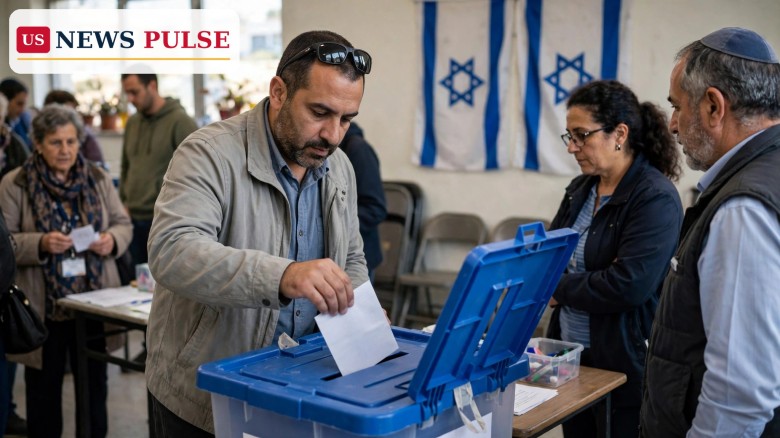
Israel election results on Wednesday left Prime Minister Benjamin Netanyahu without a path to a parliamentary majority, with his bloc holding 53 seats and parties seeking to unseat him holding 67 once Arab parties are counted, after 85.6% of votes in the country's 26th Knesset election had been tallied. The count, published by the Central Elections Committee, confirmed that neither side can govern alone — and handed Arab parties a historic 19 seats that could decide who forms the next government.
Netanyahu's Likud emerged as the largest single party with 26 seats, but his right-wing and religious allies added only 27 more: seven each for United Torah Judaism, Shas and Otzma Yehudit, and six for the Religious Zionist Party. The opposition bloc led by former military chief Gadi Eisenkot held 48 seats on its own — 21 for Eisenkot's Yashar, 12 for B'Yachad under Naftali Bennett and Yair Lapid, eight for Yair Golan's Democrats and seven for Avigdor Liberman's Yisrael Beytenu. Add the Joint List's 12 seats and Ra'am's seven, and the anti-Netanyahu camp reaches 67, six more than the 61 needed for a majority in the 120-seat Knesset.
Israelis voted on Tuesday, October 27, in the country's 26th Knesset election, turning out in the highest numbers in decades to deliver a verdict on Netanyahu, Israel's longest-serving prime minister, who has pushed the country sharply to the right and led it through a wave of wars since Hamas's October 7, 2023 attack. Exit polls on election night had put Netanyahu's camp and Eisenkot's opposition neck-and-neck at about 51 seats each, well short of a majority, and the count since then has moved only at the margins — but in a direction that weakens the prime minister.
When just over half the ballots were counted, Netanyahu's bloc led with 55 seats against 49 for Eisenkot's bloc and 16 for the Arab parties. By the time 70% were counted, his bloc had slipped to 54, with the Jewish opposition on 47 and the Arab parties at an unprecedented 19. At 77%, the figures were 54 to 66 in favour of the opposition camp including the Arab parties. The Central Elections Committee's Wednesday morning update, after almost five million votes were counted, put Netanyahu at 53, the opposition bloc at 48 and the Arab parties at 19 — a combined 67 for everyone outside the prime minister's camp.
Both Netanyahu and Eisenkot vowed on election night to form a government despite neither being projected to win a majority, setting up a coalition negotiation in which the Arab parties — long treated as untouchable by both camps — suddenly hold the balance of power. The counting of about 500,000 votes cast by soldiers and other voters away from their registered polling stations was set to begin at midnight, and those ballots have shifted seat tallies in past Israeli elections, so the final numbers are not yet settled.
Israel's electoral system makes outright majorities almost impossible: the whole country votes as a single constituency, seats are allocated proportionally, and any party clearing the 3.25% threshold enters the 120-seat Knesset. Governments are therefore always coalitions, and the question after every election is not who won the most seats but who can assemble 61.
Netanyahu has dominated Israeli politics for most of the past three decades, but this election was framed by his rivals — and by many voters — as a referendum on his leadership after three years of war, deep social divisions and a government that critics say has strained democratic institutions. Eisenkot, a former chief of staff of the Israel Defense Forces and a political novice, built his challenge around the promise of a government of change, while the Arab parties campaigned on ending what they call Netanyahu's politics of exclusion.
The Arab parties' surge is the story of this count. Their voters turned out in soaring numbers against a prime minister who has repeatedly warned that the Arab minority would dilute the Jewish nationalist direction in which he has taken Israel. The result — 19 seats, the strongest combined Arab showing on record — is precisely the outcome Netanyahu's warnings were designed to prevent, and it is what denies him a majority even as his own bloc remains the largest camp in the Knesset.
The arithmetic is unforgiving for Netanyahu. His 53 seats leave him eight short of a majority, and there is no obvious pool of extra seats: Eisenkot has rejected serving under Netanyahu, including in a rotation government, and other opposition leaders have also ruled out joining a coalition led by the prime minister. A unity government involving Netanyahu and Eisenkot has therefore been described as unlikely, and Eisenkot has instead called for the leader of the largest party in the opposition bloc to become its candidate for prime minister — though no agreement on that arrangement has been announced within the bloc.
For the opposition, the arithmetic is kinder but still awkward. Its 48 seats plus the Arab parties' 19 make 67, a comfortable majority — but only if the Jewish opposition parties are willing to govern with, or rely on, Arab lawmakers. Eisenkot said during the campaign that he would not govern with Israeli Arab lawmakers, echoing a position Netanyahu himself has taken, and Netanyahu has suggested a government relying on Arab votes would lack legitimacy. One workaround discussed in Israeli politics is a minority government: Arab lawmakers could support an Eisenkot-led government in parliamentary confidence votes without formally joining the coalition. But opposition within the bloc to relying on Arab parties could complicate even that arrangement, and the political deadlock could ultimately lead to another election.
That is the outcome President Herzog is pressing the parties to avoid. In a recorded address on Wednesday, he urged Israel's political parties to do everything they can to avoid another round of elections, said he would begin consultations next week on granting the mandate to form a government, and added that he expected party leaders to "come with an open mind."
Democrats chairman Yair Golan was the bluntest voice of the opposition on Wednesday morning, declaring the election lost for Netanyahu on the strength of the count so far. "Netanyahu lost. I know how to count to 120. Sixty-five is more than 55. That's how Israeli democracy works. Period," he said, using the earlier Wednesday morning tallies, and he called for the inclusion of Arab parties in the government. "We have a majority. We have responsibility. And we have an opportunity to form a government of change in partnership with Israel's Arab citizens. A government that will serve all Israeli citizens," Golan added. He also turned Netanyahu's own argument back on him, saying that if the prime minister was considering forming a Zionist bloc, he should "subtract from his own bloc the 16 Knesset members from the non-Zionist Haredi parties."
Joint List chairman Yousef Jabareen said on Wednesday that his party was ready to "pave the way for the ousting of the Netanyahu government." "Against a government of bloodshed, against a politics of supremacy, racism, and exclusion, we offer a completely different alternative," he posted on X. "The change comes through Jewish-Arab partnership, a true and equal partnership. No less than that, and no more than that," he added.
Later, in an interview with Army Radio, Joint List faction chairman Ahmad Tibi said the opposition bloc could unseat Netanyahu if it found the nerve. "The opposition bloc will be able to form a government if it has the courage. We are extending a hand and are ready to help," Tibi said. He called the result a "historic achievement for the Arab public" and added that without the high voter turnout in Arab communities, "Netanyahu could have formed a government by himself with the right. We blocked that possibility."
This count matters far beyond the seat tallies because it breaks a taboo that has shaped Israeli politics for decades. Arab parties have historically been excluded from government formation by both the right and much of the centre-left, treated as a bloc whose votes could be counted in opposition but never as partners in power. A result in which the Arab parties hold 19 seats — and the anti-Netanyahu camp needs them for any majority — forces that question into the open at the exact moment the country must choose a government.
It matters for the war and for the region, too. Netanyahu's government has pursued the wars that followed October 7, 2023, and expanded settlements while deepening Israel's international isolation; a government of change, or even a prolonged caretaker period, would change the calculations of allies and adversaries alike, including the United States, which has been pressing for a post-war settlement. And it matters for Israeli democracy itself: a second election in short order, after a campaign fought over the legitimacy of the vote itself, would deepen the exhaustion of voters who turned out in record numbers precisely to settle the question.
The immediate next step is the count of the roughly 500,000 soldier and double-envelope ballots, beginning at midnight, which could move one or two seats between blocs and will determine the final official tally. Once the final results are certified, President Herzog will begin consultations next week with party leaders before granting one of them the mandate to form a government — traditionally the leader with the best chance of assembling 61 seats, not necessarily the leader of the largest party.
Watch for three things in the days ahead. First, whether Eisenkot's bloc reaches a formal agreement on its candidate for prime minister, and whether that agreement includes any understanding with the Arab parties. Second, whether Netanyahu attempts to peel off individual lawmakers or smaller parties, or instead tries to delegitimise a government that depends on Arab support. And third, whether Herzog's warning about another election concentrates minds: Israel has been to the polls repeatedly in recent years, and the parties know voters punished them for it before. If no one can reach 61, the country could be heading back to the ballot box — the one outcome almost every party claims to dread.
Who won the Israel election? No bloc won a majority. With 85.6% counted, Netanyahu's bloc held 53 seats and parties seeking to unseat him held 67, including a historic 19 for the Arab parties. Likud, with 26 seats, is the largest single party.
How many seats are needed to form a government in Israel? A government needs the support of at least 61 of the 120 members of the Knesset. Netanyahu's 53 seats leave him eight short; the opposition's 48 need the Arab parties' 19 to reach 67.
Why are the Arab parties so important this time? Arab voters turned out in record numbers, giving the Joint List 12 seats and Ra'am seven — a combined 19, the strongest Arab showing on record. Without them, neither Netanyahu nor Eisenkot can reach 61.
Could there be another election? Yes. If no leader can assemble a 61-seat coalition, President Herzog could eventually call another election. He urged parties on Wednesday to do everything they can to avoid that outcome, and consultations on the mandate begin next week.
Are the results final? Not yet. About 500,000 votes cast by soldiers and voters away from their polling stations were still to be counted from midnight, and those ballots can shift one or two seats between blocs.
Related coverage on US News Pulse: Israel election results: Netanyahu leads with 54 seats but no majority, Israel election results 2026: Eisenkot claims win as deadlock leaves no bloc at 61, and Israel election 2026: record turnout as Netanyahu claims vote is being stolen.
Leave a Comment



 | Today's Date: