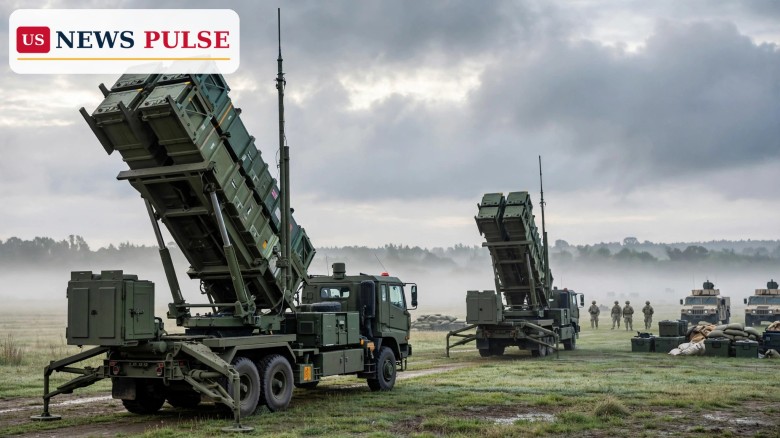
The United States has approved the sale of 500 Patriot PAC-3 missiles to Ukraine in a deal worth an estimated $2.1 billion, in what Reuters described as one of the most significant steps to supply defensive weapons to Kyiv since the start of the second Trump administration. The Patriot missile sale, announced by the State Department on Friday, October 30, 2026, will be paid for entirely by Ukraine's allies and partners, with no United States funds involved.
Under the arrangement, Canada, Germany and Norway will contribute donations through a Pentagon programme called JUMPSTART, while the rest of the cost will be covered by Ukrainian national funds financed by the European Union's Ukraine Support Loan. Lockheed Martin, which builds the Patriot interceptor, is the principal contractor for the package, which also includes spare parts, logistics and programme support.
The State Department's approval, reported by Reuters on October 30, covers up to 500 PAC-3 MSE interceptors for Ukraine's Patriot air defence systems. The department said the missiles would help Ukraine sustain its existing Patriot operations against ongoing aerial threats, and that Ukraine would have no difficulty absorbing them into its armed forces. It added that the sale would not require any additional US government or contractor personnel in Ukraine.
In its statement, the State Department was explicit about who pays. "Ukraine will pay for this purchase with donations from Canada, Germany, and Norway via the JUMPSTART program and national funds, financed by the European Union's Ukraine Support Loan," it said. "No U.S. funds are involved in this sale."
The approval is a formal notification to Congress, not a signed contract. It opens a congressional review period, after which Ukraine and the US government can sign a letter of offer and acceptance and the US Army can place the order with Lockheed Martin. The State Department gave no delivery schedule and did not say how the $2.1 billion cost will be split between the three donor countries and the EU-financed share. Divided evenly across the 500 missiles, the total comes to about $4.2 million per missile, although that figure also covers spares and support rather than the interceptor alone.
The timing matters. The approval came days after Ukrainian officials publicly pressed Washington on interceptor supplies. On October 26, President Volodymyr Zelensky said Ukraine had waited nearly a month for US Secretary of War Pete Hegseth to sign off on missiles for its Patriot and NASAMS systems, including transfers from allied stocks that require American approval. A day later, he told journalists that Ukraine had received an average of 12 Patriot interceptors a month from the United States in 2026, while Russia launches about 150 ballistic missiles a month that Ukraine needs to intercept.
Delayed missile deliveries had already added to tensions between Kyiv and Washington, after President Donald Trump announced a diesel deal with Russia and criticised Zelensky for Ukraine's unwillingness to stop attacks on Russian refineries. The Patriot approval lands in that strained context, and it is one of the largest defensive-weapons decisions of the second Trump administration so far.
Ukraine received its first Patriot battery in April 2023, and the following month Ukrainian crews shot down a Kinzhal hypersonic missile over Kyiv, the first publicly confirmed combat interception of that weapon. Ukraine has since received further batteries from the United States, Germany, the Netherlands and Romania, and in July 2025 Germany and Norway agreed to pay for three more systems to be bought from the American manufacturer.
Launchers, however, have not been the binding constraint. Interceptor supply has. In February 2026, German Defence Minister Boris Pistorius offered five PAC-3 rounds from German stocks if other allies together supplied 30 more, and in July Ukraine's Defence Ministry said it was using about $1 billion from the EU loan to buy roughly 100 Patriot missiles. The new 500-missile package is five times that July purchase, which underlines both the scale of the shortage and the scale of the allied response.
The financing reflects how Ukraine's air defence is now paid for. The US Defence Security Cooperation Agency describes JUMPSTART as a channel that lets allies and partners finance Ukraine's Foreign Military Sales cases with their own donations. Norway reported routing about 10 billion Norwegian kroner through the mechanism in 2025, much of it for F-16 support, and in September 2026 Canada said it would put about C$350 million toward air defence interceptors for Ukraine through JUMPSTART. The programme was also used in August to buy 3,350 air-launched cruise missiles worth $825 million. Separately, NATO allies buy American weapons for Ukraine through the Prioritised Ukraine Requirements List, known as PURL.
The European Union's side of the funding comes from a €90 billion loan agreed by EU governments in early 2026 for 2026 and 2027, with €60 billion set aside for defence, whose first disbursements went out in June 2026. The loan gives priority to weapons built in Ukraine, the EU and the European Economic Area, but allows purchases elsewhere when no European alternative exists. Patriot interceptors are one case where none does. Canada underlined the same allied-funding shift at a two-day summit in Montreal on October 30, agreeing to contribute to the €90 billion support loan and to work more closely with Brussels on areas from critical minerals to artificial intelligence.
The PAC-3 MSE is the Patriot system's main weapon against ballistic missiles, and it works differently from the older PAC-2 interceptor. Where the PAC-2 detonates a blast-fragmentation warhead near its target, the PAC-3 family destroys targets by direct impact, a method known as hit-to-kill. The Missile Segment Enhancement version adds a larger two-pulse solid rocket motor, with the second pulse firing late in the flight to extend range and altitude against manoeuvring threats.
That makes it the interceptor Ukraine relies on against Russian Iskander ballistic missiles and Kh-47M2 Kinzhal air-launched missiles. Ukrainian officials have described the PAC-3 as their only effective defence against Russian ballistic missiles, which is why the gap between roughly 12 interceptors received a month and roughly 150 ballistic missiles launched a month has become so politically charged in Kyiv.
Production is now the main limit on how fast the missiles can arrive. Lockheed Martin delivered 620 PAC-3 MSE interceptors in 2025, a company record. In January 2026, the company and the US Department of War signed a seven-year framework agreement to raise annual output from about 600 to roughly 2,000. In April, the US Army awarded Lockheed a $4.76 billion PAC-3 MSE contract, most of it funded through Foreign Military Sales customers, and in July the Army awarded the company a contract worth up to $58.6 billion to produce Patriot interceptor missiles. At 2025 production rates, the 500 missiles approved for Ukraine equal about 10 months of Lockheed's output, and where Ukraine's order falls in the production queue has not been disclosed. Demand has also climbed since the United States drew on its own Patriot inventory during this year's conflict with Iran.
The State Department framed the sale as defensive and fully allied-funded, saying the missiles would sustain Ukraine's existing Patriot operations and stressing that no American taxpayer money is involved. That funding point is central to the politics of the deal in Washington, where direct US military aid to Ukraine has become far more contested than allied-funded purchases of American weapons.
Zelensky's public pressure in the days before the approval set the terms of the debate in Kyiv. His statement that Ukraine had waited nearly a month for sign-off on Patriot and NASAMS missiles, followed by the stark monthly comparison of 12 interceptors received against about 150 ballistic missiles launched, turned an often technical supply question into a visible test of allied commitment.
On the delivery question, NATO's top commander in Europe offered reassurance on October 30. Speaking in Riga, General Alexus Grynkewich said: "Not a single item included in the PURL package paid for by European allies has been delayed." That comment addressed the allied-funded pipeline more broadly, although it did not give a delivery date for the newly approved Patriot missiles specifically, and the State Department itself offered none.
Russia has not, in the reporting reviewed for this article, issued a formal response to the specific approval, but Moscow has consistently condemned Western weapons supplies to Ukraine as an escalation. Any Russian reaction will be closely watched, particularly given the parallel tensions over energy deals and strikes on refineries that formed the backdrop to the announcement.
The deal matters for three reasons. First, it addresses Ukraine's most acute air-defence shortage directly: ballistic-missile defence, where no substitute system exists. Air defences protect cities, power infrastructure and front-line logistics, and every interceptor shortfall translates into missiles that cannot be stopped.
Second, it confirms a structural shift in how Ukraine is armed. The United States is no longer the payer of first resort; it is the manufacturer and approver, while Canada, Germany, Norway and the European Union provide the money. That model, built through JUMPSTART, PURL and the EU loan, is designed to survive political arguments in Washington about direct aid, but it depends on allies sustaining contributions at a scale that matches Russia's missile production.
Third, the timing sends a signal beyond Ukraine. The approval came in the same week that the EU and Canada deepened their own alliance at Montreal, that G-20 foreign ministers met in Atlanta, and that US midterm campaigning entered its final days. For allies questioning American reliability, a $2.1 billion allied-funded approval is evidence that the pipeline still functions. For Moscow, it is evidence that Ukraine's air defences will be replenished, even if slowly.
The immediate next step is congressional review. Once that period closes without blocking action, Ukraine and the US government can sign a letter of offer and acceptance, and the Army can place the order with Lockheed Martin. Only then will a delivery schedule begin to take shape, and the key unanswered question is where Ukraine's 500 missiles sit in a production queue that is also serving the US Army and other Foreign Military Sales customers.
Watch also for the cost split between Canada, Germany, Norway and the EU-financed share, which the State Department did not disclose, and for any further allied interceptor announcements. If the pattern of recent months holds, further packages through JUMPSTART and PURL are likely, because 500 missiles, while large, do not close a monthly gap measured in the dozens against a Russian launch rate measured in the hundreds.
Finally, watch Kyiv's own reporting on deliveries. Zelensky's decision to publish the monthly figures suggests Ukraine will keep the supply question public, and the pace at which interceptors actually arrive will matter more for Ukrainian cities this winter than the headline value of the approval.
Not yet. The State Department has approved a possible sale and notified Congress. A congressional review period must pass, then Ukraine and the US government sign a letter of offer and acceptance before the Army orders the missiles from Lockheed Martin.
Ukraine's allies. Canada, Germany and Norway contribute donations through the JUMPSTART programme, and the rest comes from Ukrainian national funds financed by the EU's Ukraine Support Loan. The State Department says no US funds are involved.
No delivery schedule has been given. Production is the main constraint: Lockheed delivered 620 PAC-3 MSE interceptors in 2025, and the 500 approved missiles equal roughly 10 months of output at that rate, although output is now being raised toward 2,000 a year.
Ukrainian officials say the PAC-3 is their only effective defence against Russian ballistic missiles such as the Iskander and the Kinzhal. Zelensky said Ukraine received about 12 Patriot interceptors a month from the US in 2026, against about 150 Russian ballistic missiles launched a month.
The PAC-2 detonates a blast-fragmentation warhead near its target. The PAC-3 destroys targets by direct impact, known as hit-to-kill, and the MSE version adds a larger two-pulse motor for greater range and altitude against manoeuvring threats.
Related coverage on US News Pulse: Melania Trump ceasefire brings hope to Oleshky as Ukraine aid mission begins, US-Iran strike plans: forces ready within 96 hours of Trump order, reports say, and Israel election 2026: Netanyahu fights for survival as Israel votes today.
Leave a Comment



 | Today's Date: