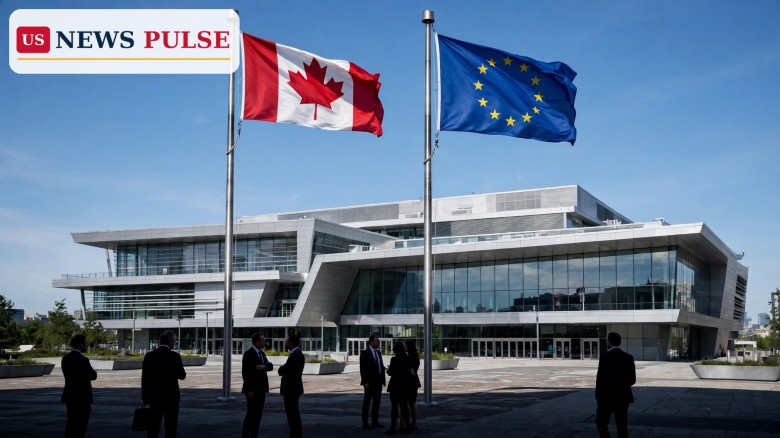
Canada and the European Union launched a sweeping new partnership in Montreal on Friday, October 30, 2026, unveiling an "Alliance for the Future" designed to bind two of America's oldest allies closer together at a moment when both say the world has become more dangerous, more divided, and more exposed to the weaponisation of trade. The Canada EU alliance, agreed at the 21st Canada-EU summit after two days of talks, bundles more than 20 measures covering trade, digital rules, critical minerals, energy, security and student exchanges — and it pointedly arrives while Ottawa and Washington remain locked in their own trade dispute.
Canadian Prime Minister Mark Carney hosted the summit alongside European Commission President Ursula von der Leyen and European Council President António Costa. The headline deals signed in Montreal included a digital trade agreement, a pact allowing the European Investment Bank to back Canadian critical-mineral projects, and Canada's entry into the EU's 90 billion euro support loan for Ukraine, with an initial Canadian contribution of 500 million euros. The two sides also promised negotiations to deepen Canada's participation in Erasmus+, the EU's flagship student exchange programme.
The summit closed on Friday after two days of meetings in Montreal, the city Carney chose to showcase a relationship both sides now describe as their closest ever short of membership. In a joint statement, Ottawa and Brussels said the alliance would cover six areas: trade and regulatory cooperation, digital and research technology, critical resources and energy, financial services, security and preparedness, and people-to-people ties. Trade in goods and services between the two sides reached roughly 130 billion euros in 2025, up more than 80 percent since 2016, according to the European Council's summit account.
The most concrete items were economic. The digital trade deal sets shared rules for cross-border data and online commerce, while the European Investment Bank agreement opens EU financing for Canadian mines and processing projects. Canada holds large reserves of rare earths and other critical minerals that Europe now sources mostly from China, but its mining industry needs major infrastructure investment before that supply can scale up. The two sides also agreed to deepen cooperation on satellite connectivity and navigation and on artificial intelligence, fields where both acknowledge they are playing catch-up with the United States and China.
On Ukraine, Carney announced that Canada would take part in the EU's 90 billion euro support loan for Kyiv, beginning with 500 million euros. The move ties Ottawa directly to Europe's biggest financial lifeline for Ukraine and comes days after Washington approved a separate $2.1 billion Patriot missile sale to Kyiv, a deal also financed in part through European contributions.
The Montreal summit builds on a partnership that already runs deep. Canada and the EU trade under a comprehensive agreement that has been in force for years, and they launched a Strategic Partnership of the Future and a Security and Defence Partnership in June 2025. What changed in 2026, both sides argue, is the pressure: tariffs, supply-chain coercion and great-power rivalry have forced traditional allies to insure themselves against shocks from any direction — including from Washington.
Carney and US President Donald Trump remain engaged in a trade dispute, with talks under way toward a Canada-US deal. Earlier reporting in this cycle noted that no Canada-US agreement was expected before the November 3 midterm elections, and Ottawa has spent months courting non-US markets as a hedge. The Montreal package is the most visible result of that strategy so far: rather than waiting on Washington, Canada is locking in alternative markets, suppliers and security partners.
The "associate member" idea itself dates to September 2026, when von der Leyen raised it in her State of the European Union address, with Carney in attendance as guest of honour. The proposal electrified commentary because no such status exists in EU law, and the bloc has admitted no new member state since Croatia joined in 2013. But it also alarmed several capitals, which worried about legal confusion, about what decision-making rights Canada might expect, and about the expectations it would raise among other outside countries.
Strip away the labels and the Montreal package is substantial even without associate membership. The signed items include the digital trade deal, the European Investment Bank critical-minerals pact, the Ukraine loan participation, and a commitment to negotiate deeper Canadian involvement in Erasmus+. Draft texts also floated a joint initiative on new subsea cable infrastructure linking Europe, Canada and Asia, a feasibility study on Canadian liquefied natural gas exports to Europe, and a scheme letting young Canadians and Europeans work across the Atlantic.
The joint statement framed all of it as a sovereignty project. "A more dangerous and divided world has fundamentally changed the requirements of sovereignty. It is no longer enough for nations to feed, fuel and defend ourselves," it said, adding that "true sovereignty" now requires secure access to critical minerals, semiconductors, payment systems, energy, vaccines, space-based communications and AI. That language — sovereignty through supply chains rather than sovereignty through borders alone — is the intellectual core of the alliance.
What was not signed matters too. The phrases "associate member" and "associated membership" were removed from the joint draft statement before publication, according to reports from dpa and Reuters citing diplomats. German Chancellor Friedrich Merz and leaders of several other member states pushed for the removal, and the final text instead pledges to define "an ever closer association of Canada to the EU, short of full membership itself" by the 2027 summit. Some commitments on financial-market integration and preferential treatment on economic-security measures were also watered down in the drafting.
Carney struck a defiant, almost poetic tone at the closing press conference. "The world's becoming more dangerous and divided. Our societies are being shaken by new storms," he said, citing eroding democratic norms and "the weaponisation of trade." Then he offered the summit's signature image: "Together, Canada and the European Union are anchoring the ground. Anchoring our ground to uphold our values while forming a protective canopy under which our citizens can all thrive."
On social media, Carney kept the associate-member language alive even as the declaration dropped it. "Canada and the EU are working to establish the closest possible partnership, which will be far from full membership, but which will make Canada the first associate member of the European Union," he posted on X. "Today in Montreal, we have taken a major step forward by establishing more than twenty measures that will increase affordability, create opportunities and ensure our sovereignty on both sides of the Atlantic."
Von der Leyen, arriving in Montreal, used the same term in her own post: "We have a new ambition: bringing Canada closer to us than ever before, as Associate Member of the EU. And we want to take our unique partnership even further." She added: "With an Alliance for the Future, we will stand together and respond to a world of growing rivalries." Carney, for his part, played down the naming row, telling reporters it "doesn't matter about specific names or nomenclature" and that what counts is the difference closer ties make for Canadians. Trump, by contrast, had reportedly dismissed the associate-member proposal as "laughable" and suggested the US might halt trade with Europe on "many things" if he saw it as a hostile act.
For the United States, the Montreal summit is a warning written in diplomatic ink: its closest neighbours and oldest allies are now building insurance policies against American unpredictability. Canada is not leaving the US orbit — its economy remains deeply tied to its southern neighbour — but it is deliberately reducing the share of its future that depends on Washington's goodwill. Europe, likewise, is diversifying its sources of minerals, energy and technology at a time when supply chains have become instruments of statecraft.
For Ukraine, the practical gain is immediate. Canada's entry into the 90 billion euro loan spreads the burden of sustaining Kyiv beyond Europe and signals that support for Ukraine is widening, not narrowing, even as Washington's own Ukraine policy zigzags. For American voters days before the midterms, the summit also reframes the tariff debate: the administration's trade wars are not merely raising prices at home, critics will argue, but pushing allies into each other's arms.
There are limits, and they are worth stating plainly. An "ever closer association" is not membership, carries no vote in EU institutions, and still needs a year of negotiation to define. The minerals pact will take years to produce ore, the LNG study is only a study, and the digital deal's real test will be enforcement. Montreal launched a direction of travel, not a finished destination.
Formal negotiations launched at the summit are expected to run for about another year, with the concept of "ever closer association" due to be defined by the 2027 EU-Canada summit. Watch for three early tests: whether the European Investment Bank announces its first Canadian mineral projects, whether Erasmus+ negotiations produce a concrete Canadian participation deal, and whether the subsea-cable and LNG proposals move from draft language to funded projects.
Washington's reaction will matter just as much. If the Trump administration treats the alliance as a provocation, Canada-EU cooperation could accelerate further; if it concludes a Canada-US trade deal after the midterms, some of the urgency may fade. Either way, the Montreal summit has already changed the map: the world's two largest Western trading blocs outside the United States now have a standing framework to act together, and both have said they intend to use it.
Is Canada now a member of the EU? No. Canada is not an EU member and has said it does not seek full membership. The summit promised an "ever closer association" short of full membership, to be defined by 2027.
What is the "Alliance for the Future"? It is the name Canada and the EU gave their new partnership framework, covering trade, digital technology, critical minerals, energy, finance, security and people-to-people ties, with more than 20 agreed measures.
What did Canada actually agree to on Ukraine? Canada will join the EU's 90 billion euro support loan for Ukraine, with an initial contribution of 500 million euros.
Why was "associate member" dropped from the declaration? The term has no legal basis in EU law and was contested by several member states, including Germany, which pushed for it to be replaced with "ever closer association."
Does this affect the United States? Indirectly but significantly: it gives Canada alternative markets and suppliers while its trade dispute with Washington continues, and it signals that US allies are hedging against American tariffs and unpredictability.
Related coverage: US approves $2.1 billion Patriot missile sale to Ukraine, Canada-US trade stalemate to outlast midterms, and Trump tariffs fail to cut US trade deficit, IW report shows.
Leave a Comment



 | Today's Date: