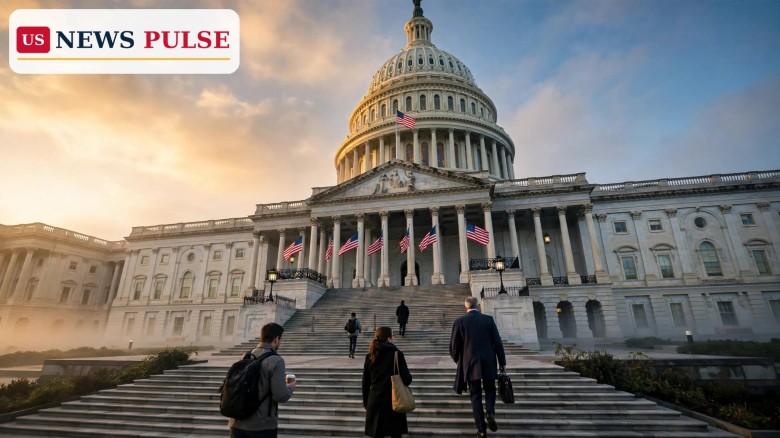
The US national debt 100% of GDP milestone is official: debt held by the public reached $32.2 trillion at the end of fiscal 2026, equal to 100.03% of the nation's gross domestic product, the first time the fiscal year-end ratio has crossed 100% since 1946. The figure, reported by The Wall Street Journal on Thursday, October 29, 2026, lands just days before the November 3 midterm elections and turns a number economists have watched for years into a headline fact of American public life.
It is a milestone 80 years in the making, and it arrives without the emergency that produced the last one. In 1946, the United States had just borrowed its way through the Second World War. In 2026, it crossed the same line in peacetime, with the economy growing, unemployment low by historical standards, and the federal deficit still running at nearly $2 trillion a year. That contrast — a wartime ratio reached in a growing economy — is why the number has drawn so much attention, and why economists on both sides of the aisle say the path ahead, not the round number itself, is what matters.
The calculation became possible only when the Commerce Department released its first estimate of third-quarter economic growth on Thursday, October 29. The Bureau of Economic Analysis reported that real GDP grew at a 3.4% annualised rate in the third quarter of 2026, beating market expectations of 3.2%. With a full fiscal year of output now in hand — fiscal 2026 ran from October 1, 2025, through September 30, 2026 — the Journal's calculation put the $32.2 trillion in publicly held debt reported by the Treasury at 100.03% of fiscal-year GDP.
The margin is razor-thin, and the reporting is careful about that. The United States had already crossed 100% in an intra-year calculation earlier in 2026 — the Committee for a Responsible Federal Budget, cited by Fortune, put the trailing ratio at 100.2% at the end of March. What is new is the fiscal year-end figure, the standard measure economists use to compare one year with another. Even that could still move: subsequent revisions to third-quarter GDP, or changes in how the Treasury issues debt, could push the final ratio back below 100% or further above it.
The deficit behind the debt was confirmed earlier in October. The Treasury Department said on October 16 that the fiscal 2026 budget deficit totalled $1.992 trillion, or 6.2% of GDP. That is a deficit level more commonly associated with recessions or wars. Newsmax's account of the milestone stressed the point: the borrowing continued "outside a recession, major war, or comparable emergency," even as the economy grew rapidly in the third quarter and federal borrowing kept pace with economic output.
President Donald Trump is the first president since Harry Truman in 1946 to see the fiscal-year ratio this high, a comparison that marks the date rather than assigning blame. The Journal's reporting, as relayed by multiple outlets, links the debt to decades of tax cuts, emergency spending and an ageing population under both parties — a bipartisan accumulation, not a single administration's creation.
The road from 33.7% to 100.03% is one of the great reversals in modern American fiscal history. In 2000, debt held by the public equalled 33.7% of GDP and was falling. The late 1990s had produced annual budget surpluses, helped by strong economic growth, spending restraint and capital-gains tax revenue from the technology boom. By early 2001, then-Federal Reserve Chairman Alan Greenspan was publicly discussing the potential complications if the government paid off its publicly held debt entirely.
What followed reversed the trajectory step by step. Repeated tax cuts and increased spending pushed borrowing higher. Federal responses to the September 11, 2001, terrorist attacks, the 2008-09 financial crisis and the COVID-19 pandemic each added large new layers of debt. Meanwhile, an ageing population steadily increased Social Security and Medicare costs, the two largest drivers of long-term federal spending. No single president or party produced the 100% figure; it is the sum of a quarter-century of choices, crises and demographics.
The distinction between the two debt numbers in circulation matters for understanding the milestone. Gross federal debt recently exceeded $40 trillion, but that figure includes money one part of the government owes another, including Treasury securities held by the Social Security trust fund. Debt held by the public — $32.2 trillion — is the money owed to outside lenders: private investors, foreign governments and the Federal Reserve. Economists generally prefer it because it measures the borrowing that competes for capital in financial markets and sets the price the government pays to borrow.
The wider economic backdrop makes the milestone more striking, not less. The third-quarter GDP report showed consumer spending, which accounts for more than two-thirds of output, growing at a 3.8% pace, and business investment rising 12.7%, powered in large part by artificial-intelligence infrastructure spending. The Federal Reserve held its benchmark rate at 3.75% to 4.00% on October 28, 2026, while acknowledging inflation "remains elevated" — the Fed's preferred PCE price index rose 3.6% year-on-year in September. Growth, in other words, is not the problem. The deficit is running at wartime scale in a growing economy, and that is what has pushed the debt ratio over the line.
If the debt ratio itself is a symbol, the interest bill is the substance. The Congressional Budget Office projects that annual net interest costs will increase by more than 1 percentage point of GDP over the next decade — and that forecast assumed interest rates below today's levels. On October 28, the 10-year Treasury yield stood at 5.05% and the 30-year at 5.37%, according to the Journal's reporting. Higher yields do not just raise the government's borrowing costs; they set the rates families pay on mortgages and other long-term loans.
The sensitivity is stark. By the Journal's math, if interest rates run just 0.1 percentage point above the CBO's assumptions across the forecast period, federal interest expenses would rise by an additional $379 billion over a decade. That is the arithmetic of a $32 trillion debt pile: small moves in rates translate into hundreds of billions in extra interest, which in turn must be borrowed, pushing the ratio higher still. It is a feedback loop economists warn about, and it is already running.
The longer-term projections point in one direction. The CBO expects the ratio of debt held by the public to GDP to keep rising, reaching 120% by 2036, according to Korean-language reporting of the CBO outlook. The Social Security trust fund is expected to be depleted in 2032, after which only about 78% of scheduled benefits could be paid unless Congress acts — a deadline that now sits less than six years away. CBO Director Phillip Swagel, speaking at an event this month, captured the political difficulty as reported by the Journal: "I think there is understanding about the challenging fiscal trajectory. Of course, the difficulty is that the U.S. is a divided country and a divided society and we're divided politically."
The milestone also lands in a week of uncomfortable fiscal news for the administration. A study by the German Economic Institute IW, seen by Reuters on Friday, October 30, found that President Trump's tariffs, tax cuts and manufacturing drive had delivered solid growth and buoyant AI investment but failed to reduce the trade deficit: the goods gap reached $130 billion in August, above its level two years earlier, while foreign direct investment inflows fell 8.2% to $248 billion in 2025. Growth is holding up; the fiscal balance is not.
Direct political reaction to the 100% figure was still forming on Friday, but the expert framing was consistent across the reporting: this is a bipartisan, decades-long trajectory, and the number matters less as a threshold than as a warning about interest costs and fiscal space. The Journal's account emphasised that the debt reflects "decades of tax cuts, emergency spending and an aging population under both parties," a formulation designed to resist partisan cherry-picking in the final days of a midterm campaign.
Swagel's remark about a divided country points to the practical obstacle. Reducing a deficit of 6.2% of GDP requires some combination of higher revenue, lower spending, or faster growth — and each option divides Congress. The Social Security deadline sharpens the choice: by 2032, inaction itself becomes a benefit cut, delivered automatically rather than voted on. Economists who track the trust funds have long argued that earlier action is cheaper, because smaller adjustments compounded over more years close the gap with less pain.
Market reaction, for now, has been muted compared with the week's other shocks. The 10-year Treasury yield at 5.05% and the 30-year at 5.37% on October 28 already price in heavy federal borrowing, and the week's global tech sell-off — Alphabet's roughly $500 billion one-session rout — dominated trading floors. But bond markets have a long memory: the fiscal year-end crossing of 100% removes one more psychological buffer, and traders will watch the next Treasury refunding announcements and the December Fed meeting, where markets expect a rate rise, for signs of how much more the government will pay to borrow.
A debt ratio above 100% does not mean the United States cannot pay its bills. The dollar remains the world's reserve currency, Treasury securities remain the global safe asset, and the government borrows in its own currency — advantages no other heavily indebted country enjoys in full. Japan's debt ratio is far higher, and its government has not defaulted. The 100% line is not a cliff edge.
What it does mean is less room to manoeuvre. Every dollar spent servicing the debt is a dollar not spent on defence, infrastructure, research or tax relief. When the next recession or crisis arrives — and one will — the government will enter it already borrowing at 6.2% of GDP, with interest costs climbing and a debt pile larger than the economy. The fiscal space that let Washington respond massively to the 2008 crisis and the pandemic is narrower now, and the CBO's 120%-by-2036 projection shows it narrowing further on current policy.
For voters heading to the polls on November 3, the milestone reframes the affordability debate that has dominated the campaign. High prices at the pump — regular gasoline averaging 42% more than before the US-Israeli war with Iran disrupted energy markets, according to AAA data cited in recent reporting — and mortgage rates set off Treasury yields are the household face of the same fiscal story. The debt is abstract; the interest rate on a home loan is not.
It also matters for the next Congress in a concrete, procedural way. The debt limit, the Social Security shortfall and the annual appropriations fights will all arrive against a backdrop in which the United States owes more to the public than it produces in a year. That fact will be invoked by both parties — one side to argue for spending restraint, the other to argue for revenue — but neither can wish the arithmetic away.
Three things will decide where the ratio goes from here. The first is GDP revisions: the Bureau of Economic Analysis will revise its third-quarter estimate twice in the coming weeks, and a change to output could move the fiscal-year figure back below 100% or confirm it more firmly above. The second is interest rates: if long-term Treasury yields stay near 5%, interest costs will keep running above what the CBO assumed, adding to the debt faster than forecast. The third is Congress, which must deal with the Social Security shortfall before 2032 or accept automatic benefit cuts.
The nearer-term calendar is crowded. The Federal Reserve's December meeting, where investors largely expect a quarter-point rate rise, will test how the central bank balances elevated inflation against a slowing labour market. The new Congress seated after the midterms will face the annual funding cycle, and the Treasury's borrowing schedule will show, quarter by quarter, how much of the $32 trillion pile must be refinanced at today's yields. Each auction is a small referendum on confidence in American public finances.
Longer-term, the question is whether 100% becomes a turning point or a waypoint. In 1946, the ratio fell rapidly as the wartime economy demobilised, growth surged and the government ran surpluses. Nothing in current projections offers a repeat: the CBO sees the ratio rising, not falling, for the next decade. Reversing that path would require the kind of sustained fiscal consolidation the United States has not attempted since the 1990s — in a political environment Swagel describes as divided. The milestone, in that sense, is less a verdict than a starting gun for a debate the country has postponed for 25 years.
It means debt held by the public — $32.2 trillion at the end of fiscal 2026 — is slightly larger than the value of everything the US economy produced in that fiscal year. The ratio was 100.03%, up from 99.4% a year earlier.
No. Gross federal debt recently passed $40 trillion, but it includes intragovernmental debt — money one part of the government owes another, such as Treasury securities held by the Social Security trust fund. Debt held by the public excludes those internal obligations and is the measure economists prefer.
1946, the year after the Second World War ended, when the ratio reached its all-time high of 106% after wartime borrowing. The fiscal 2026 figure of 100.03% is the first fiscal year-end reading above 100% since then.
Yes, in principle. The calculation uses the first estimate of third-quarter 2026 GDP, which will be revised twice. A large enough upward revision to output could push the ratio back below 100%, though the intra-year trailing ratio already passed 100% in March 2026.
On current policy, the CBO projects the ratio rising toward 120% by 2036, with net interest costs up more than 1 percentage point of GDP over the next decade. The Social Security trust fund would be depleted in 2032, triggering automatic benefit reductions to about 78% of scheduled levels unless Congress acts.
Read more on US News Pulse: US GDP grew 3.4% in Q3 2026 as investment and spending beat forecasts, Trump tariffs fail to cut US trade deficit as $130bn gap grows, IW report shows, and Fed holds rates at 3.75% to 4% in October decision.
Leave a Comment



 | Today's Date: