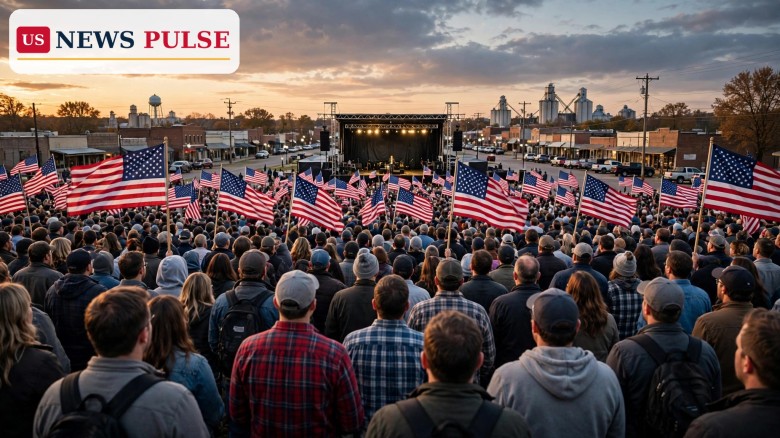
President Donald Trump has put his cancelled Kansas and Iowa rallies back on the calendar for Sunday, November 1, reversing course less than 24 hours after scrapping both events and handing Republicans in two unexpectedly tight Senate races a final-weekend boost just two days before the November 3 midterm elections. The Trump Kansas Iowa rallies will now go ahead in person, after the president said Republicans in both states told him a personal appearance would beat a telephone rally.
The reversal, confirmed on Friday, October 30, capped a whirlwind 24 hours in which the cancellations set off speculation that Trump and his party had effectively given up on Kansas, where polls show Democratic nominee Adam Hamilton leading Republican Senator Roger Marshall. Trump, speaking to reporters in the Oval Office on Friday, said he had tried to talk both states out of asking him to travel — and then agreed to go anyway.
On Thursday, October 29, Trump abruptly cancelled weekend rallies planned for Senator Roger Marshall in Kansas and Representative Ashley Hinson in Iowa, two Republicans fighting unexpectedly competitive Senate races in states that have historically voted Republican. The Republican National Committee said at the time that Trump would instead take part in a series of telephone rallies, arguing that virtual appearances would let him reach voters in more states in the campaign's final days.
By Friday, the plan had changed. A source familiar with the arrangements confirmed the rallies were back on, saying the dates had been rearranged to accommodate dozens of tele-rallies Trump is planning for Republican candidates in the final days of the campaign. A source close to the administration put it more colourfully to Al Jazeera: "Rallies are BACK ON! No one works harder, fights harder, or loves the American people more than President Donald J. Trump!"
Trump himself addressed the switch in the Oval Office on Friday. "We have a couple of races that are very important, and they said if you could go, it would be better than a tele-rally," he told reporters. "And I tried to talk them out of that. I said, 'What about a tele-rally?' But they asked me. So I'm going to go on Sunday."
The Kansas event had originally been scheduled for Saturday, October 31, in Salina. It will now take place on Sunday, alongside the Iowa rally in Dubuque, which was already set for Sunday, November 1. Republican officials have also not ruled out adding another campaign event to the president's schedule before Election Day on Tuesday, November 3.
The cancellations landed like a thunderclap because of what they seemed to signal. Kansas last elected a Democrat to a full term in the Senate in 1932, and Trump carried the state by 16 percentage points in the 2024 presidential election. Yet multiple polls now show Hamilton, a megachurch pastor and the Democratic nominee, ahead of Marshall. A Washington Post poll released Friday found Hamilton leading Marshall 52 percent to 43 percent among likely voters, while a CNN poll found a narrower four-point Hamilton lead, within the survey's margin of error. An Emerson College poll on Friday put Hamilton ahead 49 percent to 45 percent.
Iowa tells a similar story of a once-safe state turned competitive. Trump carried Iowa by 13 percentage points in 2024, but Hinson, the Republican Senate nominee, leads Democratic nominee Josh Turek by less than one percentage point, according to a RealClearPolitics average of recent polls. Hinson is seeking to move from the House to the Senate in a race that could help decide control of the chamber.
Trump has held more than two dozen rallies since October 1, across 19 states, in a breakneck homestretch schedule aimed at energising the Republican base. His appearances often run for nearly two hours, and his voice has turned hoarse in recent days. On Thursday, when a Reuters reporter asked whether he had cancelled the Kansas trip because he was tired of travelling, Trump erupted: "You've been following me for two weeks. I feel perfect. You are disgusting. Put yourself in shape. You look like hell."
The stakes on Tuesday are high. Nonpartisan analysts believe Republicans are likely to lose their slim majority in the House of Representatives, while control of the Senate is expected to be hard fought. Democrats need a net gain of four seats to win back the Senate majority from the Republicans' current 53-seat hold, and about ten Senate races are considered highly competitive.
The Trump Kansas Iowa rallies matter because they test a central question of the campaign's final weekend: whether a presidential visit helps or hurts in states where the president's own popularity is underwater. USA TODAY noted that Trump's approval is below water in many of the states he is visiting, including Kansas and Iowa, making his appearance a risk for the very candidates he is trying to help. A rally can electrify the base and dominate local news for a day; it can also hand opponents a fresh news cycle and remind wavering voters of the national issues — above all the cost of living — that have dragged on Republican candidates.
The reversal also matters as a signal of intent. When the cancellations were announced, Democrats were quick to frame them as retreat. David Axelrod, a senior adviser to former President Barack Obama, described the cancellation as a "strategic retreat" on social media. Marshall himself had defended the original decision, saying on Thursday: "They think that I'm doing so well in the polls that he's probably got better places to spend his time." Restoring the rallies lets Republicans argue the opposite — that the president is fighting for every seat until the end — and denies Democrats a talking point in the final 72 hours.
Analysts have warned that Republican candidates could feel a backlash at the polls over the cost of living, with fuel prices running higher than normal amid the US-Israel war on Iran. That backdrop makes the closing message of the Sunday rallies as important as the fact of them: Trump is expected to frame the midterms as a referendum on his presidency and on the economy, while Democrats are casting the election as a check on his power.
"We are going to have a strong Tuesday night," Trump said of the midterms on Friday, projecting confidence despite polls showing Democrats ahead on the generic congressional ballot. In the Oval Office, he was blunt about how the decision was made: "They asked me. So I'm going to go on Sunday."
The day before, his tone had been very different. Asked by reporters on Thursday about Kansas, Trump said: "I don't feel I have to go to Kansas." The contrast between the two days is the story of the reversal in miniature — a president who first signalled he could skip two difficult states, then decided, after calls from Republicans there, that he could not.
Democrats, meanwhile, have used the episode to argue that Republicans are rattled. The cancellation, coming with less than four days to go before the vote, was seized on by Democratic commentators as evidence that the party in power feared its own closing argument was not landing. Republicans counter that the tele-rally plan was always about efficiency, not retreat — and that the restored in-person events, alongside nearly 20 virtual appearances before Tuesday according to a White House official, show a campaign working at full stretch.
Former Vice President Kamala Harris, whom Trump defeated in the 2024 election, was campaigning for Democrats in Atlanta on Friday, telling a crowd in Macon, Georgia, on Thursday: "The last year and a half, it's been difficult. Now we're in the phase where we can do a whole lot." Her presence in Georgia underlines that both parties are fighting hardest in the states where the Senate map will be decided.
Sunday's rallies will be among the last major set-piece events of the 2026 campaign, and they arrive with early voting already at record levels. More than 46 million Americans had already voted early as of Friday morning, according to the University of Florida's Election Lab, surpassing the total from the 2022 midterms. Among them was Chicago native Pope Leo, who became the first pontiff to vote in a US election, the Vatican press office announced on Friday.
That flood of early ballots means the Sunday rallies are aimed less at persuading undecided voters from scratch than at turning out supporters who have not yet voted and shaping the final news cycle before Tuesday. In Kansas, where early voting has been watched closely, and in Iowa, where the margin is under a point, even a small turnout effect could matter.
The episode also captures the volatility of the campaign's final days. In a single week, Trump has campaigned in Mississippi, South Carolina, Texas and Florida, cancelled and then restored two rallies, and seen his administration step up legal interventions in Alaska and California that election officials say could pave the way for challenges to the results. Voters heading to the polls on Tuesday will do so in a climate where the mechanics of voting itself have become part of the campaign argument.
Trump will speak in Daytona Beach, Florida, on Friday night, campaigning for Moody and Donalds at the Ocean Center, a 9,300-seat venue where doors opened at 3:30 p.m. and Trump was expected to take the stage at 7 p.m. He will then travel to Kansas and Iowa on Sunday for the restored rallies, with tele-rallies for candidates in more than 15 states also planned, according to MAGA Inc.
Early voting ends on Saturday, October 31, in Florida, and Election Day itself is Tuesday, November 3, with polls open from 7 a.m. to 7 p.m. local time in Florida. Results in the closest Senate races — including Kansas and Iowa — may not be known on election night, particularly if margins are narrow and mail ballots are still being counted. Control of the Senate could remain unclear for days if any of the tightest races head to extended counts or legal challenges.
Watch, too, for any further additions to Trump's schedule. Republican officials have not ruled out one more event before Tuesday, and the president's own closing message on Sunday — in two states he won comfortably in 2024 but where his party is now fighting for its life — will set the tone for election night.
Yes. After cancelling both events on Thursday, October 29, President Trump restored them on Friday, October 30. Both rallies will now take place in person on Sunday, November 1.
The Kansas rally, originally set for Saturday, October 31, in Salina, moves to Sunday. The Iowa rally in Dubuque was already scheduled for Sunday, November 1, and remains on that day.
The Republican National Committee said Trump would instead hold tele-rallies, arguing virtual appearances would let him reach voters in more states. Trump later said Republicans in both states asked him to come in person instead, and he agreed.
In Kansas, polls show Democrat Adam Hamilton leading Republican Senator Roger Marshall — by nine points in a Washington Post poll (52-43), by four points in a CNN poll, and by four points in an Emerson College poll (49-45). In Iowa, Republican Ashley Hinson leads Democrat Josh Turek by less than one percentage point in the RealClearPolitics average.
Election Day is Tuesday, November 3, 2026. More than 46 million Americans had already voted early as of Friday morning, surpassing the 2022 midterm total.
Related coverage: Trump's Texas rallies and the Talarico surge, Trump's $5,000 dividend promise back in the spotlight and Trump's $1 million voter-fraud reward.
Sources: USA TODAY, Al Jazeera, Reuters via The Straits Times, October 30, 2026.
Leave a Comment



 | Today's Date: