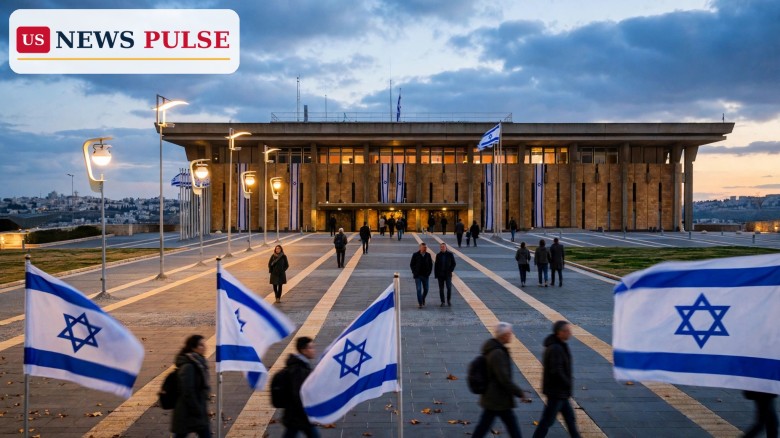
Israel election fraud claims made by Prime Minister Benjamin Netanyahu's Likud party have been rejected by police, who say they have found no evidence to support them, as the count from Tuesday's parliamentary election leaves no bloc with the 61 seats needed to govern. The police response, reported on Thursday, October 29, 2026, undercuts the party's charge that Arab parties "stole" the election, and shifts attention back to the coalition arithmetic that will decide who forms Israel's next government.
The pushback from law enforcement came a day after Likud published its accusations. In a post on X on Wednesday, October 28, the party said the election had been stolen by Arab parties that support terrorism and seek the destruction of the Jewish state, and said it would submit hundreds of testimonies and pieces of evidence to the police, the Shin Bet security agency and the Central Elections Committee, demanding investigation and prosecution.
Police answered on Thursday. "Election day passed with very few irregular incidents concerning the integrity of the election, even when compared to previous elections," a police source told multiple Hebrew-language media outlets. "It should be emphasized that there is no investigative- or intelligence-based supporting evidence for the claims," the source said. The Times of Israel reported the police position on Thursday morning, and Israel Hayom reported the same finding, citing multiple sources.
The Central Elections Committee reached a similar conclusion. A committee official dismissed the fraud claims on Wednesday, and the committee said on Tuesday that there were no indications of systematic ballot manipulation, with individual reports being checked promptly. The committee confirmed it had received Likud's complaint and said it was examining it as part of its standard review of election-integrity complaints from parties across the political spectrum.
Hebrew media reported before voting that Likud had planned to challenge results from Arab locales and claim the election was "stolen" if Netanyahu did not win, with a number of complaints and fraud allegations drawn up in advance. That reporting, rather than any new evidence, now frames how the party's complaint is being read in Jerusalem.
Israelis voted on Tuesday, October 27, 2026, in the country's first parliamentary election since the October 7, 2023 attacks, and turnout was high. The Central Elections Committee put overall turnout at 77.7 percent, with more than 5.4 million people having voted by 8 p.m. on election day, the highest figure for that hour since 1988. Turnout in Arab communities was described as unprecedented, and that surge is central to the result.
The count, with about 90 percent of votes tallied, gives Netanyahu's bloc 53 seats, the bloc led by former military chief Gadi Eisenkot 48 seats, and Arab-led parties 19 seats. A party or coalition needs 61 seats in the 120-member Knesset to command a majority, so neither main camp can govern alone. Likud remains the largest single party with 26 seats, followed by Eisenkot's Yashar party with 21, while the Joint List and the centre-right Together party stand at 12 each. The United Arab List, known as Ra'am, holds seven seats, though some Israeli media reported it gaining an eighth at the Joint List's expense, leaving the Arab total unchanged at 19.
Counting is not finished. The committee announced on Thursday that counting of "double envelope" votes had begun. Those ballots, about 500,000 in total, come from voters who cast absentee ballots, largely soldiers, along with prisoners, medical personnel, people with medical conditions and Israeli representatives at missions abroad. Regular votes had been processed from 11,712 of 12,018 polling stations, representing 5,126,759 voters, with the rest undergoing standard verification. Dozens of military ballot boxes were even airlifted from the south to the Knesset by helicopter after heavy rain flooded roads around Eilat and the Arava region, cutting off the main entrance to Eilat.
The gap between Likud's language and the authorities' findings is the story. Likud alleged coordinated bribery, intimidation, violence, forgery and multiple voting, plus the unlawful use of prohibited software to mobilise voters in Arab communities. Police and the elections committee, the two bodies that would have to act on such a complaint, have each said the evidence does not support it. The committee's position is that election day passed with very few irregularities, and police say there is no investigative or intelligence-based evidence behind the claims.
That does not end the process. The committee is still reviewing Likud's material, as it does with complaints from any party, and the double-envelope count could still move individual seats between parties, including the disputed 19th Arab seat decided by the surplus-vote agreement between Ra'am and the Joint List. Official committee figures as of early Thursday still gave that seat to the Joint List, with Ra'am about 1,200 votes short of taking it. What the police statement does is set a high bar for any challenge: a claim of systematic fraud needs systematic evidence, and the authorities say they have not seen it.
The Arab-led parties rejected the accusations outright. Ahmad Tibi, leader of one of the Joint List's factions, described the claims as "the rhetoric of the defeated" and said there had been no election irregularities. Speaking to Israel's Army Radio, Tibi said the opposition bloc led by Eisenkot could form a government with the Arab parties "if it wants to, if it is brave enough to." He called the result a "historic achievement for the Arab public," adding: "Without the high voter turnout in Arab communities, Netanyahu could have formed a government by himself with the right. We blocked that possibility."
Yousef Jabareen, chairman of the Joint List, said his party was ready to help oust Netanyahu, calling for genuine Jewish-Arab partnership as an alternative to what he described as Netanyahu's "government of bloodshed." He said anyone seeking a genuine alternative to Netanyahu's government would have to engage with the Joint List.
President Isaac Herzog urged restraint on Wednesday, calling on the parties to do everything they can to avoid another round of elections. In a recorded address, he said he would begin consultations next week on granting the mandate to form a government, adding that he expected party leaders to "come with an open mind." Netanyahu, meanwhile, said on Wednesday that he could work with US President Donald Trump to eliminate what he called the "existential threat" posed by Iran, a reminder that the government-formation talks are unfolding alongside warnings of renewed military action against Iran after America's November 3 midterm elections.
The police finding matters because it protects the legitimacy of a result that neither side can yet turn into a government. With 19 seats, the Arab-led parties hold the balance of power in a way they never have before, and any government that excludes them must still find 61 seats from a fragmented field. If the fraud claims had gained traction, they could have delayed or delegitimised that bargaining; with police and the elections committee both pushing back, the bargaining proceeds on the numbers as counted.
It also matters beyond Israel. The election took place during an eight-month war with Iran, and Washington has told Gulf allies to prepare for possible renewed strikes after the US midterms, as well as possible Iranian retaliation. A prolonged Israeli government-formation crisis, or a caretaker Netanyahu government making security decisions, would land in the middle of that tension. Iran's foreign minister, Abbas Araghchi, warned this week that any Israeli-instigated attack would have a "devastating impact" on global markets.
The double-envelope count continues, and the final seat distribution could still shift by one or two seats, including the Ra'am-Joint List seat. Once the count is complete, Herzog's consultations next week will test whether Eisenkot can assemble 61 seats with the Arab parties, whether Netanyahu can find partners elsewhere, or whether Israel faces another election with Netanyahu remaining as caretaker prime minister. Likud's complaint remains under routine committee review, but without new evidence it is unlikely to change the outcome.
Watch for three markers: the final official count, Herzog's choice of who gets the first mandate, and whether any party breaks ranks to join a coalition it had ruled out. Until then, the police verdict stands as the clearest official answer to the fraud claims: no supporting evidence.
Police said there is no investigative or intelligence-based evidence to support the claims, and that election day passed with very few irregular incidents concerning the integrity of the election, even compared with previous elections.
Likud alleged that Arab parties "stole" the election through bribery, threats, violence, forged documents, multiple voting and prohibited software used to mobilise voters, and said it submitted hundreds of testimonies to police, the Shin Bet and the Central Elections Committee.
With about 90 percent of votes counted, Netanyahu's bloc has 53 seats, Eisenkot's bloc has 48, and Arab-led parties have a record 19 seats. A majority in the 120-seat Knesset requires 61 seats.
They are absentee ballots, about 500,000 in total, cast mainly by soldiers, along with prisoners, medical personnel, people with medical conditions and diplomats abroad. Their count began on Thursday, October 29.
President Isaac Herzog will begin consultations next week on granting the mandate to form a government, and has urged parties to avoid another election. If no leader assembles 61 seats, Israel could face another vote.
Related coverage on US News Pulse: Israel election results: Netanyahu bloc at 53 as opposition reaches 67, Israel election 2026: Netanyahu fights for survival as Israel votes, and US warns allies to prepare for possible Iran strikes.
Sources: The Times of Israel live blog, October 29, 2026; TRT World; Arab Times Online; WIO News live blog; Haaretz election live blog, October 28-29, 2026. The featured image is an original illustration created for US News Pulse and does not depict a real event or person.
Leave a Comment



 | Today's Date: