The United States has expelled a Cuban diplomat after a shouting match on the floor of the United Nations General Assembly hall turned into a shoving episode, a swift ejection that has become the latest flashpoint in a rapidly deteriorating relationship between Washington and Havana. The Cuban diplomat expelled was the first secretary of Cuba's mission to the UN, US Ambassador to the UN Mike Waltz said, and by Wednesday he had already left the country on a flight to Havana.
The expulsion, announced by Waltz on Tuesday evening and confirmed by the State Department on Wednesday, followed a chaotic scene in the General Assembly hall on Tuesday, when Waltz's speech denouncing Cuba's government prompted Cuban delegates to pound their desks, demand a point of order and walk toward the podium. What began as a procedural protest during the annual debate over the US economic embargo against Cuba ended with accusations of assault, a formal expulsion order signed by Secretary of State Marco Rubio, and a fresh warning from Washington that it will not tolerate what it calls intimidation by Havana's representatives on American soil.
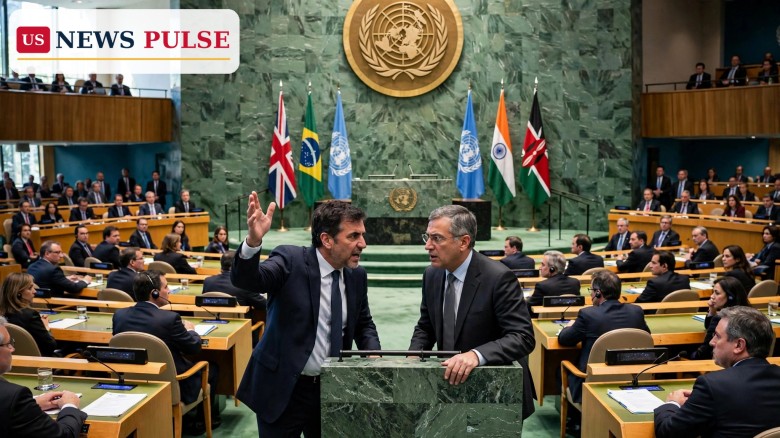
The confrontation unfolded on Tuesday afternoon, nearly an hour into the annual General Assembly debate on the US embargo against Cuba. Waltz took the podium to speak against the embargo resolution and immediately accused the late Cuban leader Fidel Castro of sending thousands of people to "concentration camps." As he spoke, members of Cuba's delegation began pounding on their desks, and one made a timeout motion while others demanded that the presiding official respect procedural rules that would allow them a response.
Waltz then held up an image of Castro wearing two Rolex watches, which he said were worth about $40,000 in today's money, and displayed a further image of current Cuban President Miguel Díaz-Canel wearing what he described as another Rolex. The argument from the podium was that Cuba's leaders live in luxury while ordinary Cubans struggle — a charge that drew louder protests from the Cuban seats. Cuban Foreign Minister Bruno Rodríguez Parrilla, followed by other Cuban diplomats, walked toward the rostrum where Waltz was speaking to address the presider, Bangladesh's Khalilur Rahman, who was seated behind the US ambassador.
Video of the scene shows Rodríguez Parrilla approaching the stage as Waltz instructs him not to come closer. "This individual needs to back away from this podium. He's not going to intimidate me in the United States of America like he tries to intimidate political prisoners," Waltz shouted from the podium. "I'm the representative of the United States of America. Back up!" Rodríguez Parrilla shouted back that Waltz was a liar, and shouts calling Waltz a liar were heard across the hall as the presiding official repeatedly instructed delegates to sit down.
A second, separate episode took place at a different location inside the hall. US diplomat J.P. Freire was filming the shouting match when a Cuban diplomat moved in, wagged a finger and pushed Freire's phone away. Video shared by Waltz's account on X showed the Cuban diplomat swatting away the phone, with the diplomat saying the person filming was violating his personal space. Waltz later described that moment in far stronger terms, accusing the Cuban diplomat of shoving and trying to assault a member of the American delegation.
Hours later, Waltz appeared on Fox News' Hannity programme on Tuesday evening and announced that the response had already been decided. "Just before I came on tonight, Secretary Rubio signed the paperwork to eject the diplomat," Waltz said, identifying him only by title as the first secretary of Cuba's delegation. "He's gone. He's going to be on a plane to Havana within the next 24 hours. You lay a hand on an American here in the United States, President Trump, Secretary Rubio, and myself, we're not going to stand for it. There will be consequences."
Expulsions of diplomats are a familiar tool of statecraft, but the circumstances here are unusual. The United States has ordered Cuban diplomats out of the country a number of times in the past, usually after accusations of spying. This time, the stated reason is not espionage but a physical altercation inside the UN's most famous chamber, captured on video and argued over in public within hours. That speed — from floor clash on Tuesday afternoon to a signed expulsion order on Tuesday evening — reflects how directly the episode fed into an already confrontational US approach to Cuba.
The clash also took place against a ritual that has repeated for decades. Each year, the General Assembly debates and votes on a resolution condemning the US economic embargo against Cuba, and each year the resolution passes overwhelmingly. On Wednesday, the Assembly again condemned the embargo, by 130 votes in favour, 17 against and 25 abstentions. The United States votes against the resolution, and its ambassador's speech is traditionally a moment of open argument with the Cuban delegation. This year, that argument spilled out of the usual diplomatic script and into a face-to-face confrontation at the podium.
The wider relationship has been worsening for months. The Trump administration has tightened economic pressure on Cuba as it seeks to force change from the government in Havana, and US officials say tough sanctions have brought the island's already struggling economy to a halt. In recent days, administration officials have also increased their public rhetoric about possible US intervention to oust Cuba's longtime government, a shift in tone that has given every incident between the two countries a sharper edge.
President Donald Trump has added his own flourish on the campaign trail. Speaking to a South Florida midterm rally crowd, he said the United States would deal with Cuba "on the way back from Iran." "We'll take care of Cuba on our way back from Iran. We'll do a little stopover," Trump said, repeating a claim he has made several times. "Actually, what we're going to do with Cuba is we're going to come back from Iran. Those beautiful ships. We'll pass Cuba. We'll have one of them stop about 50 yards off the coast. They'll raise up their hands, and then we're going to send Marco Rubio in to finish up the game."
The expulsion matters because it compresses a much larger standoff into a single, visible incident. On one side is the US position: an American diplomat was shoved on American soil, inside the headquarters of the world's leading international body, and the United States responded by removing the person responsible within a day. On the other side is Cuba's position: its diplomat was filmed at close range without consent, his personal space was invaded, and the video was posted online to damage his reputation. Both accounts agree that something physical happened around a phone; they disagree sharply about who was the aggressor and who was the victim.
That disagreement is now part of the formal record. Later on Tuesday, the Cuban Mission to the UN sent a letter to the Secretary-General expressing deep concern about the incident. In the letter, the mission said a US diplomat had invaded the Cuban diplomat's personal space to film him and put the videos on social media with the intention of damaging the Cuban diplomat's reputation. The mission's complaint, and Washington's expulsion order, now sit side by side as competing official versions of the same few minutes in the General Assembly hall.
There is also a question of identity that US officials have left deliberately vague. Waltz identified the expelled diplomat only by his title, the first secretary of Cuba's delegation, and did not name him publicly. Some reports have identified the diplomat as Richard Tur de la Concepción, whose listed title corresponds to first secretary of Cuba's Permanent Mission to the UN, but that identification has not been confirmed by US officials. The State Department's statement likewise referred only to "this individual." For readers, the important fact is the office and the action — a senior member of Cuba's UN mission was declared unwelcome and removed — rather than a name Washington has chosen not to publish.
The sharpest words came from Waltz himself, on television, within hours of the clash. "He's gone. He's going to be on a plane to Havana within the next 24 hours," he said on Tuesday evening. "You lay a hand on an American here in the United States, President Trump, Secretary Rubio, and myself, we're not going to stand for it. There will be consequences." On Wednesday he repeated the point in blunter travel terms: the diplomat "will be on a flight back to Havana and out of this country today."
The State Department's formal statement on Wednesday was equally unsparing about Havana, though it stopped short of repeating the assault allegation in detail. "Members of the incompetent communist Cuban regime showed their true essence through their intimidation and oppression tactics," the spokesperson told CNN. "Those tactics will not work, nor will they be tolerated." The statement confirmed the outcome — the diplomat had left — without adding new detail about the incident itself.
From the Cuban side, the most detailed public response so far is the mission's letter to the Secretary-General. Its central claim reverses the US framing: it was the US diplomat who invaded the Cuban diplomat's personal space, filming him at close range and posting the video online to damage his reputation. Cuba's mission has not, in the reporting reviewed, issued a separate public statement accepting or contesting the expulsion itself, and CNN reported that it had reached out to the Cuban Mission to the UN for comment.
For ordinary readers, the expulsion is a window into how fast diplomacy can break down when the political temperature is already high. Diplomats argue at the UN every day; they rarely end up shouting at each other at the podium, and more rarely still see one of their number expelled within 24 hours over a shoving incident. The speed of the US response signals that Washington is not treating this as a routine protocol dispute to be smoothed over quietly, but as a test of resolve to be answered publicly.
For Cuba, the stakes are practical as well as symbolic. Its UN mission in New York is one of its most important diplomatic outposts, and losing a first secretary — a senior rank within a mission — disrupts its work at the very institution where it wins its most lopsided votes against the US embargo. For the United States, the stakes run in the opposite direction: every expulsion narrows the already thin channels of contact with Havana, at a moment when Washington is simultaneously urging Cubans to seek change and warning of possible intervention.
The immediate question is whether Havana retaliates. Expulsions in diplomacy often invite a mirror response, and Cuba could declare a US diplomat in Havana unwelcome or restrict the movement and work of the remaining US diplomatic presence. No such step had been reported in the coverage reviewed, but the pattern of past US-Cuba expulsions makes a reciprocal move a realistic possibility to watch in the coming days.
A second question is what happens to the embargo debate itself. The General Assembly has now voted, 130-17, to condemn the embargo, but the resolution is non-binding, and the United States has shown no sign of changing its policy. The vote's real significance is political: it measures how much of the world still opposes the embargo, and it gives Havana a yearly platform to argue its case. The expulsion, by contrast, gives Washington a yearly reminder that it is willing to act unilaterally when it believes its diplomats have been threatened.
A third thread to watch is the administration's public campaign aimed at Cuba. Rubio's "now is the time" message, the CIA's Spanish-language video on secure contact, and Trump's talk of a stopover "on the way back from Iran" all point in the same direction: Washington is trying to speak past Havana's government directly to Cubans, while keeping military and economic pressure in reserve. Whether that campaign produces defections, protests or simply more rhetoric will become clearer in the weeks ahead, and the expulsion will likely be cited by both sides as proof of the other's intentions.
The first secretary of Cuba's Permanent Mission to the United Nations. US officials have identified him by title only; some reports have named Richard Tur de la Concepción, but Washington has not publicly confirmed a name.
During the annual debate on the US embargo against Cuba, Ambassador Mike Waltz's speech prompted protests from Cuba's delegation. Foreign Minister Bruno Rodríguez Parrilla walked toward the podium and the two men shouted at each other, and in a separate episode a Cuban diplomat pushed away the phone of a US diplomat who was filming.
Washington says the Cuban diplomat shoved and tried to assault an American diplomat. Cuba's mission says a US diplomat invaded the Cuban diplomat's personal space to film him and posted the video online to damage his reputation.
Yes. The State Department confirmed on Wednesday that the individual had left, after Waltz said on Tuesday evening that he would be on a plane to Havana within 24 hours.
On Wednesday, the General Assembly passed a resolution condemning the longstanding US embargo against Cuba by 130 votes in favour, 17 against and 25 abstentions. The resolution is non-binding.
Related coverage on US News Pulse: UN Cuba embargo vote: world to judge US blockade after fiery UN clash, US warns Middle East allies to prepare for possible renewed Iran strikes after Nov 3 midterms.
Leave a Comment



 | Today's Date: