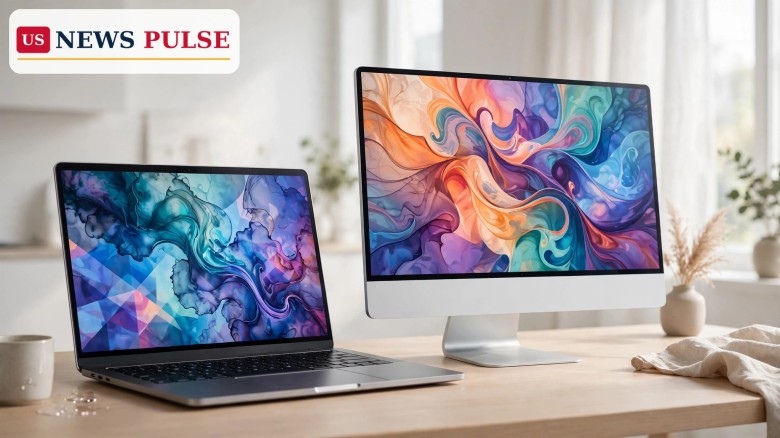
Apple M6 MacBook Pro pre-orders opened on Wednesday, October 28, 2026, as Apple unveiled a new 14-inch MacBook Pro and a new iMac powered by its M6 chip, pitching both machines as a leap in on-device artificial intelligence rather than just a routine speed bump. The MacBook Pro starts at $1,999 in the United States, the iMac starts at $1,499, and both go on sale on November 6, 2026.
The headline numbers, all reported by Apple, are aimed squarely at buyers who run AI tools, creative software and code locally: up to 30 percent faster graphics and up to 25 percent faster on-device AI performance on the MacBook Pro compared with the M5 model, and up to five times faster on-device AI performance on the new iMac compared with the previous M4 iMac. Apple also claims up to 24 hours of battery life for the laptop, which it describes as the longest ever in a Mac.
Apple announced the two machines as part of a multi-day product rollout that culminated on October 28, 2026, according to reports of the launch, with the MacBook Pro and iMac presented as the consumer face of its latest silicon. The 14-inch MacBook Pro is the first laptop to carry the M6, while the iMac brings the same chip family to Apple's all-in-one desktop, replacing the M4 generation in that line.
For the MacBook Pro, Apple says the M6 delivers a 12-core central processor and a 12-core graphics processor, two more cores on each side than the M5 model it replaces. That extra silicon, combined with faster unified memory, is what Apple credits for the claimed gains: up to 30 percent faster graphics, useful for gaming, photo editing and 3D modelling, and up to 25 percent faster processing of large language model prompts, the kind of work behind on-device AI features. Apple also says the chip's Neural Engine performance is up to 1.9 times faster than before, with dedicated Neural Accelerators built into every graphics core.
The laptop keeps the familiar 14-inch form factor and comes in two finishes, space black and silver. It supports Wi-Fi 7 and Bluetooth 6, offers unified memory starting at 16GB and configurable up to 32GB, and storage up to 4TB on the top configuration. Fast charging can restore up to 50 percent of the battery in 30 minutes when paired with a compatible higher-wattage USB-C power adapter, according to launch coverage.
The new iMac keeps its 24-inch 4.5K Retina display, with 500 nits of brightness and P3 wide colour gamut coverage, and comes in two M6 configurations. The 10-core CPU and 10-core GPU version starts at $1,499 in the United States, while the 12-core CPU and 12-core GPU version starts at $1,699. Apple says the new iMac is up to 50 percent faster than the M4 generation in productivity applications such as Microsoft Excel, and up to 2.5 times faster than the original M1 iMac. It keeps the 12MP Centre Stage front-facing camera, colour-matched Touch ID peripherals and seven standard colour finishes, and adds Wi-Fi 7, Bluetooth 6 and a standard 2.5Gb Ethernet port, with support for up to two external 6K displays over Thunderbolt 4.
The M6 launch lands at a moment when every major technology company is being judged on whether its AI spending is paying off. Alphabet and Microsoft were both due to report earnings after the US market closed on October 28, with investors watching Google Cloud growth, AI chip supply and capital spending guidance, and Apple itself reports later in the same earnings week. The Mac launch therefore doubles as a statement of intent: Apple wants its AI story told through devices that do more work on the machine itself, rather than only through cloud services.
That on-device emphasis is the thread running through the M6 announcements. Running supported AI features locally can keep more personal data on the device and cut the wait for a remote server, although some features still rely on cloud-based models, and Apple has not published a full comparison for every real-world task. The new macOS 27 software, which ships on both machines, carries the next generation of Apple Intelligence, including Siri AI, described as more capable, conversational and personal, able to pull information across messages, emails and photos, and Visual Intelligence, which can identify more about whatever is on screen.
The launch also arrives against a backdrop of rising memory prices, which have already pushed up computer prices in some markets. In South Korea, for example, the previous M5 MacBook Pro's factory price rose during 2026 to 3.29 million won, a level the new M6 model matches there, with local reports attributing the earlier rise to a surge in memory prices. In the United States, by contrast, Apple has held the MacBook Pro's starting price at $1,999, with education pricing from $1,899, and the iMac's starting price at $1,499.
The most important change in the MacBook Pro is not a single benchmark but where the speed is aimed. The two extra CPU and GPU cores, the faster unified memory and the Neural Accelerators are designed for workloads that have become ordinary in the last two years: generating and upscaling images, running local language models, editing high-resolution video and compiling code. Apple says ray-traced rendering in Blender can run up to 11.7 times faster than on the M1 MacBook Pro, and code compilation in Xcode up to 2.5 times faster, comparisons that matter most to buyers upgrading from much older machines rather than from last year's M5.
Battery life is the other practical claim. Apple says the M6 MacBook Pro offers up to 24 hours of battery life, its longest ever for a Mac, and pairs that with fast charging to 50 percent in 30 minutes. As with every battery claim, real-world results will depend on the workload and configuration, and independent reviews will be needed to test whether the headline figure survives heavy creative or AI work. Connectivity is more straightforward: Wi-Fi 7 and Bluetooth 6 are now standard, and the laptop's memory ceiling of 32GB and storage ceiling of 4TB define who it is for — professionals and creators, not buyers chasing the cheapest possible Mac.
The iMac tells a similar story from the desktop side. Its claimed gains over the M4 — up to five times faster on-device AI performance, up to 2.5 times faster app performance and up to 3.3 times faster graphics in some summaries of Apple's figures — are larger because the comparison spans a bigger generational gap than the MacBook Pro's M5-to-M6 step. For a family or office buying its first Apple desktop in years, the iMac's pitch is a brighter, sharper all-in-one that can run modern AI features without a separate tower, while keeping the familiar colourful design and built-in camera and speakers.
Apple has framed the launch in its own terms, presenting the M6 as a chip built for on-device AI, with the MacBook Pro's graphics up to 30 percent faster and its AI prompt processing up to 25 percent faster than the M5, and the iMac's on-device AI up to five times faster than the M4. Those are company-reported figures, and launch coverage has been careful to present them as such rather than as independently verified results, noting that Apple has not provided a full comparison for every real-world task.
Analysts quoted in launch coverage have projected that enterprise upgrades could drive significant revenue growth from the refreshed Mac lineup, a view that fits the timing: the machines arrive just as businesses plan their next hardware refresh cycle and as investors weigh whether AI features are enough to persuade owners of recent Macs to upgrade. More cautious coverage has made the opposite point — that battery hours, memory ceilings and thermal behaviour cannot be judged from a press release and need a review unit, not a spec sheet. That tension, between Apple's headline percentages and the hands-on verdict, will define the next two weeks before the November 6 launch.
There is also a pricing reaction built into the launch itself. Holding the US starting prices at $1,999 for the MacBook Pro and $1,499 for the iMac, despite the memory-price pressures seen in other markets, suggests Apple is prioritising volume and upgrades in its home market over passing on component costs. Buyers outside the United States should check local stores, since regional pricing and pre-order dates vary — in Singapore, for example, pre-orders begin October 29 rather than October 28.
The M6 launch matters beyond Apple because it shows where the personal computer industry thinks AI is going: not only into chatbots in a browser tab, but into the silicon itself. If on-device AI becomes the selling point of a laptop, then the chip, the memory and the neural engine matter as much as the screen and the keyboard, and buyers will increasingly compare machines on how well they run local models, generate images and upscale video without a cloud round-trip. That is a different buying decision from the one that dominated the last decade, when processor speed and battery life were the whole story.
It also matters for Apple's own earnings story. The company has spent the last year arguing that its devices, not just its services, are the platform for AI, and the M6 Macs are the first full expression of that argument in its computer line. If reviewers confirm the battery and AI claims, Apple has a strong upgrade pitch for the millions of owners of M1 and M2 machines. If they do not, the launch will be remembered as a solid but incremental refresh, and the focus will shift back to whether Apple's cloud AI can keep pace with rivals pouring tens of billions into data centres.
For ordinary buyers, the practical takeaway is simpler. Anyone buying a Mac this autumn now gets a machine designed for AI workloads out of the box, with macOS 27 and the new Siri AI included. Anyone who bought an M5 MacBook Pro last year has little reason to upgrade on these numbers alone, while anyone on an M1 or Intel machine has a much stronger case — provided the November 6 reviews back up Apple's claims.
Pre-orders for the MacBook Pro opened on October 28, 2026, in 35 countries and regions, with the iMac following the same rollout in most markets, and both machines go on sale on November 6, 2026. The first independent reviews are expected in the days before that date, and they will test the three claims that matter most: the 24-hour battery figure, the 25 percent AI gain over the M5, and the fivefold on-device AI gain on the iMac over the M4.
Apple's earnings later in the week will give the first indication of whether the launch is moving the needle commercially, although Mac revenue in the current quarter will mostly reflect the older lineup, since the new machines ship in November. The longer test comes over the holiday quarter, when the M6 MacBook Pro and iMac compete with a crowded field of AI PCs and with Apple's own phone and tablet launches. Watch also for the next step in the silicon rollout: the M6 family has so far been shown only in the entry-level 14-inch MacBook Pro and the iMac, leaving the higher-end MacBook Pro models and the desktop Mac line for later announcements.
Related coverage on US News Pulse: Big Tech earnings test: Alphabet, Amazon and Apple face AI spending verdict, Meta $95 billion AI raise leads a $198 billion day of AI spending, and OpenAI Google AI chips plan marks major shift beyond Nvidia, report says.
When can I buy the Apple M6 MacBook Pro and iMac? Pre-orders opened October 28, 2026, in the United States and 35 countries and regions, and both machines go on sale November 6, 2026. Some regions, such as Singapore, begin pre-orders October 29.
How much do the new M6 Macs cost? The 14-inch MacBook Pro with M6 starts at $1,999 in the US ($1,899 for education). The new iMac starts at $1,499 for the 10-core version and $1,699 for the 12-core version.
How much faster is the M6 than the M5? Apple claims the M6 MacBook Pro offers up to 30% faster graphics and up to 25% faster on-device AI performance than the M5 model. The iMac's on-device AI is claimed to be up to five times faster than the previous M4 iMac.
What is macOS 27 and Apple Intelligence? macOS 27 is the new operating system shipping on both machines, carrying the next generation of Apple Intelligence, including a more conversational Siri AI and Visual Intelligence for identifying what is on screen.
Should I upgrade from an M5 MacBook Pro? On Apple's numbers alone, probably not — the gains are incremental over the M5. Owners of M1, M2 or Intel Macs have a stronger case, but waiting for independent reviews before November 6 is the safer move.
Leave a Comment



 | Today's Date: