The US-Japan missile deal announced in the Philippines on Wednesday night marks a new step in one of the world's most important military alliances. The United States and Japan have agreed to establish a facility in Japan for the joint production of advanced medium-range air-to-air missiles, Japanese Defence Minister Shinjiro Koizumi said, in a move both allies framed as an answer to China's growing military assertiveness in Asia. The missiles, produced under a joint effort called Operation Supercharge, are "essential for the F-35," Koizumi said, without giving further details of the agreement.
Koizumi announced the deal at a news conference late on Wednesday in Cebu, in the central Philippines, where he met US Defence Secretary Pete Hegseth on the sidelines of the annual meeting of Southeast Asian defence chiefs and their major Asian and Western counterparts. The announcement was short on specifics — no location for the plant, no production timeline, no missile type and no quantities were disclosed — but its message was unmistakable: Washington and Tokyo intend to build the weapons their fighter jets need, together, and faster than before.
Koizumi made the announcement at a news conference on Wednesday night in Cebu, where defence ministers from the Association of Southeast Asian Nations (ASEAN) and their dialogue partners were gathered for the 20th ASEAN Defence Ministers' Meeting and the 13th ADMM-Plus meeting. The annual meetings aim to avert a major regional conflict and strengthen defence cooperation. On the sidelines, however, the United States and China and their allies have often traded criticisms.
During his brief meeting with Hegseth in Cebu, Koizumi said he "shared a sense of crisis" with the US defence secretary "regarding the increasingly severe regional situation and we agreed to strengthen the deterrence and response capabilities of the Japan-US alliance with greater speed and intensity than ever before." The two sides also "reaffirmed the importance of a free and open international order based on the rule of law, which rejects any attempts to unilaterally alter the status quo through the use of force, coercion or other means," Koizumi said. He cautiously added that their discussions were not directed at any specific country.
Hegseth, for his part, assured ASEAN defence ministers of strong US support to deter aggression in the region, without specifically naming China, according to reports from the meeting. The US defence secretary has been on a tour of the region, meeting allies and partners as Washington juggles crises from the Middle East to the western Pacific in the final days before America's November 3 midterm elections.
What the agreement does not yet say is almost as notable as what it does. Koizumi did not elaborate on the deal or provide other details: not the missile's designation, not where in Japan the facility will be built, not when production would begin, and not how many missiles the plant would turn out. The US-made F-35 is one of the world's most advanced fighter aircraft and is also operated by Japan's military, which is why a dedicated missile supply line for the jet carries weight even before the fine print arrives.
The deal lands in a region that has grown steadily more tense. China has expanded its navy and air force, pressed its claims around Taiwan and in the South China Sea, and flown increasingly assertive patrols near Japan's southwestern islands, which sit close to Taiwan. Japan, in turn, has been fortifying those islands with missile units, radars and shelters, while US-Japan exercises such as Keen Sword now rehearse their defence.
Japan's military build-up is the largest since the Second World War. Under its 2022 national security strategy, Tokyo set a target of spending 2 per cent of gross domestic product on defence by 2027, and it has been buying the hardware to match: up to 400 US Tomahawk cruise missiles, an extended-range version of its own Type 12 missile with a range of around 1,000 kilometres, hypersonic glide weapons under development, and a sixth-generation fighter being developed with the United Kingdom and Italy under the GCAP programme, due around 2035.
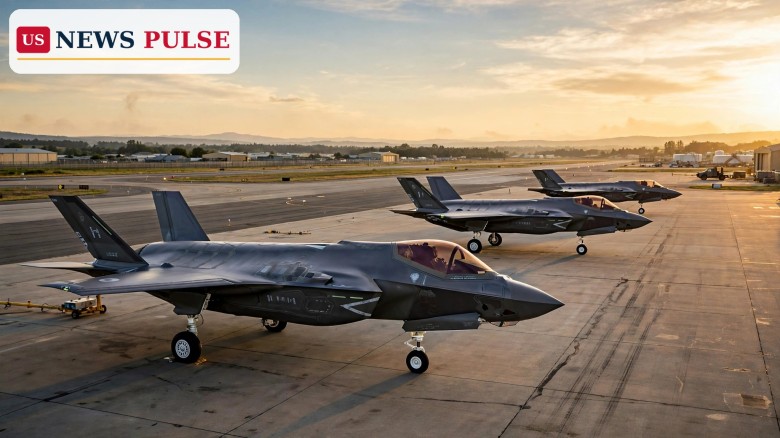
At the centre of that build-up is the F-35. Japan plans to buy 147 of the Lockheed Martin stealth fighters in total — 105 F-35A conventional take-off variants and 42 F-35B short take-off and vertical landing variants — making it the largest operator of the jet outside the United States. The F-35Bs are being paired with two Izumo-class helicopter carriers refitted to operate them, a step that gives Japan a carrier-based air arm for the first time since the Second World War. The F-35As, based today principally at Misawa in northern Japan, are replacing the air force's ageing F-15s.
The alliance itself rests on deep foundations. The United States keeps around 55,000 troops in Japan, and the two countries have co-produced defence equipment before, including missile-defence interceptors. But building air-to-air missiles for the F-35 on Japanese soil would deepen that industrial tie in a new way: it would put a piece of the F-35's weapons supply chain inside Japan, closer to the squadrons that would use the missiles in a crisis, and less exposed to the long logistics lines across the Pacific.
The name Operation Supercharge is the most concrete detail to emerge so far, and it signals intent. Koizumi described the missiles as "essential for the F-35," which points to the practical problem the deal is meant to solve: a fifth-generation fighter is only as useful as the weapons it carries, and air-to-air missiles are consumed fast in any serious air battle. Stockpiles in the United States and among its allies have been under strain for years, as wars in Ukraine and the Middle East have burned through Western munitions and exposed how slowly the defence industry replenishes them.
For Japan, producing the missiles at home would ease that strain and build a domestic industrial base it can sustain. For the United States, a second production line in allied territory adds capacity and resilience — if one plant is disrupted, another keeps running. For both, it sends a signal to Beijing that the alliance can arm itself at speed, without waiting on a single country's factories. That signalling matters in a region where deterrence depends as much on what an adversary believes you can sustain as on what you can fire on day one.
There are limits to what can be claimed yet. Without a missile designation, a site or a schedule, it is impossible to say how soon the plant would deliver weapons, or in what numbers. Joint production also brings familiar complications: technology transfer controls, cost-sharing, work-share between American and Japanese firms, and the question of whether missiles built in Japan could be exported to third countries. None of those questions was answered in Cebu, and each will shape whether Operation Supercharge becomes a production line or remains a headline.
Koizumi's own words set the tone. "We shared a sense of crisis regarding the increasingly severe regional situation," he said of his meeting with Hegseth, "and we agreed to strengthen the deterrence and response capabilities of the Japan-US alliance with greater speed and intensity than ever before." On the rules-based order, he added: "We reaffirmed the importance of a free and open international order based on the rule of law, which rejects any attempts to unilaterally alter the status quo through the use of force, coercion or other means."
The caution in Koizumi's phrasing was deliberate. By adding that the discussions were not directed at any specific country, Tokyo kept the door open to Beijing while still delivering the message. China has in the past condemned US-Japan defence cooperation as Cold War thinking, and both allies have learned to pair firm moves with careful language. Hegseth's own assurance to ASEAN ministers — strong US support to deter aggression, without naming China — followed the same pattern.
No reaction from Beijing had been reported in the first hours after the announcement, and no statement from the Pentagon beyond the meeting itself had been published. Analysts will watch for both, and for whether the deal appears in the formal readouts from the Cebu meetings, which usually spell out what was agreed in more detail than a late-night news conference.
The deal matters for three reasons. First, it ties Japan more tightly into the F-35 enterprise, the largest weapons programme in history, at a moment when air power is the sharp end of any Taiwan or East China Sea contingency. Second, it answers a real industrial problem: the West's missile stockpiles are thin, and adding a production line in Japan is one of the few ways to thicken them quickly. Third, it is a political signal — to China, that the alliance is hardening; to the region, that Washington's attention is not consumed entirely by the Middle East; and to voters at home, that the administration is strengthening alliances rather than letting them drift.
It also matters for what it reveals about Japan's changing role. For decades after the Second World War, Japan's constitution and politics kept its military in a supporting role, with the United States providing the sharp end of deterrence. The 2022 strategy, the counterstrike missiles, the carrier conversions and now a missile factory for the F-35 all point the same way: Japan is becoming a country that can arm, sustain and project force alongside the United States, not merely host it.
The next steps will be watched closely. Expect the two governments to publish fuller details — the missile type, the plant's location, the companies involved and a production schedule — either in meeting readouts or in a formal announcement in the coming days. Japan's defence ministry will also face questions in Tokyo about cost, technology transfer and export rules, while the Pentagon will face questions about how the plant fits into its wider effort to expand missile production across allied countries.
China's response, when it comes, will be another marker. Beijing has typically answered US-Japan defence announcements with diplomatic protests and sometimes with military activity of its own, such as patrols near the Senkaku Islands or exercises around Taiwan. How sharp that response is will indicate how seriously Beijing reads Operation Supercharge.
For now, the deal stands as a late-night announcement with a big name and bigger implications — a promise to build, together, the missiles that the alliance's most advanced fighter needs. Whether it delivers weapons on a meaningful timeline will be the test of whether Cebu was a turning point or just a headline.
They agreed to establish a facility in Japan for the joint production of advanced medium-range air-to-air missiles for F-35 fighter jets, under a joint effort called Operation Supercharge, announced by Japanese Defence Minister Shinjiro Koizumi after meeting US Defence Secretary Pete Hegseth.
Operation Supercharge is the name of the US-Japan joint effort to produce the missiles. Koizumi said the missiles are "essential for the F-35," but no further details — missile type, location, timeline or quantities — were given at the announcement.
The F-35 is the allies' most advanced fighter, and air-to-air missiles are its primary weapon in air combat. A dedicated production line in Japan would keep those weapons closer to the squadrons that use them and add capacity to strained Western stockpiles.
Japan plans to buy 147 F-35s in total — 105 F-35A variants and 42 F-35B short take-off and vertical landing variants — making it the largest F-35 operator outside the United States.
Both allies have repeatedly voiced alarm over China's growing military assertiveness in Asia, and Koizumi spoke of a "shared sense of crisis." But he cautiously added that the discussions were not directed at any specific country, and Hegseth did not name China in his remarks to ASEAN ministers.
Related coverage on US News Pulse: US warns allies to prepare for possible Iran strikes, Hegseth fires Pentagon top planner as Trump weighs Iran strikes, and Iran's 7-day Hormuz plan returns.
Sources: Associated Press via ETV Bharat, Arab News, Daily Pioneer and Moneycontrol; Newsbytes; Thai Rath (English), October 28-29, 2026. The featured image is an original illustration created for US News Pulse.
Leave a Comment



 | Today's Date: