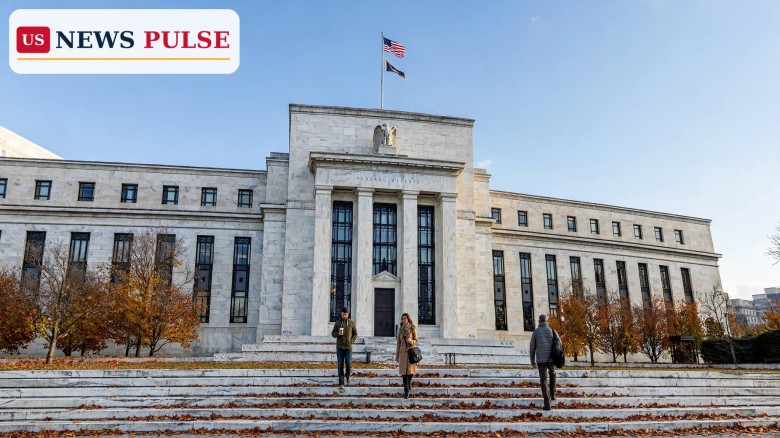
The Lisa Cook hearing at the centre of President Donald Trump's year-long effort to remove a Federal Reserve governor will not take place on November 5 after all. The White House has delayed the hearing until December, the president's top economic adviser said on Thursday, pushing the next chapter of the fight over the independence of America's central bank into the same month the Fed is widely expected to raise interest rates again.
Yet within hours of that announcement, the delay itself became a point of dispute. Lawyers for Cook declined on Friday to confirm that any December date had been agreed, a reminder that almost nothing in this confrontation — not the timetable, not the process and not the underlying mortgage allegations — is settled. What is clear is that Cook remains on the Federal Reserve Board, that she dissented this week when the Fed left interest rates steady, and that the question of whether Trump can lawfully remove her is now headed for a White House hearing room rather than a courtroom, at least for now.
Kevin Hassett, director of the National Economic Council and Trump's top economic adviser, told Bloomberg TV on Thursday that the White House had moved the planned hearing into December. "The president has asked a small set of his people to run a completely fair process that puts all the information on the table, and then the president will decide next steps," Hassett said. "We in the White House, the White House counsel, has worked very closely with Governor Cook's people. I think that they've agreed to a date in December to meet together and talk these things through."
That last claim did not survive the day intact. A spokeswoman for Cook's lawyer did not confirm any new date in December when asked on Friday, according to Reuters. The gap between the two accounts matters because the hearing is supposed to be the procedural fix for the flaw the Supreme Court identified in June: Cook, the court said, had not been given a fair opportunity to answer the allegations against her before Trump first tried to remove her. If the two sides cannot even agree on when she will be heard, the credibility of the process — already doubted by Cook's legal team — will be under scrutiny before it begins.
Cook's lawyers had previously drawn their own line on timing, saying she would not be available for any hearing until after the Fed's December 8-9 policy-setting meeting. That position, if it holds, would place the hearing in the second half of December, after the central bank's final rate decision of the year. Hassett did not give a specific December date in his Bloomberg TV appearance, and the White House has not publicly supplied one since.
The hearing was originally scheduled for November 5 at the White House, under a notice dated October 7 and released on October 9, when Trump announced a fresh investigation into Cook. Under that plan, Cook would submit a written statement at least three days before the hearing, which would last no more than four hours, and would then have a further opportunity to respond in writing before the committee reported to Trump on whether there is "cause" for her removal. Whether that structure survives the move to December is not yet clear.
The dispute began on August 25, 2025, when Trump first tried to fire Cook after Federal Housing Finance Agency Director Bill Pulte accused her of mortgage fraud. The allegation, in essence, is that Cook claimed homes in Atlanta, Georgia, and Michigan as her primary residence on separate mortgage agreements in 2021, potentially securing more favourable loan terms, and later rented out the Atlanta property. Cook called the accusations baseless, denied any wrongdoing and sued to block her removal.
Cook's lawyers have said the Atlanta designation was an inadvertent mistake, pointing to other loan documents that identified the property as a second home. In August 2026, when the White House revisited the matter and told Cook that Trump was again considering terminating her, she was given 21 days to respond. Her attorneys submitted a letter on August 26 denying that she had committed mortgage fraud. She has not been charged with a crime.
In June 2026, the Supreme Court sided with Cook in a 5-4 decision, ruling that she had not been given adequate time to respond to the allegations and that Trump could not remove her "at will". Chief Justice John Roberts wrote in the majority opinion that Cook was entitled to sufficient time and notice to respond to a termination and that she had not been given a fair opportunity to do so when Trump first sought to remove her. But the ruling did not settle the underlying facts. As Roberts put it, the "ultimate question of whether the president can remove Cook for cause will depend in part on the underlying facts," which he said had "yet to be found or analyzed under the relevant legal standards."
The law allows a president to remove Federal Reserve governors "for cause", generally understood to mean negligence or malfeasance in office — a much higher bar than the freedom presidents enjoy over most political appointees. No president has ever removed a sitting Fed governor, and the court's decision the same day in a separate case, affirming Trump's power to dismiss officials at other independent agencies for any reason, only sharpened the distinction the justices drew around the central bank. Analysts described the June ruling as giving Trump a roadmap: follow a fair process, and a second removal attempt might survive where the first did not.
Cook, appointed by former President Joe Biden in 2022, is the first Black woman to serve as a Federal Reserve governor, and her term runs to 2038. She has continued to do the job throughout the legal fight, including dissenting this week when the Fed left interest rates steady rather than delivering another rate hike to curb inflation, as she would have preferred. The Fed is widely expected to raise rates again in December, and the week also brought a warning from St. Louis Fed President Alberto Musalem on Friday about the urgency of preventing elevated price pressures from spreading more broadly through the economy.
Moving the Lisa Cook hearing to December changes the politics and the economics of the fight at the same time. Politically, it takes the spectacle of a White House hearing on a sitting Fed governor out of the final days before the November 3 midterm elections, when every administration action is read through an electoral lens. A November 5 hearing would have landed two days after voters went to the polls; a December hearing lands after the results are known, and after the Fed's own December meeting has set the next direction for interest rates.
Economically, the timing puts Cook's fate on the calendar alongside the rate decision itself. Trump has long railed against the Fed for not cutting rates, and has accused a "political" Fed Board, which includes Cook, of keeping Fed Chairman Kevin Warsh from doing so. Cook's dissent this week pointed in the opposite direction — she wanted another hike, not a cut — which complicates any simple story that the removal effort is only about forcing easier money. If the hearing follows the December 8-9 meeting, as Cook's lawyers have previously insisted it must, the committee will be judging a governor who has just voted, in public, against the direction the president prefers.
The delay also buys both sides time, and time is not neutral here. For the White House, it allows the committee of inquiry to assemble its record without the rush of a November deadline. For Cook's team, it preserves the argument that no hearing should interrupt the Fed's policy work, and it keeps alive the question of whether a panel made up of presidential appointees can fairly judge a governor the president has repeatedly said he wants gone. Hassett sought to answer that concern on Thursday, describing the committee as "people of honor who are charged with looking at the evidence and correctly characterizing it in a way that people will be able to observe and criticize if they like." He also said he felt Warsh "has done a good job of allowing, you know, normal dissent and then driving a consensus."
The committee itself is a small one: Hassett, Keith Sonderling, the acting head of the Office of Government Ethics, and Andrea Lucas, chair of the Equal Employment Opportunity Commission. Its job is to investigate whether Cook made false statements in connection with one or more mortgage instruments and to recommend to Trump whether there are grounds for her removal. Hassett had called Cook "partisan" last August for not vacating her post after Trump's allegations — a remark Cook's lawyers are likely to cite if the committee's recommendation goes against her and the matter returns to court.
Cook's lawyers, Abbe Lowell and Norm Eisen, have not softened their position since the committee was announced. They said Cook "welcomes the opportunity to present the facts so she can clear her name and demonstrate there is no legal basis to fire her." But they added: "In light of Trump's repeated statements that he has already decided to fire Governor Cook, we have grave doubts that this 'hearing' is a legitimate one that would conform to the law. But if it is anything close to objective, the conclusion will be that Governor Cook did not commit mortgage fraud, leaving no cause to remove her from the Federal Reserve Board."
Trump, in the announcement that created the committee, framed the inquiry as a matter of faithful execution of the laws. "As President, it is my job to ensure the laws are faithfully executed, including by firing subordinates who cannot be trusted to tell the truth and follow the law," he wrote. "To assist me in carrying out that responsibility, the Committee shall investigate the allegations against Governor Cook and report to me whether there is 'cause' for Governor Cook's removal."
Analysts remain divided on where the process leads. Terry Haines of Pangaea Policy said in a note that the likelihood of finding enough evidence to meet the statutory "for cause" standard is low, but not impossible. Ed Mills, Washington policy analyst at Raymond James, put it more starkly, telling CNN that the June Supreme Court decision "did not prohibit President Trump from firing a Fed Governor, it gave him a roadmap to do it." Mills added that Cook is "very clearly at risk of being fired, and it is unclear if the Supreme Court would block President Trump in Round 2."
The White House, for its part, has presented the December delay as evidence of fairness rather than retreat. Hassett's message on Thursday was that the president wants "a completely fair process that puts all the information on the table." Cook's camp, by declining to confirm a December date, signalled that it does not yet accept that characterisation — or the timetable behind it.
The Lisa Cook hearing is about more than one governor's mortgage paperwork. The Federal Reserve's independence from day-to-day political pressure is one of the foundations of American monetary policy, and markets watch it closely because it shapes expectations for interest rates, inflation and the dollar. A successful presidential removal of a Fed governor "for cause" on disputed mortgage allegations from before she took office would set a precedent that future presidents could invoke against governors whose votes they dislike. A failed attempt, by contrast, would reinforce the court's June message that the Fed sits apart from ordinary political appointments.
The stakes are visible in the market backdrop to this week's news. Stocks slid on Friday as concerns over Big Tech's artificial intelligence spending weighed on technology shares, with the Nasdaq falling to its lowest level in nearly three months, while investors also weighed the path of interest rates and the Fed's December decision. In that environment, uncertainty about who sits on the Fed Board — and whether the White House can reshape it — is not an abstract legal question. It feeds directly into how investors price the risk that monetary policy could become an instrument of political preference rather than economic judgement.
There is also a narrower, human consequence. Cook's dissent this week showed a governor willing to break publicly with the majority on inflation grounds, at a moment when the administration wants lower rates. If the hearing process is perceived as punishment for independent votes, it could chill dissent inside the Fed even if Cook ultimately keeps her seat. If it is perceived as a genuine inquiry into pre-office conduct, it could instead establish a workable — if contentious — procedure for the "for cause" standard that has never before been tested against a Fed governor.
The immediate question is whether the two sides agree on a December date at all, and if so, whether it falls before or after the Fed's December 8-9 meeting. Cook's lawyers have previously said she would not be available until after that meeting; Hassett has spoken only of a date in December. Until a date is confirmed by both sides, the November 5 plan should be treated as postponed rather than replaced.
Once a date is set, the published procedure gives Cook the chance to submit a written statement ahead of the hearing and another written response afterwards, before the committee makes its recommendation to Trump. The president would then decide whether to attempt removal again — a decision that would almost certainly return to the courts, where the Supreme Court's June reasoning would be tested against a fuller record. A second legal battle could take months, running well beyond December and into a new year in which Cook's seat, and the Fed's composition, remain contested.
For now, Cook remains a governor, the Fed's December meeting approaches, and the hearing that was meant to resolve this fight has slipped by at least a month. The delay may yet prove to be a routine rescheduling — or the first sign that the "completely fair process" Hassett promised is harder to agree on than to announce.
Kevin Hassett, Trump's top economic adviser, said on Bloomberg TV on Thursday that the White House and Cook's team had worked closely together and agreed to meet in December instead of November 5. Cook's lawyers, however, declined on Friday to confirm that any December date had been agreed.
The White House alleges Cook made false statements on mortgage documents, claiming homes in Atlanta and Michigan as her primary residence on separate agreements in 2021 and later renting out the Atlanta property. Cook denies committing mortgage fraud, and her lawyers say the Atlanta designation was an inadvertent mistake. She has not been charged with a crime.
Only "for cause", under the law governing Fed governors. The Supreme Court ruled in June 2026, by 5-4, that Trump could not fire Cook "at will" but could do so if he gave her a chance to defend herself against evidence showing cause for removal.
The three-person committee comprises Kevin Hassett, director of the National Economic Council; Keith Sonderling, acting head of the Office of Government Ethics; and Andrea Lucas, chair of the Equal Employment Opportunity Commission.
Under the published procedure, Cook can submit written statements before and after the hearing, the committee will recommend to Trump whether there is cause for removal, and the president will decide next steps — a decision that would likely face a fresh court challenge.
Related reading: Fed Rate Decision October 2026: Why a Pause Looks Likely Despite High Inflation and US-India Trade Deal Nears Finish as White House Calls Talks Productive.
Leave a Comment



 | Today's Date: